The NVH Dilemma: Drivetrain Friction vs. HVAC Electromagnetics
As automotive technicians navigate the increasingly complex landscape of 2026 vehicle diagnostics, Noise, Vibration, and Harshness (NVH) complaints remain some of the most time-consuming issues to resolve. A frequent point of confusion arises when a driver reports a rhythmic chirping, squeaking, or metallic clicking from the front of the engine bay. Two primary culprits often occupy the exact same acoustic zip code: the manual transmission clutch fork pivot assembly and the car A/C compressor clutch. Because both components rely on friction interfaces and are subjected to high-stress engagement cycles, misdiagnosis is rampant. Replacing a perfectly good HVAC compressor when the issue is a dry transmission pivot ball—or vice versa—results in wasted labor and frustrated customers.
This expert guide provides a definitive framework for isolating clutch fork and pivot issues from electromagnetic HVAC failures. By understanding the metallurgy, acoustic signatures, and precise measurement protocols of both systems, you can accurately pinpoint the root cause on platforms ranging from the Tremec T-56 Magnum to the Ford MT82, while correctly identifying when a failing car A/C compressor clutch is the true source of the noise.
Acoustic Profiles: Differentiating the Squeak
Before reaching for a stethoscope, it is critical to understand how these two components generate noise. The acoustic signature of a mechanical drivetrain fulcrum differs vastly from an electromagnetic HVAC friction plate.
The Clutch Fork Pivot Chirp
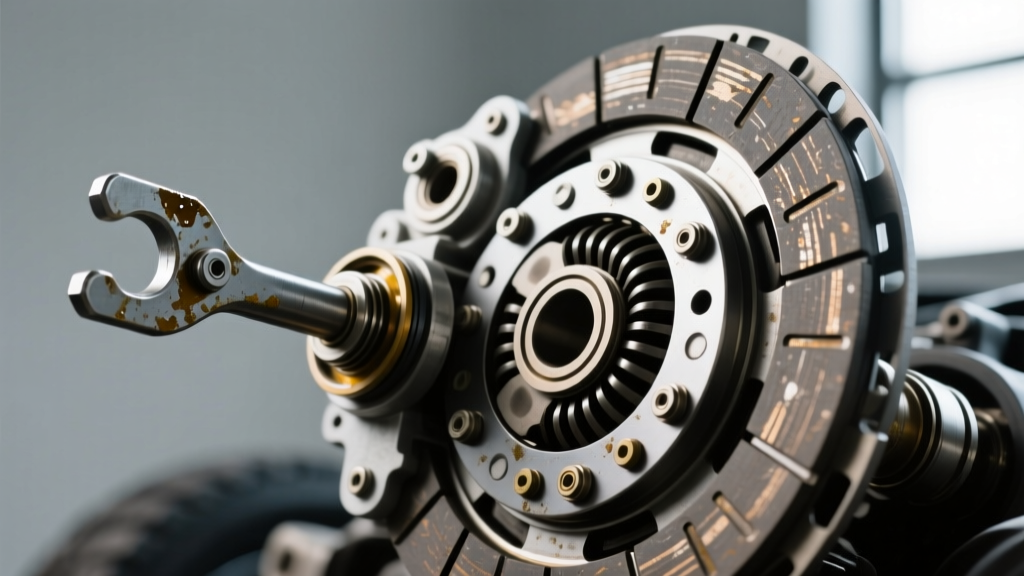
The clutch fork acts as a lever, multiplying the force applied to the clutch pedal to disengage the diaphragm spring. The pivot ball serves as the fulcrum. Under the extreme clamping forces of modern performance clutches (often exceeding 3,500 lbs of release bearing load), the steel-on-steel or steel-on-aluminum contact point at the pivot is subjected to immense friction. When the high-temperature grease degrades, the pivot ball galls, creating a distinct, rhythmic 'chirp' or 'squeak' that perfectly correlates with clutch pedal travel. The pitch typically shifts as the pedal moves through the engagement zone, and the noise is entirely independent of engine RPM or accessory belt loads.
The Car A/C Compressor Clutch Squeal
Conversely, the car A/C compressor clutch operates via an electromagnetic coil that pulls a friction plate against the spinning compressor pulley. If the air gap between the friction plate and the pulley is too wide, the clutch will slip during engagement, producing a high-pitched, belt-like squeal that lasts for 1 to 3 seconds upon A/C activation. If the clutch bearing is failing, it will emit a continuous metallic growl or grind that changes pitch strictly with engine RPM, regardless of whether the clutch is engaged or disengaged. According to Denso Global, thermal degradation of the electromagnetic coil can also cause intermittent slipping, mimicking a mechanical squeak but only occurring under high ambient heat loads.
The 4-Step Expert Isolation Protocol
To definitively separate a drivetrain pivot issue from an HVAC clutch fault, follow this sequential isolation protocol. This methodology eliminates variables without requiring immediate teardown.
Step 1: Static Pedal Pump (Key OFF)
With the engine completely off and the key removed, pump the clutch pedal slowly and rapidly. Listen closely at the bellhousing inspection cover or through the cabin firewall. If the chirp or squeak is present without the engine running, the car A/C compressor clutch is instantly ruled out (as it requires electrical power and engine rotation). The fault is isolated to the clutch fork pivot, release bearing guide tube, or pedal box linkage.
Step 2: The A/C Load Toggle (Key ON, Engine ON)
Start the engine and let it idle. Keep the A/C system turned OFF. Press the clutch pedal. Note the sound. Next, turn the A/C to MAX. Listen for the engagement click of the compressor. If a squeal occurs precisely when the A/C engages and stops once the compressor is fully locked, the issue is the car A/C compressor clutch air gap or a glazed friction surface. If the pedal squeak remains unchanged regardless of A/C status, the drivetrain pivot is the culprit.
Step 3: Feeler Gauge Air Gap Test
If suspicion falls on the HVAC system, use a non-magnetic feeler gauge to measure the air gap between the A/C clutch friction plate and the pulley rotor. Most OEM specifications (including Sanden and Denso units) require an air gap between 0.020' and 0.030' (0.5mm - 0.75mm). If the gap exceeds 0.040', the electromagnetic coil lacks the strength to pull the plate flush, resulting in slippage and squealing.
Step 4: Electronic Stethoscope Triangulation
For ambiguous cases, use a wireless NVH chassis ear system. Place one sensor on the transmission bellhousing near the clutch fork access window, and a second sensor on the A/C compressor snout. Actuate the clutch pedal while the engine idles. The sensor with the highest decibel spike during pedal travel will reveal the true source of the mechanical bind.
Expert Tip: Never use standard lithium-based chassis grease on a clutch fork pivot ball. The extreme pressure and heat generated near the exhaust downpipes will cause lithium grease to melt, run out, and leave the pivot completely dry within 5,000 miles. Always use a Molybdenum Disulfide (MoS2) fortified high-temp grease, such as GM High Temp Pivot Grease (Part # 12346293) or Lubriplate No. 140.
Deep Dive: Clutch Fork and Pivot Ball Failure Modes
When the isolation protocol confirms the transmission is at fault, understanding the specific failure modes of the clutch fork and pivot assembly is essential for a permanent repair. Simply packing the area with grease is a temporary band-aid that will result in a customer comeback.
Galling and Wear Grooves
The most common failure on heavy-duty applications like the Tremec T-56 Magnum and Ford MT82 is pivot ball galling. The spherical pivot ball presses into the machined recess of the clutch fork. Over time, the friction wears a deep groove into the fork, or flattens the pivot ball. This alters the geometry of the release mechanism, leading to uneven clutch disengagement, premature release bearing wear, and the characteristic squeak. If you can feel a physical 'notch' or ridge on the pivot ball with your fingernail, both the fork and the pivot must be replaced.
Aftermarket Upgrades and Best Practices
For high-performance or track vehicles, standard OEM pivot assemblies are insufficient. Upgrading to a roller-bearing pivot kit or a bronze-insert clutch fork eliminates the sliding friction entirely, replacing it with rolling friction. When servicing a GM T-56, the OEM pivot ball (Part # 19300042) must be torqued precisely to the factory specification to prevent the retainer from backing out under load.
Repair Data: Torque Specs, Clearances, and Pricing
Accurate repair requires adherence to strict torque specifications and an understanding of current market pricing for 2026. Below is a comparative breakdown of repair scenarios for both systems.
| Component / System | Common Application | Critical Spec / Torque | Est. Part Cost (2026) | Est. Labor Time |
|---|---|---|---|---|
| Clutch Fork & Pivot Kit | Ford MT82 (Mustang GT) | Pivot Bolt: 18 lb-ft | $85 - $140 | 4.5 - 6.0 hrs (Trans R&R) |
| Clutch Fork & Pivot Kit | GM T-56 Magnum | Pivot Ball: 20 lb-ft | $60 - $110 | 4.0 - 5.5 hrs (Trans R&R) |
| Car A/C Compressor Clutch | Denso 10S17C (Various) | Air Gap: 0.020' - 0.030' | $90 - $180 (Clutch Only) | 1.0 - 1.5 hrs (Front of Engine) |
| Full A/C Compressor Assy | Sanden SD7V16 (Various) | System Vacuum: 500 microns | $350 - $650 | 2.5 - 4.0 hrs (Includes Recharge) |
Note: Labor times for clutch fork and pivot replacement assume the transmission must be removed to access the bellhousing internals safely and inspect the release bearing guide tube. While some technicians attempt to spray grease through the inspection window, this is considered malpractice on modern dual-mass flywheel setups due to the risk of contaminating the friction disc.
When the Diagnosis Points to the A/C Compressor
If your testing confirms the noise originates from the front of the engine and is tied to the HVAC system, addressing the car A/C compressor clutch requires a different set of tools and parameters. The most frequent issue is an excessive air gap caused by wear on the friction surfaces or a weakening electromagnetic coil.
Shimming the Air Gap
If the air gap measures over 0.035', the clutch will slip and squeal, especially on hot days when the magnetic coil's resistance increases and its pulling force drops. To fix this, remove the center bolt of the clutch friction plate. Behind the plate, you will find thin metal shims. Removing one or two shims (typically 0.010' to 0.015' thick) will pull the plate closer to the pulley, restoring the air gap to the optimal 0.025' specification. This simple $5 shim adjustment can save a customer from an unnecessary $800 compressor replacement.
Testing Electromagnetic Coil Resistance
If the air gap is correct but the clutch still fails to engage fully (resulting in a chatter or rapid clicking), the coil itself may be failing. Disconnect the electrical connector to the compressor clutch and measure the resistance across the coil terminals using a digital multimeter. According to Tremec and various OEM HVAC service manuals, a healthy A/C clutch coil should read between 3.5 and 4.5 ohms at 68°F (20°C). A reading below 3.0 ohms indicates an internal short, while a reading above 5.5 ohms or an open circuit (OL) means the coil windings are broken and the entire clutch assembly—or compressor—must be replaced.
Summary: Precision Over Guesswork
Diagnosing under-hood squeaks requires a methodical approach that respects the distinct mechanical and electrical properties of the drivetrain and HVAC systems. By utilizing the static pedal pump test, verifying A/C clutch air gaps with feeler gauges, and adhering to strict lubrication protocols like MoS2 grease for clutch fork pivots, technicians can eliminate guesswork. Whether you are rebuilding a Tremec bellhousing or shimming a Denso compressor clutch, relying on exact torque specs and precise measurements ensures a permanent repair, safeguarding your shop's reputation and your customer's wallet in the demanding automotive landscape of 2026.