The Critical Physics of the Clutch Fork and Pivot Ball
The clutch fork and pivot ball form the foundational fulcrum of any manual or automated manual transmission. When you depress the clutch pedal, hydraulic pressure or an electronic actuator pushes the fork pad. The fork pivots on a stationary ball stud, multiplying the input force to push the throwout bearing against the pressure plate diaphragm fingers. Because this assembly must handle extreme clamp loads—often exceeding 2,500 lbs in high-performance applications—the pivot point is subjected to immense shear stress and friction.
As of 2026, the automotive landscape has bifurcated. Technicians are no longer just servicing traditional hydraulic linkages; they are increasingly diagnosing electric clutches (often branded as e-clutch or clutch-by-wire systems) found in 48V mild-hybrid vehicles and automated manual transmissions (AMTs). While the internal bellhousing mechanics remain remarkably similar, the diagnostic approach to clutch fork and pivot wear differs drastically between hydraulic and electric architectures.
Symptoms of Clutch Fork and Pivot Degradation
Before tearing into the bellhousing, a skilled drivetrain technician will identify the specific acoustic and tactile signatures of fork and pivot failure. Common symptoms include:
- Tactile Clicking or Popping: A distinct 'pop' felt in the pedal or heard near the transmission tunnel during engagement. This indicates the fork is slipping off a worn, egg-shaped pivot ball.
- Incomplete Disengagement (Gear Crunch):strong> As the pivot ball wears, the fulcrum geometry changes. The fork travels its full arc, but the throwout bearing fails to compress the pressure plate sufficiently, resulting in synchro clash during 1st or Reverse gear selection.
- Clutch Chatter on Takeoff: Uneven wear on the fork tips or a grooved pivot ball causes the throwout bearing to apply uneven pressure to the diaphragm fingers, inducing harmonic chatter as the clutch engages.
- Pedal Vibration: Often misdiagnosed as a warped flywheel, high-frequency vibration can stem from a loose pivot ball bolt allowing micro-movements of the entire fork assembly under load.
Traditional Manual Transmissions: Mechanical and Hydraulic Forks
In traditional setups, such as the Tremec T56 Magnum or the Ford MT-82, the clutch fork is actuated by a hydraulic slave cylinder. The primary failure point is the interface between the hardened steel pivot ball and the stamped steel or cast aluminum fork.
Wear Limits and Torque Specifications
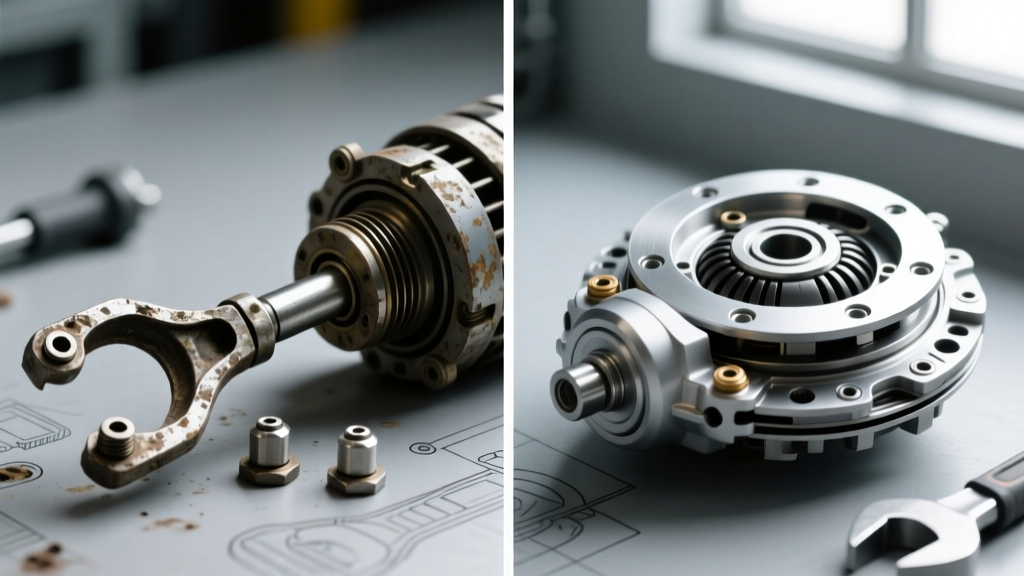
When inspecting a traditional fork, use a dial caliper to measure the thickness of the fork pad (the area resting on the pivot ball) and the fork tips (contacting the throwout bearing). OEM fork pad thickness is typically around 3.2mm. If wear exceeds 0.5mm (dropping below 2.7mm), the fork must be replaced. According to Tremec Engineering Specifications, a worn fork alters the release bearing travel, leading to premature bearing failure and pressure plate damage.
Pivot ball retention is equally critical. For the Ford MT-82, the pivot ball is secured by an M12 bolt that must be torqued to exactly 48 Nm (35 lb-ft) with medium-strength threadlocker (Loctite 243). For the GM T56 Magnum, the M10x1.5 pivot bolt requires 35 Nm (26 lb-ft). Failure to adhere to these torque specs results in the pivot ball backing out under the cyclic loading of stop-and-go traffic, destroying the bellhousing mounting threads.
The Rise of Electric Clutches: Clutch-by-Wire Diagnostics
The integration of electric clutches has revolutionized manual transmission efficiency, particularly in mild-hybrid platforms like the Hyundai/Kia Smartstream iMT (Intelligent Manual Transmission) and systems developed by Schaeffler Automotive. In these vehicles, there is no mechanical or hydraulic linkage between the pedal and the fork. Instead, a pedal stroke sensor sends a signal to the ECU, which commands a brushless DC motor actuator to move the clutch fork.
How Pivot Wear Destroys E-Clutch Calibration
Inside the electric actuator, a Hall-effect sensor or potentiometer maps the exact rotational position of the motor, which correlates to the linear travel of the clutch fork. The ECU relies on this mapping to determine the precise 'bite point' and full disengagement stroke.
If the internal pivot ball wears by even 1.5mm, the physical arc of the fork shifts. The electric actuator will push the fork to its programmed 'disengaged' position, but due to the lost travel from pivot wear, the throwout bearing falls short of fully releasing the clutch. The ECU detects a mismatch between the commanded motor position and the actual transmission input shaft speed (via the ISS sensor). This triggers limp mode and stores diagnostic trouble codes such as P0805 (Clutch Position Sensor Circuit) or P2783 (Clutch Position Sensor Performance).
Diagnostic Comparison: Hydraulic vs. Electric Clutches
| Diagnostic Parameter | Traditional Hydraulic Fork | Electric Clutch (e-Clutch / iMT) |
|---|---|---|
| Actuation Method | Hydraulic Slave Cylinder / Cable | Brushless DC Motor Actuator |
| Primary Wear Symptom | Pedal popping, gear crunch, physical play | ECU Limp Mode, bite-point hunting, DTCs |
| Sensor Involvement | None (Purely mechanical/hydraulic) | Hall-effect / Potentiometer stroke mapping |
| Calibration Requirement | Hydraulic bleed / Free-play adjustment | Bi-directional OBD2 Actuator Stroke Adaptation |
| Common Failure Codes | N/A (Fluid leak codes possible) | P0805, P2783, P0810 |
Expert Best Practices for Inspection and Replacement
Whether you are servicing a classic hydraulic manual or a modern 48V electric clutch system, adhering to strict best practices ensures longevity and prevents comeback repairs.
1. Precision Measurement and Billet Upgrades
Never reuse a stamped steel fork in a high-torque application. When upgrading to a twin-disc clutch, the clamp load increases dramatically, which can bend OEM forks. Install a billet aluminum or forged steel fork (e.g., from McLeod or Ram Clutches). When installing an aftermarket billet fork, verify the pivot ball height. Some billet forks require a taller pivot ball or shims to maintain the correct release bearing preload and diaphragm finger geometry.
2. Strategic Lubrication Protocols
Lubricating the pivot ball and fork pad is mandatory, but the type of lubricant depends entirely on the system architecture:
- Traditional Hydraulic Systems: Apply a high-quality Molybdenum Disulfide (Moly) grease to the pivot ball and fork tips. Moly grease handles extreme boundary friction and prevents the steel-on-steel galling that causes pedal squeaks.
- Electric Clutches: Exercise extreme caution. The electric actuator and its Hall-effect sensors are often mounted in close proximity to the fork window. Moly grease contains metallic particles that can attract magnetic debris or interfere with sensor readings. For electric clutch pivot points, use a dry PTFE (Teflon) spray or a non-conductive synthetic dielectric grease applied sparingly with a micro-brush.
3. E-Clutch Actuator Recalibration
If you replace the clutch fork, pivot ball, or throwout bearing on a vehicle equipped with electric clutches, physical installation is only half the job. You must connect a bi-directional professional scan tool (such as an Autel MaxiSYS or Snap-on Zeus) to perform the 'Clutch Actuator Stroke Learn' or 'Bite Point Adaptation'. This procedure forces the electric motor to cycle the fork from full engagement to full disengagement, allowing the ECU to map the new physical boundaries of the fresh components. Skipping this step will result in immediate clutch slip or harsh engagement, potentially burning out the electric actuator motor within 500 miles.
2026 Market Pricing and Sourcing
Understanding the financial scope of these repairs helps in quoting customers accurately. As of 2026, OEM replacement pivot balls range from $15 to $40, while heavy-duty billet pivot kits cost between $65 and $120. Stamped steel OEM forks typically cost $45 to $85, whereas forged/billet performance forks command $150 to $280. For electric clutch vehicles, the external actuator assembly is a dealer-only proprietary item, often pricing between $600 and $1,100, making the meticulous inspection and preservation of the internal fork and pivot ball an absolute financial necessity for the vehicle owner.