Introduction to Chevy Axle Leak Points
General Motors has relied on a few staple axle architectures for decades, most notably the 8.5-inch and 8.6-inch 10-bolt semi-floating axles found in half-ton Silverados, Tahoes, and Suburbans, alongside the legendary 10.5-inch 14-bolt full-floating axles in 2500/3500 HD trucks. While these Chevy differentials are incredibly robust, age, heat cycles, and heavy towing eventually compromise the sealing surfaces. A leaking differential is not just a messy driveway issue; low fluid levels lead to catastrophic ring and pinion gear failure, bearing seizure, and ruined axle shafts.
This model-specific repair guide provides exact diagnostic procedures, OEM and aftermarket part numbers, torque specifications, and critical warnings for servicing GM 10-bolt and 14-bolt axles. Whether you are dealing with a weeping pinion seal or a saturated brake drum, the following protocols reflect current 2026 best practices for drivetrain maintenance.
Identifying the Leak: Pinion vs. Axle Seal vs. Cover
Before unbolting a single component, you must accurately locate the origin of the leak. Gear oil is highly viscous and tends to migrate along the axle tubes and crossmembers due to airflow and centrifugal force.
The Clean-Down and Dye Test Procedure
- Step 1: Safely elevate the vehicle on jack stands, ensuring the suspension is loaded (or at ride height) so the axle seals are in their normal operating position.
- Step 2: Use a dedicated brake parts cleaner and a stiff bristle brush to completely degrease the differential cover, pinion yoke, axle tubes, and backing plates. Allow to dry completely.
- Step 3: If the leak is intermittent, add a UV-reactive oil dye to the differential fill plug. Drive the vehicle for 15-20 miles under load.
- Step 4: Inspect with a UV blacklight. Pinion leaks will sling oil radially onto the underside of the chassis and driveshaft. Axle seal leaks will migrate outward toward the wheel hubs, often contaminating the brake pads or shoes—a severe safety hazard that requires immediate brake service.
Model-Specific Repair: GM 8.5" / 8.6" 10-Bolt Semi-Float
The 10-bolt axle is ubiquitous in GM light-duty trucks. Leaks here typically occur at the outer axle seals, the differential cover gasket, or the pinion seal.
Outer Axle Seal Replacement
To access the axle seal on a semi-float 10-bolt, you must remove the differential cover, drain the fluid, and rotate the carrier until the pinion shaft lock bolt is accessible. Remove the lock bolt (typically 5/16-inch or 8mm) and push the pinion shaft inward. This allows you to push the axle shaft inward and retrieve the C-clip lock washer from the groove on the axle side gear. Once the C-clip is removed, the axle shaft slides out of the housing tube, exposing the outer axle seal and bearing.
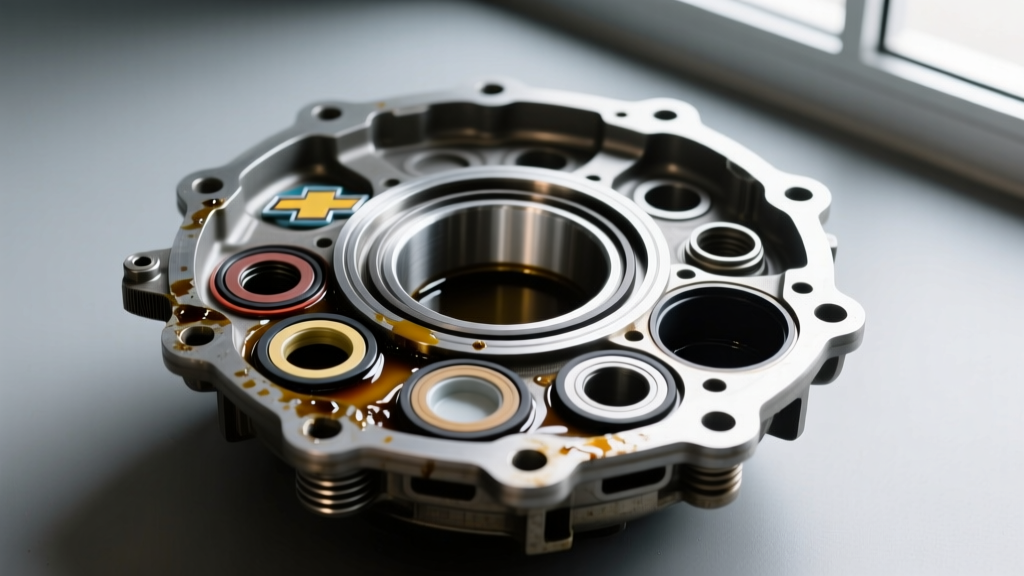
- Recommended Seal: SKF 19843 or National 710928 (Priced around $15-$22 each in 2026).
- Installation Tool: Use a dedicated seal driver or a large socket that matches the outer diameter of the seal housing. Drive it in flush. Never hammer the seal directly with a steel hammer.
- Axle Shaft Nut Torque: When reinstalling the wheel hub to the axle shaft, torque the M14 or M16 flange nuts to 140-160 lb-ft depending on the specific year and stud size.
The Pinion Seal and Crush Sleeve Warning
Replacing the pinion seal (Timken 710928) on a 10-bolt requires removing the driveshaft and the pinion yoke nut. This is where most DIYers destroy their differentials.
Critical Warning: Most GM 10-bolt axles use a crush sleeve to set pinion bearing preload. If you use an impact wrench to remove or reinstall the pinion nut, you will over-crush the sleeve, resulting in excessive bearing preload, extreme heat generation, and total bearing failure within 500 miles. Always measure rotational preload with an inch-pound torque wrench before removal, and tighten the new nut incrementally until the exact preload (typically 15-25 in-lbs for used bearings) is achieved. If you over-tighten, you must install a new crush sleeve and start over.
Model-Specific Repair: GM 10.5" 14-Bolt Full-Float
The 14-bolt full-float (FF) axle is a staple in Chevy HD trucks. Because the axle shaft only transmits torque and does not support the vehicle's weight, the sealing architecture is entirely different. Leaks here usually manifest at the hub seal or the spindle O-ring.
Hub Seal and Spindle Bearing Service
When a 14-bolt FF hub seal fails, gear oil bypasses the seal and washes out the grease in the outer spindle bearings, leading to catastrophic wheel bearing failure. To repair this, you must remove the locking hub assembly, the spindle nut (using a specialized 4-prong socket), and pull the entire hub and rotor assembly off the spindle.
- Recommended Hub Seal: SKF 38855 or Corteco 19033670B.
- Spindle O-Ring: Always replace the large rubber O-ring that seals the spindle to the axle housing tube. GM P/N 14056184.
- Bearing Adjustment: Reassembly requires setting the wheel bearing preload. Tighten the inner spindle nut to 50 lb-ft while rotating the hub to seat the bearings, back off by 1/4 turn, and align the lock washer. The final endplay should measure between 0.001" and 0.004" using a dial indicator.
Chevy Differential Fluid & Torque Specification Matrix
Using the correct fluid and adhering to precise torque specs is vital for longevity. The table below outlines the specifications for the most common Chevy axles.
| Axle Model | Cover Bolt Torque | Fill Plug Torque | Fluid Capacity (Approx.) | Recommended 2026 Fluid Spec |
|---|---|---|---|---|
| 8.5" / 8.6" 10-Bolt | 25 lb-ft | 25 lb-ft | 2.1 - 2.5 Quarts | 75W-90 Synthetic API GL-5 |
| 9.5" 14-Bolt Semi-Float | 30 lb-ft | 25 lb-ft | 2.75 Quarts | 75W-90 Synthetic API GL-5 |
| 10.5" 14-Bolt Full-Float | 35 lb-ft | 25 lb-ft | 3.5 - 4.0 Quarts | 75W-90 or 75W-140 Synthetic |
| 11.5" AAM (HD Models) | 40 lb-ft | 25 lb-ft | 3.8 Quarts | 75W-90 Synthetic API GL-5 |
Note: If your Chevy differential is equipped with the G80 RPO automatic locking differential, do NOT add aftermarket limited-slip friction modifiers. The G80 relies on standard GL-5 gear oil to function correctly; modifiers can cause the locking mechanism to slip or engage erratically. For standard Truetrac or clutch-type LSDs, add 4 oz of GM P/N 88900401 friction modifier.
Differential Cover Resealing: RTV vs. Pre-Cut Gaskets
When resealing the differential cover, you have two choices: RTV silicone or a pre-cut gasket. While pre-cut gaskets (like the Fel-Pro RDS55016 for the 10-bolt) are convenient, many drivetrain specialists prefer high-tack RTV for older housings where the mating surfaces have been gouged by previous prying.
If using RTV, select a sensor-safe, high-oil-resistance formula like Permatex Ultra Black (80338) or the OEM GM equivalent. Apply a continuous 3/16-inch bead around the bolt holes on the inside. Allow the RTV to skin over for 10-15 minutes before mating the cover, and wait at least 2 hours before filling with gear oil to prevent the silicone from extruding into the sump and clogging the oil pickup or bearing journals.
Cost Breakdown and Final Thoughts
In 2026, tackling a differential leak at home offers massive savings over dealership labor rates. A pair of OEM-grade Timken or SKF axle seals will cost between $25 and $45, while a high-quality synthetic 75W-90 gear oil (such as AMSOIL Severe Gear or Mobil 1) runs about $60 to $85 for the required volume. Conversely, a dealership will typically charge $250 to $400 per axle shaft seal replacement due to the book time allocated for brake removal, axle pulling, and fluid service.
For in-depth setup procedures and bearing preload specifications, consulting resources like the Yukon Gear & Axle Technical Documents or the SKF Automotive Seal Catalog is highly recommended before beginning your teardown. By utilizing the correct seals, respecting crush-sleeve tolerances, and filling with premium synthetic lubricants, your Chevy differential will remain leak-free and battle-ready for hundreds of thousands of miles.