The Recall Context: Why Cherokee Axle Bearings and Seals Fail
When owners and technicians search for a Jeep Cherokee rear differential recall, they are typically reacting to a well-documented history of National Highway Traffic Safety Administration (NHTSA) investigations and FCA/Stellantis Technical Service Bulletins (TSBs) concerning catastrophic rear axle bearing failures. While a blanket, universal recall for every Cherokee generation was never fully enacted, specific model years—particularly the XJ (1984-2001) and KJ/KK (2002-2012) equipped with Dana 35 and Chrysler 8.25 (C8.25) axles—have been subject to extended warranties, defect petitions (such as NHTSA PE19-012), and TSBs addressing seal leaks and bearing seizures.
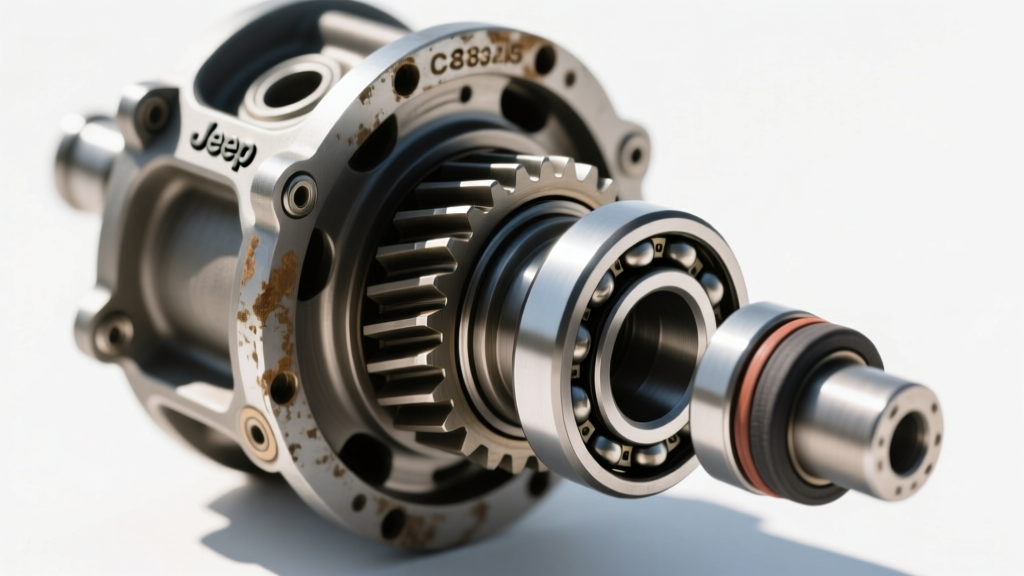
As of 2026, the aging fleet of Cherokees faces compounding issues. The primary failure mode begins with the outer axle seal degrading due to heat cycling and road debris. Once the seal fails, 75W-90 or 75W-140 gear oil leaks onto the brake backing plates, compromising braking performance. Simultaneously, water and grit infiltrate the bearing race. The roller bearings pit, the cage disintegrates, and the axle shaft begins to wobble. In severe cases documented by the NHTSA recalls database, a seized bearing causes the axle shaft to snap or the differential housing to overheat from extreme friction, occasionally igniting leaked gear oil and causing vehicle fires.
Diagnostic Framework: Differentiating Seal Leaks from Bearing Wear
Before tearing down the axle, you must accurately diagnose whether you are dealing with a simple seal leak or a compromised bearing assembly. Misdiagnosis leads to replacing seals on a pitted bearing, guaranteeing a comeback repair within 500 miles.
| Symptom | Probable Cause | Expert Verification Method |
|---|---|---|
| Wetness on backing plate / low fluid | Outer Axle Seal Failure | Clean housing, drive 10 miles, inspect for fresh seepage past the flange. |
| Low-frequency growl (35-55 mph) | Inner/Outer Bearing Pitting | Raise rear axle, spin wheel by hand. Listen for 'crunching' via stethoscope. |
| Lateral axle shaft play (>0.010') | Bearing Cage Disintegration | Grab tire at 3 and 9 o'clock; check for in/out play indicating bearing wear. |
| ABS fault codes / erratic speedometer | Tone Ring Damage from Wobble | Scan ABS module; visually inspect tone ring for cracked teeth or misalignment. |
OEM vs. Aftermarket Parts Selection Matrix
Do not rely on unbranded, white-box bearing and seal kits from overseas marketplaces. The Dana 35 and C8.25 axles require precise dimensional tolerances to maintain proper bearing preload and seal seating. Below is the definitive parts matrix for the most common Cherokee rear axles.
| Component | Dana 35 (C-Clip Axle) | Chrysler 8.25 (Bolt-In) | Expert Notes |
|---|---|---|---|
| Wheel Bearing | Timken SET-10 | Timken SET-36 (A-10) | Always use Timken or SKF. Avoid generic brands for roller bearings. |
| Outer Axle Seal | National 8660S / SKF 17915 | National 8660S / SKF 17915 | Ensure the seal lip faces INWARD toward the gear oil. |
| Inner Pinion Seal | National 710928 | National 710928 | Replace if pinion flange shows a worn groove. |
| C-Clip Eliminator Kit | Randy's Ring & Pinion 130-K | N/A (Already bolt-in) | Highly recommended for Dana 35s to prevent shaft ejection if side gears fail. |
For comprehensive dimensional data and load ratings on these specific taper roller bearings, technicians should consult the Timken automotive bearing catalog.
Expert Replacement Procedure: Dana 35 & Chrysler 8.25
The extraction and installation processes differ fundamentally between the C-clip retained Dana 35 and the bolt-in C8.25. Understanding these nuances is critical for a successful repair.
Step 1: Axle Shaft Extraction
For the Dana 35, you must drain the differential fluid, remove the differential cover, and rotate the carrier until the cross-pin shaft aligns with the axle tubes. Push the axle shaft inward (approximately 1/2 inch) to access the C-clip. Use a magnetic pick-up tool to extract the C-clip from the side gear groove. Once removed, slide the axle shaft out. Warning: The C-clip can easily drop into the differential housing or the axle tube. Use a shop rag to plug the opposite tube.
For the Chrysler 8.25, the process is simpler. Remove the four 1/2-inch (or 13mm) retainer plate nuts on the outside of the axle flange. Use a slide hammer with an axle puller attachment to extract the shaft. Do not pry between the backing plate and the axle housing, as this will warp the brake assembly.
Step 2: Bearing and Seal Extraction
Once the shaft is out, use a bearing puller and shop press to remove the old bearing and retainer collar. If you lack a press, a specialized slide-hammer bearing puller (like the Lisle 45400) can extract the bearing from the axle tube. Clean the axle tube bore meticulously with brake cleaner and a lint-free cloth; any residual grit will score the new seal.
Step 3: Installation and Seating Depth
Press the new Timken bearing onto the axle shaft. The retainer collar must be pressed against the bearing inner race with approximately 3-5 tons of force to ensure it locks in place. Next, apply a thin layer of multi-purpose grease to the outer edge of the new National/SKF seal. Drive the seal into the axle tube using a seal driver tool. Critical Spec: The seal must be seated perfectly flush with the end of the axle tube. Recessing it too deep will cause it to ride on an unworn portion of the axle shaft, resulting in an immediate leak. Protruding it too far will bind against the bearing retainer plate.
Critical Torque Specifications & Clearances
Improper torque is the leading cause of premature bearing failure and differential noise post-repair. Adhere strictly to these specifications:
- Dana 35 Cross-Pin Shaft Lock Bolt: 15-20 lb-ft (Use Loctite 242 on threads).
- Dana 35 Differential Cover Bolts: 25-30 lb-ft (RTV silicone required, no gasket).
- Chrysler 8.25 Retainer Plate Nuts: 30-40 lb-ft.
- Pinion Flange Nut (If replacing pinion seal): 160-220 lb-ft. Note: This is a crush-sleeve dependent spec. You must measure rotational torque using an inch-pound beam torque wrench. Target 15-25 in-lbs of rotating torque (add 5 in-lbs to the pre-teardown measurement if reusing the pinion gear).
- Brake Backing Plate Nuts: 45-60 lb-ft.
Fluid Refill, Trac-Lok Additives, & Break-In Protocol
Once the bearings and seals are installed, the differential must be filled with the correct lubricant. While the factory spec often called for 80W-90 GL-5, most drivetrain experts in 2026 recommend upgrading to a full synthetic 75W-140 GL-5 (such as Mobil 1 or Red Line ShockProof) for aging Cherokee axles, especially if the vehicle is used for towing or off-roading. The heavier viscosity helps cushion worn gear sets and maintains a thicker hydrodynamic film on the bearings.
Limited Slip (Trac-Lok) Additive Protocol
If your Cherokee is equipped with a Trac-Lok limited-slip differential, you must add a friction modifier to prevent chatter during tight turns. Add exactly 2.5 ounces of Mopar Limited Slip Additive (Part # 05010320AA) or an equivalent like Lubegard Limited Slip Supplement before filling the rest of the housing with gear oil. The total fluid capacity for the Dana 35 is approximately 3.5 pints (1.75 quarts), while the C8.25 holds roughly 4.4 pints (2.2 quarts). Fill until the fluid level is exactly flush with the bottom of the fill hole.
The Break-In Drive Cycle
After reassembly, drive the vehicle in a large, empty parking lot. Perform ten figure-eight maneuvers at idle speed to force the clutch packs in the Trac-Lok to engage and disengage, distributing the friction modifier evenly. For the first 500 miles, avoid sustained highway speeds over 65 mph and heavy towing to allow the new Timken bearings to seat properly and the gear oil to stabilize. Check the axle tube ends for seepage after the first 50-mile heat cycle.
By treating the Jeep Cherokee rear differential recall context not just as a historical footnote, but as a mandate for precision repair, you can extend the life of the iconic Dana 35 and C8.25 axles well past the 250,000-mile mark. Always prioritize premium seals, exact torque specs, and high-quality synthetic fluids to keep your rig safely on the trail and off the tow truck.
For further reading on drivetrain architecture and Spicer/Dana axle service manuals, refer to the Dana aftermarket resource center.