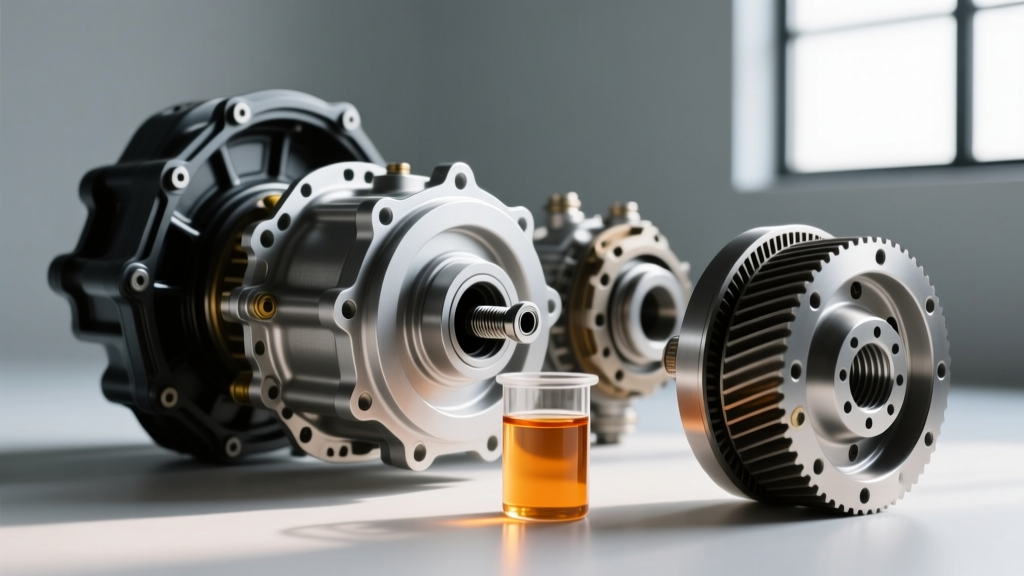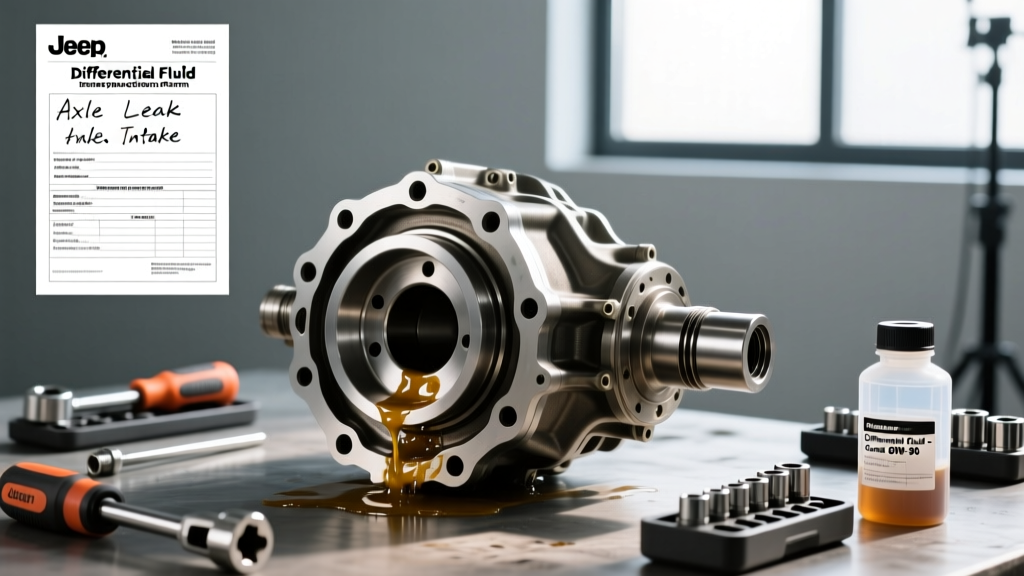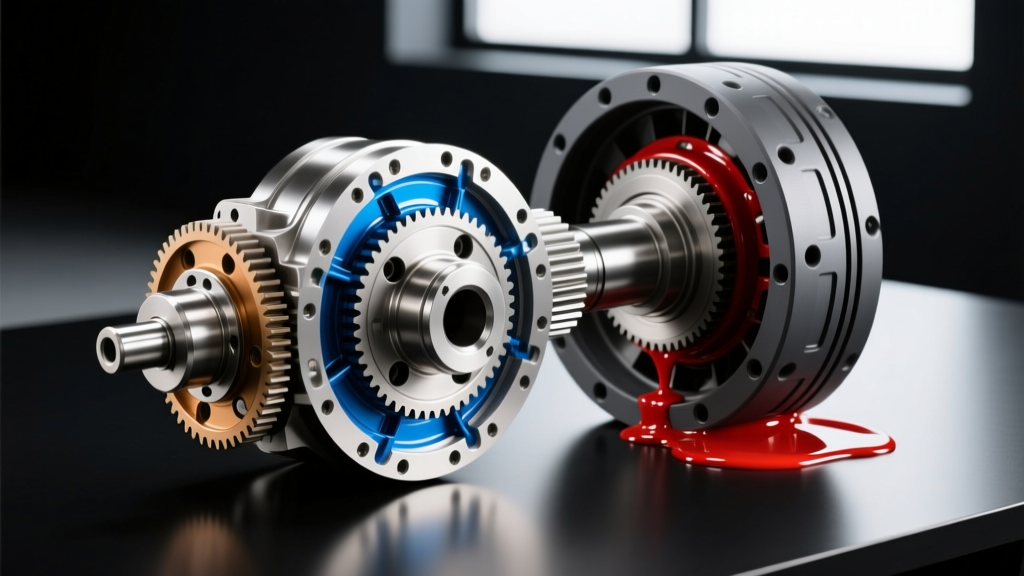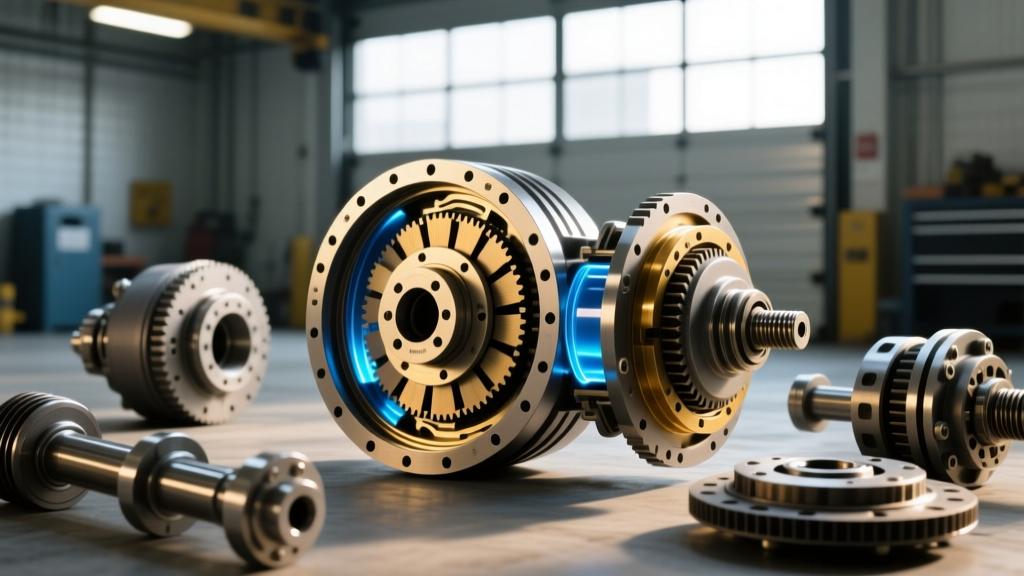
The Drivetrain Duo: Transfer Case vs. Differential
For beginners entering the world of four-wheel-drive (4WD) and all-wheel-drive (AWD) vehicles, the undercarriage can look like a tangled mess of iron and aluminum. Two of the most critical—and frequently confused—components in this system are the transfer case and the differentials. While they work in tandem to deliver power to the pavement, they serve entirely different mechanical functions. More importantly, the health of one directly impacts the other, making the selection and maintenance of your limited slip differential fluid a matter of total drivetrain survival.
The transfer case (T-case) is bolted directly to the rear of the transmission. Its sole job is to split engine torque between the front and rear axles. Whether you are driving a Jeep Wrangler with an NV241OR Rock-Trac case or a Ford F-150 with a BorgWarner 4406, the T-case manages the longitudinal (front-to-back) power distribution.
The differentials, located at the center of the front and rear axles, take that power and split it laterally (left-to-right). When cornering, your outside wheels must spin faster than the inside wheels. The differential allows this speed differential to occur smoothly. However, when a differential is equipped with a limited-slip mechanism (using clutch packs or helical gears), it requires specialized chemistry to function without destroying itself or sending destructive harmonic vibrations back into the transfer case.
The Danger of Driveline Wind-Up
To understand why limited slip differential fluid matters to your transfer case, you must understand "driveline wind-up." In a part-time 4WD system, engaging 4-High locks the front and rear driveshafts together inside the T-case. If you drive on dry pavement, the front and rear axles will inevitably want to turn at different speeds due to steering angles and tire wear. Because the T-case is locked, it cannot compensate for this front-to-rear discrepancy.
Expert Insight: The only way to relieve part-time 4WD wind-up is through tire slip or lateral differential slip. If your rear limited-slip differential (LSD) is binding due to degraded fluid, the stress bypasses the axle shafts and transfers directly into the transfer case chain and planetary gears, leading to catastrophic failure.
The Chemistry of Traction: Why Limited Slip Differential Fluid is Unique
Standard open differentials simply require a high-quality API GL-5 gear oil to lubricate the ring and pinion gears. However, clutch-type limited-slip differentials (like the Ford 8.8 Traction-Lok or the Dana 44 Trac-Lok) use internal friction discs to transfer torque to the wheel with the most grip.
If you use standard gear oil in these units, the clutch packs will grab aggressively, causing a violent shudder or "chatter" during low-speed turns. This is where limited slip differential fluid comes in. These fluids contain specialized friction modifiers—typically long-chain organic esters—that alter the coefficient of friction on the clutch plates. This allows the clutches to slip microscopically before engaging, ensuring smooth torque transfer.
The Misdiagnosis Trap: T-Case Chain vs. LSD Chatter
One of the most common mistakes beginner mechanics make is misdiagnosing a driveline noise. A degraded friction modifier in the rear differential will cause the clutch packs to chatter during tight turns. This chatter sends a low-frequency harmonic vibration up the rear driveshaft, directly into the transfer case output shaft.
Many owners feel this vibration through the floorboards and immediately assume their transfer case chain is stretched or the output shaft bearing is failing. They pull the T-case apart, only to find it in perfect condition. The culprit was simply a $15 bottle of ignored friction modifier. Always service your differential fluid before condemning a transfer case.
2026 Drivetrain Fluid Specification Chart
Below is a reference guide for popular 4x4 platforms, highlighting the distinct fluid requirements for the transfer case versus the limited-slip differentials. Never cross-contaminate these fluids.
| Vehicle Platform | Transfer Case Model | T-Case Fluid & Capacity | Rear LSD Model | LSD Fluid & Modifier |
|---|---|---|---|---|
| Jeep Wrangler JL (Rubicon) | NV241OR | ATF+4 (2.8 qts) | Dana 44 AdvanTEK | 75W-85 GL-5 + Mopar 68218655AA |
| Ford F-150 4x4 (2015-2020) | BW4406 / HD | Mercon ULV / ATF (2.0 qts) | Ford 9.75" | 75W-140 GL-5 + Ford XL-3 |
| Chevy Silverado 1500 Z71 | NVG246 / 261 | AutoTrak II (2.0 qts) | GM 9.5" (G80) | 75W-90 GL-5 (No modifier needed for G80) |
Note: The GM G80 locker is a mechanical locking differential, not a clutch-type LSD, and therefore does not require friction modifiers. Adding modifiers to a G80 can actually delay its engagement. Always verify your specific RPO code or axle tag.
Step-by-Step: Servicing the Rear LSD and Transfer Case
Maintaining the relationship between your T-case and differentials requires strict adherence to service intervals. While the transfer case might see a 60,000-mile interval, your limited slip differential fluid should be changed every 30,000 to 50,000 miles, especially if you tow, off-road, or submerge the axle in water.
Tools and Torque Specifications
- Fluid Pump: A manual or pneumatic gear oil pump is mandatory. Do not attempt to squeeze it from the bottle.
- Drain/Fill Plugs: Most modern axles use a 3/8" or 1/2" square drive, or a 13mm/15mm hex bolt.
- Torque Specs (Dana 44): 35 lb-ft for both fill and drain plugs.
- Torque Specs (Ford 8.8/9.75): 25 lb-ft for the fill plug.
- Torque Specs (NV241 T-Case): 15-20 lb-ft (Do not overtighten; the T-case housing is thin cast aluminum).
The Golden Rule: Fill First, Drain Second
When servicing the differential, always remove the fill plug before removing the drain plug. If your fill plug is seized, rusted, or stripped, you do not want to discover this after you have already drained 2 quarts of gear oil onto the floor, leaving your vehicle immobile. Once the fill plug is confirmed loose, drain the old fluid, reinstall the drain plug to spec, and pump in the new limited slip differential fluid mixed with your friction modifier until it weeps out of the fill hole.
Understanding Fluid Viscosity Standards
Gear oil viscosity is governed by the SAE J306 Standard. Unlike engine oil, gear oil numbers are much higher (e.g., 75W-90, 75W-140), but a 75W-90 gear oil is roughly equivalent in actual thickness to a 10W-40 engine oil. The "W" stands for winter, indicating cold-flow properties.
According to the American Petroleum Institute (API), GL-5 is the required standard for hypoid gears found in differentials, as it contains high levels of sulfur-phosphorus extreme pressure (EP) additives. However, these EP additives can be corrosive to the yellow metals (bronze/copper) used in some transfer case synchronizers. This is exactly why you must never use GL-5 differential fluid inside your transfer case, even if they share the same physical bolt pattern for drain plugs.
Cost Breakdown: DIY vs. Dealership in 2026
Servicing the transfer case and rear differential at a dealership has become increasingly expensive. Here is what you can expect to pay in 2026:
- Dealership Service: $350 - $550 (Includes shop markup on synthetic fluids and 1.5 hours of labor).
- DIY Cost (Synthetic 75W-90): $18 - $28 per quart (You need 2 quarts = ~$45).
- DIY Friction Modifier: $12 - $18 per 4oz bottle (e.g., Mopar, Ford XL-3, or Red Line).
- Transfer Case Fluid (ATF+4 or AutoTrak II): $10 - $14 per quart.
By performing the service yourself, you save upwards of $300 while gaining intimate knowledge of your drivetrain's health. You can inspect the drain plugs for metallic fuzz (normal) versus chunky metal shards (indicative of failing ring/pinion gears or T-case chain slip).
Frequently Asked Questions
Can I use synthetic gear oil that claims to be "LSD Compatible" without adding a separate modifier?
Many modern synthetic gear oils (such as Amsoil Severe Gear or Mobil 1 Synthetic Gear Lubricant) advertise that they are "compatible with limited-slip differentials." While these contain a baseline level of friction modifiers, Motortrend and OEM service manuals consistently recommend adding the specific manufacturer friction modifier (like Ford XL-3) if chatter occurs. Start with the pre-mixed synthetic; if the rear end chatters during figure-eight turns, add half a bottle of dedicated modifier.
Does the transfer case fluid affect the limited-slip differential?
Not chemically, as they are sealed, separate chambers. However, mechanically, they are deeply linked. If your T-case fluid is low or degraded, the internal clutch packs (in AWD models) or the chain (in 4WD models) will slip and generate excessive heat and vibration. This vibration travels down the driveshaft and can accelerate the wear of the differential's spider gears and LSD clutch packs.
How do I know if my differential has a limited slip?
Jack up the rear of the vehicle safely (both wheels off the ground). Put the transmission in Neutral. Spin one rear tire by hand. If the opposite tire spins in the same direction, you have a limited-slip or locking differential. If it spins in the opposite direction, you have an open differential and do not require friction modifiers.