The Physics of Caramela Clamp Loads vs. Stock Linkage
Upgrading to a high-performance Caramela clutch system fundamentally alters the mechanical stress distribution within your bellhousing. While stock OEM clutch assemblies typically exert between 2,000 and 2,400 lbs of clamp load on the pressure plate, a Stage 3 or Stage 4 Caramela clutch kit designed for 800+ lb-ft applications can generate upwards of 3,800 to 4,500 lbs of clamping force. This massive 60% to 100% increase in diaphragm spring pressure does not merely affect pedal effort; it transfers exponentially higher parasitic loads directly to the clutch fork, pivot ball, and throwout bearing (TOB) collar.
As of 2026, many enthusiasts pairing Caramela clutch kits with modern overdrive transmissions like the Tremec TKX or T-56 Magnum F mistakenly assume that the hydraulic or mechanical linkage will handle the increased load without modification. In reality, stamped-steel OEM forks are prone to elastic deformation (bending) under these extreme loads, and cast-iron pivot balls rapidly develop deep wear grooves. When the fulcrum geometry shifts due to this wear, the throwout bearing is forced into a misaligned engagement with the diaphragm fingers, leading to catastrophic bearing failure, clutch chatter, and incomplete disengagement. Understanding the precise diagnostics and setup protocols for these components is critical for preserving your drivetrain investment.
Diagnostic Matrix: Identifying Fork and Pivot Wear
Before tearing down the transmission, you can often diagnose clutch fork and pivot ball issues by analyzing pedal behavior and engagement symptoms. The table below outlines the most common failure modes associated with high-clamp-load Caramela setups.
| Symptom | Probable Root Cause | Verification Method |
|---|---|---|
| Clutch pedal pulsation or vibration at 1,500-2,500 RPM | Pivot ball grooving causing TOB collar wobble | Inspect pivot ball for concentric wear rings; measure TOB collar runout with a dial indicator. |
| Clutch fails to fully disengage despite full pedal travel | Clutch fork elastic deflection (bending) under high clamp load | Measure fork thickness and compare to OEM spec; check for stress fractures near the fulcrum pivot. |
| Harsh 'clunk' upon clutch engagement or gear change | Improper TOB air gap or worn fork pivot retainer clip | Verify 0.100' to 0.150' air gap between TOB and diaphragm fingers; inspect retainer spring tension. |
| Pedal effort increases progressively during a single drive | Pivot ball galling due to lack of high-temp lubrication | Remove fork and inspect pivot surface for metallic transfer and lack of molybdenum grease. |
Critical Measurements: Pivot Height and Air Gap
The most frequent cause of premature Caramela clutch failure is incorrect fulcrum geometry. If the pivot ball height is incorrect, the clutch fork will not push the throwout bearing parallel to the transmission input shaft. This angular misalignment causes the TOB to ride on the tips of the diaphragm fingers or bind against the transmission bearing retainer collar.
Establishing the Pivot Ball Height
For standard GM/Tremec bellhousings (commonly used with T-56 Magnum and TKX applications), the industry-standard pivot ball height is exactly 4.750 inches (± 0.050') from the bellhousing-to-engine block mating surface. According to Tremec Engineering Documentation, deviating from this measurement alters the mechanical advantage of the fork, leading to either bottoming out the slave cylinder or failing to fully stroke the clutch.
- Measurement Tool: Use a precision machined straight-edge across the bellhousing mating surface and measure down to the apex of the pivot ball using digital calipers.
- Correction: If the measurement is off, install an adjustable pivot ball (typically $45-$85) or use hardened steel shims beneath the fixed pivot ball base.
Setting the Throwout Bearing Air Gap
Unlike older multi-finger Borg & Beck clutches that required a constant-contact TOB, modern diaphragm-style Caramela clutches require a specific air gap to allow the pressure plate to fully clamp the friction disc without riding the TOB. The target air gap between the TOB face and the diaphragm spring fingers is 0.100' to 0.150'. If the gap is too tight, the TOB will constantly spin, generating immense heat and destroying the bearing within 500 miles.
Mechanical Fork vs. Hydraulic Throwout Bearing (HTOB)
When diagnosing linkage issues, the type of actuation system dictates your troubleshooting path. High-torque Caramela clutch kits are frequently paired with both mechanical external forks and internal Hydraulic Throwout Bearings (HTOB).
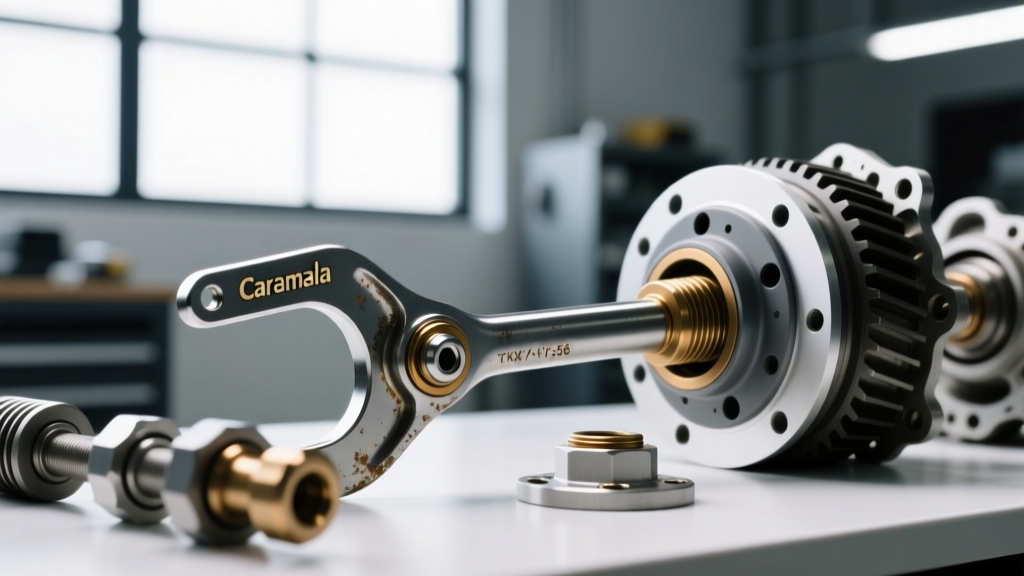
Mechanical Fork Systems: These rely on an external slave cylinder pushing a physical fork. The primary vulnerability here is the pivot ball and the fork's stamped steel construction. Under the 4,000+ lb clamp load of a Caramela Stage 4, the fork can flex up to 0.040' at the TOB collar, effectively robbing you of critical clutch disengagement travel. Upgrading to a billet aluminum fork is highly recommended for any Caramela clutch producing over 600 lb-ft of torque.
Internal HTOB Systems: HTOBs eliminate the fork and pivot ball entirely, utilizing hydraulic pressure to push the bearing directly against the diaphragm fingers. While this solves the flex issue, it introduces hydraulic complexities. If your Caramela clutch is chattering or slipping with an HTOB, the issue is rarely mechanical wear and almost always related to improper bearing depth shimming or trapped air in the hydraulic lines. According to McLeod Racing Tech Bulletins, HTOB setups require precise shim stacks (usually 0.050' to 0.150') to ensure the piston does not over-extend and blow its internal O-rings under the heavy resistance of a high-clamp-load pressure plate.
Expert Upgrade Recommendations & Part Numbers
To reliably support a Caramela clutch system, replace marginal OEM linkage components with heavy-duty aftermarket alternatives. Budget approximately $250 to $450 for a complete heavy-duty linkage overhaul, excluding labor.
- Billet Clutch Fork: McLeod Billet Aluminum Fork (Part #169101) or Tremec Heavy-Duty Steel Fork (Part #1386-000-011). Price range: $160 - $240. These eliminate elastic deflection and feature replaceable pivot contact pads.
- Adjustable Pivot Ball: Tilton or McLeod adjustable pivot (Part #7800-Series). Price range: $45 - $85. Allows for micro-adjustments of the fulcrum height without removing the bellhousing.
- Pivot Ball Retainer Spring: Upgraded high-tension retainer clip. Essential to prevent the fork from dislodging from the pivot ball during aggressive, high-RPM power shifts.
- High-Temp Lubricant: Molybdenum disulfide (moly) based grease. Standard chassis grease will melt and wash out under bellhousing temperatures, leading to rapid pivot galling.
Step-by-Step Adjustment Protocol
Follow this precise protocol when installing or diagnosing a Caramela clutch linkage system to ensure optimal geometry and longevity. For further fabrication and installation insights, Summit Racing Tech Articles provides excellent visual references for bellhousing alignment.
- Bellhousing Alignment Check: Before installing the fork, dial-indicate the bellhousing bore relative to the crankshaft. Total indicated runout (TIR) must not exceed 0.005'. Misaligned bellhousings force the fork to operate at an angle, accelerating pivot wear.
- Install Adjustable Pivot: Thread the adjustable pivot ball into the bellhousing boss. Apply medium-strength threadlocker (e.g., Loctite 243) to the threads and set the initial height to 4.750' from the mating surface.
- Lubricate Contact Points: Apply a generous layer of moly-based grease to the pivot ball apex, the fork pivot cup, and the transmission input shaft bearing retainer collar where the TOB slides.
- Mount the Fork and TOB: Snap the fork onto the pivot ball and secure the heavy-duty retainer clip. Slide the throwout bearing onto the fork arms (for mechanical setups) ensuring the anti-rotation tabs are seated in the bearing retainer slots.
- Set the Air Gap: With the clutch fully engaged (pedal up), measure the gap between the TOB face and the Caramela diaphragm fingers. Adjust the external slave cylinder pushrod (or internal HTOB shims) until a precise 0.125' gap is achieved.
- Torque the Bellhousing: When reinstalling the bellhousing to the engine block, torque the M10 or 3/8'-16 bolts to 35-50 lb-ft in a star pattern. Uneven torque can distort the bellhousing and ruin your pivot height measurements.
By treating the clutch fork and pivot ball as precision instruments rather than simple levers, you ensure that your high-capacity Caramela clutch engages smoothly, disengages fully, and survives the extreme demands of modern performance driving.