The Anatomy of an Off-Road Crawl Ratio
When building a dedicated trail rig, rock crawler, or overland expedition vehicle, understanding how to calculate gear ratios is the difference between conquering a slick rock shelf and snapping an axle shaft. Unlike highway-focused builds that prioritize low-RPM fuel economy, off-road drivetrain math is entirely about torque multiplication, clutch preservation, and low-speed throttle control. As we navigate the 2026 off-road landscape—where heavy electric platforms like the Rivian R1T and Hummer EV are changing drivetrain dynamics with single-speed reductions and dual-motor torque vectoring—mastering traditional internal combustion crawl ratios remains the bedrock of hardcore trail engineering.
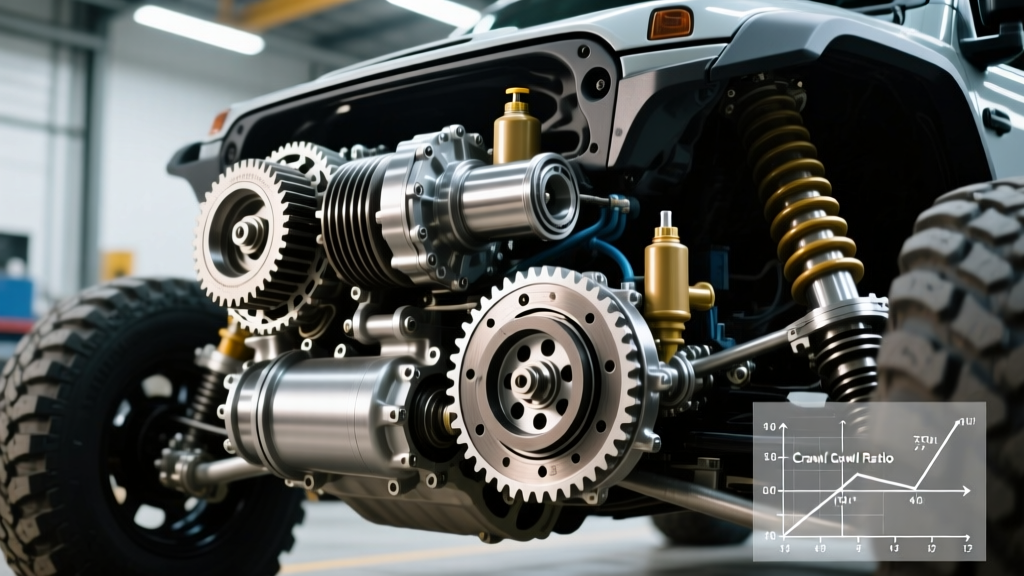
The fundamental goal of off-road gearing is to achieve a final crawl ratio between 50:1 and 130:1, depending on the terrain and tire size. To get there, you must multiply the three primary reduction points in your drivetrain. This guide breaks down the exact formulas, component selections, and setup specifications required to build a bulletproof low-range system.
The Master Crawl Formula
Before ordering ring and pinion sets or swapping transfer cases, you must understand the master equation. The final crawl ratio is calculated by multiplying the lowest gear in your transmission, the low-range reduction of your transfer case, and the final drive ratio in your axles.
The Crawl Ratio Formula:
Transmission 1st Gear × Transfer Case Low Range × Axle Ratio = Final Crawl Ratio
For example, if you are running a classic AX15 manual transmission (1st gear 3.83:1), an NV241OR Rock-Trac transfer case (4.0:1 low range), and a Dana 60 axle with 5.13:1 gears, your math looks like this: 3.83 × 4.0 × 5.13 = 78.59:1. This is a highly capable crawl ratio for 37-inch tires on moderate to difficult rock crawling terrain.
Transmission First-Gear Disparities
Not all first gears are created equal, and this drastically alters your downstream gearing requirements. Modern automatic transmissions offer massive first-gear reductions, which can sometimes eliminate the need for extreme axle ratios.
- ZF 8HP75 (8-Speed Auto): Found in modern Jeeps and Rams, the 8HP75 boasts a massive 4.71:1 first gear. When paired with a 4:1 transfer case and 4.88 axles, you achieve a 91.9:1 crawl ratio right out of the factory.
- Ford 10R80 (10-Speed Auto): The 10R80 features a 4.69:1 first gear. However, its complex planetary gearset requires precise tuning to prevent shift-hunting on steep inclines.
- Aisin AS69RC (Heavy Duty 6-Speed): Common in Ram Cummins platforms, this transmission has a relatively shallow 3.09:1 first gear. To achieve a 100:1 crawl ratio with a standard 2.72:1 transfer case, you would need an impractical 11.9:1 axle ratio, forcing you to upgrade to an aftermarket transfer case.
Transfer Case Multipliers: NV241OR vs. Atlas II
The transfer case is the most cost-effective place to multiply torque without altering your highway driving manners. According to drivetrain specialists at Novak Adapters, upgrading the transfer case reduction is often preferred over installing extreme axle gears, as it keeps the driveshaft RPMs higher, reducing vibration and U-joint bind at low speeds.
The factory NV241OR (Rock-Trac) offers a robust 4.0:1 reduction and holds up to 300 lb-ft of continuous torque, requiring exactly 2.5 pints of ATF+4 fluid. For extreme builds, the aftermarket Advance Adapters Atlas II allows for custom reductions like 4.3:1 or even 5.0:1. An Atlas II twin-stick case costs between $3,800 and $4,500, but it provides unparalleled low-speed control and independent front/rear axle engagement.
Axle Ratios: The Dana 60 Benchmark
When dealing with 40-inch tires and high-horsepower V8s, the Dana 60 is the industry standard. According to Dana Spicer engineering specifications, the Dana 60 can safely accommodate ratios up to 5.38:1. A popular choice is the Motive Gear D60-513 (5.13:1) ring and pinion set, which typically costs around $280 to $320 per axle.
However, installing deep gears requires a master setup kit. Do not reuse old crush sleeves or carrier shims. A high-quality Timken master install kit (approx. $180) includes fresh bearings, races, shims, and a new crush sleeve. Expect to pay a professional drivetrain shop between $800 and $1,200 per axle for labor if you lack the specialized dial indicators and inch-pound torque wrenches required for the setup.
2026 Crawl Ratio Matrix: Popular Configurations
| Transmission (1st Gear) | Transfer Case (Low) | Axle Ratio | Final Crawl Ratio | Best Application |
|---|---|---|---|---|
| ZF 8HP75 (4.71:1) | NV241OR (4.0:1) | 4.88:1 | 91.9:1 | 37-40" Tires / Rock Crawling |
| AX15 Manual (3.83:1) | NV231 (2.72:1) | 5.13:1 | 53.4:1 | 33-35" Tires / Overlanding |
| TH400 (2.48:1) | Atlas II (4.3:1) | 5.38:1 | 57.4:1 | 42" Tires / Buggy Comp |
| 10R80 (4.69:1) | NV271D (2.64:1) | 4.56:1 | 56.4:1 | 35" Tires / Desert Running |
The Hidden Variable: Tire Size and Effective Gearing
Knowing how to calculate gear ratios is only half the battle; you must also account for tire diameter. Taller tires effectively 'raise' your numerical gear ratio, robbing you of torque at the contact patch. If you regear your axles but later upgrade from 35-inch to 38-inch tires, your effective gearing changes drastically.
Effective Ratio Formula:
(New Tire Diameter / Old Tire Diameter) × Current Axle Ratio = Effective Ratio
If you currently run 4.56 gears with 35-inch tires, and you install 38-inch tires, your math is: (38 / 35) × 4.56 = 4.95:1. Your truck now 'feels' like it has 4.95 gears, resulting in sluggish acceleration, higher transmission temperatures, and increased fuel consumption. Always calculate your target axle ratio based on the largest tire you plan to run in the future, not the tire currently on the truck.
The Tire Spin Method: Finding Unknown Ratios
If you purchased a used rig and need to know how to calculate gear ratios without tearing the differential cover off, use the tire spin method. This requires a floor jack, a jack stand, and a piece of chalk.
- Safely jack up one side of the drive axle and place it on a jack stand. Ensure the transmission is in Neutral and the transfer case is in 2WD or 4WD Neutral.
- Mark the driveshaft and the pinion flange with chalk. Mark the bottom of the raised tire.
- Rotate the raised tire exactly two full revolutions while counting the number of times the driveshaft rotates.
- If the driveshaft turns roughly 4.5 times, you have 4.56 gears. If it turns just over 5 times, you likely have 5.13 gears.
Note: This method assumes an open differential. If your axle is equipped with a locking differential or a spool, you must raise both tires off the ground and rotate them together, counting the driveshaft turns for only one full tire revolution.
Expert Setup: Torque Specs and Break-In Procedures
Installing deep off-road gears like a 5.38:1 set generates immense heat and friction during the initial miles. Improper setup will lead to catastrophic tooth shearing on the trail. According to Spicer Parts documentation, achieving the correct bearing preload and gear backlash is non-negotiable.
Dana 60 Critical Torque Specifications
- Ring Gear Bolts: 120 lb-ft (Apply red Loctite 271 to the threads; never use lock washers).
- Carrier Bearing Cap Bolts: 175 lb-ft (Ensure caps are installed in their original orientation and direction).
- Pinion Nut (Crush Sleeve): 200 to 350 lb-ft (Tighten in small increments while checking rotating torque).
- Pinion Bearing Preload (Rotating Torque): 20-30 in-lbs for used bearings; 30-45 in-lbs for new bearings.
The 50-Mile Break-In Protocol
New ring and pinion gears must be heat-cycled to properly mate the machined surfaces. Fill the differential with a high-quality synthetic gear oil, such as Amsoil Severe Gear 75W-140 (Dana 60 rear capacity is approximately 4.0 pints). Drive the vehicle on paved roads for 15 to 20 miles at speeds under 50 MPH. Stop and let the axle cool completely to ambient temperature. Repeat this heat-cycle process three times. Avoid towing, heavy throttle loads, or high-speed highway driving for the first 500 miles. After the break-in period, drain the fluid to remove the metallic break-in paste, replace the cover gasket, and refill with fresh synthetic oil and a friction modifier if your limited-slip differential requires it.
Final Thoughts on Drivetrain Math
Mastering how to calculate gear ratios ensures your vehicle operates within its optimal powerband, whether you are winching up a 45-degree mud rut or cruising at 75 MPH on the interstate. By balancing transmission first-gear multiplication, transfer case reductions, and axle ratios against your specific tire diameter, you build a drivetrain that is both resilient and capable. Always invest in premium setup components, adhere strictly to torque specifications, and respect the break-in period to guarantee your gears survive the harshest environments the trail has to offer.