The Universal Law of Gears: From Fishing Reels to Axles
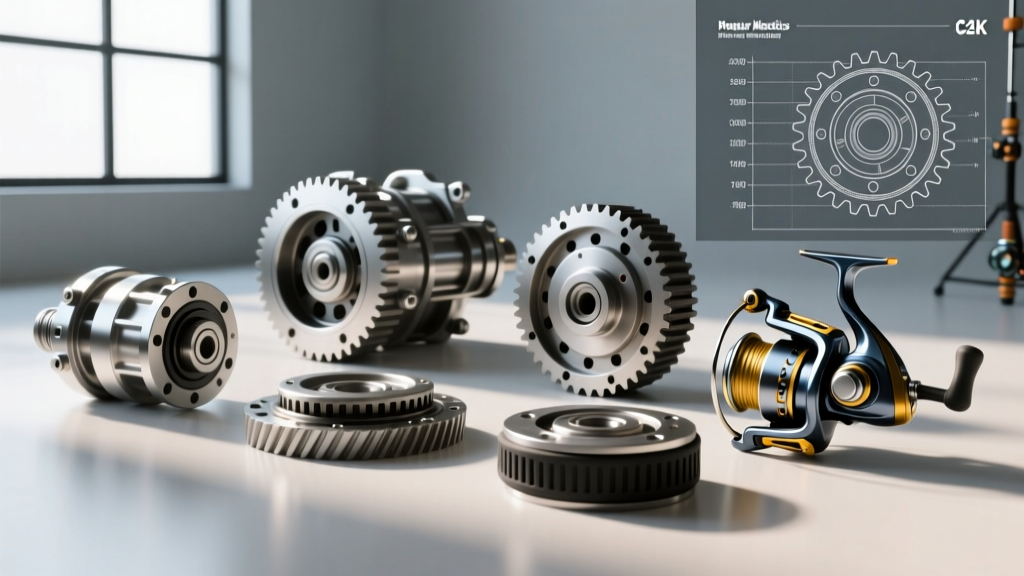
If you have ever found yourself searching what gear ratio for crankbaits, you have already taken the first step into the fascinating world of mechanical advantage. At first glance, a baitcasting fishing reel and a heavy-duty automotive differential seem to have nothing in common. One is held in the palm of your hand to catch a 5-pound bass; the other is bolted to the chassis of a 5,000-pound truck. Yet, the underlying physics governing torque, speed, and rotational force are absolutely identical.
At AutoGearNexus, we believe that understanding drivetrain mechanics starts with relatable concepts. Whether you are trying to winch a heavy lure through thick weeds or crawl a Jeep over a boulder field, gear ratios dictate your success. In this beginner-friendly explainer, we will decode the mechanics of crankbait reels and seamlessly transition those lessons into a comprehensive guide on differential gear ratio selection for your vehicle.
What Gear Ratio for Crankbaits? (The Baseline Physics)
In the fishing world, baitcaster gear ratios are expressed as two numbers, such as 6.4:1 or 8.1:1. This tells you how many times the spool rotates for every single turn of the handle.
- 5.4:1 (Slow/High Torque): Used for deep-diving crankbaits. The low ratio provides immense cranking power to pull lures with high water resistance, but retrieves line slowly.
- 6.4:1 (Medium): The versatile middle ground for standard crankbaits and jerkbaits.
- 8.1:1 (Fast/Low Torque): Used for burning shallow squarebill crankbaits or quickly picking up slack line. High speed, but less cranking power.
The key metric here is Inches Per Turn (IPT). A higher gear ratio yields more IPT but sacrifices the torque needed to move heavy, water-resistant objects. This exact trade-off—speed versus torque—is the foundational principle of automotive differential gear ratio selection.
Differential Gear Ratio Selection: The Automotive Equivalent
Inside your vehicle's axle, the driveshaft turns a small gear called the pinion, which meshes with a massive, bowl-shaped gear called the ring gear. If your differential has a 4.10:1 ratio, it means the driveshaft (and pinion) must rotate 4.1 times to turn the axle shafts (and ring gear) exactly one time.
Just like choosing a 5.4:1 reel for heavy pulling, choosing a numerically higher differential gear (like 4.56:1 or 5.38:1) multiplies engine torque at the wheels, making it ideal for off-roading, towing, or launching off the line. Conversely, a numerically lower gear (like 3.08:1 or 3.31:1) favors high-speed efficiency and low RPM highway cruising.
The 2026 Paradigm Shift: Modern Transmissions Change the Math
As we navigate the 2026 automotive landscape, differential gear ratio selection has been fundamentally altered by the widespread adoption of 8-speed and 10-speed automatic transmissions. In the past, a truck owner towing an 8,000-pound trailer absolutely needed a 4.10:1 rear axle to get moving from a dead stop.
Today, transmissions like the Ford 10R80 or the GM 10L80 feature incredibly aggressive first-gear ratios (often around 4.69:1 or 4.86:1). Because the transmission itself provides massive initial torque multiplication, modern trucks can utilize much taller, fuel-efficient differential ratios like 3.31:1 or 3.55:1 without sacrificing towing capability. When selecting your gear ratio, you must calculate the Final Drive Ratio by multiplying the transmission's lowest gear by the axle ratio.
Real-World Axle Specs, Torque Data, and Costs
Selecting the ratio is only half the battle; executing the swap requires precision. Below is a reference table for some of the most common solid axles found in trucks and off-road vehicles, detailing the exact specifications required for a proper ring and pinion setup.
| Axle Model | Ring Gear Size | Bolt Size | Torque Spec | Backlash Spec |
|---|---|---|---|---|
| Ford 8.8-Inch | 8.8 inches | 7/16-20 | 70-85 lb-ft | 0.008" - 0.012" |
| Dana 44 | 8.5 inches | 3/8-24 | 55-65 lb-ft | 0.006" - 0.010" |
| Dana 60 | 9.75 inches | 1/2-20 | 110-120 lb-ft | 0.008" - 0.012" |
| GM 14-Bolt (SF) | 10.5 inches | 5/8-18 | 150-170 lb-ft | 0.008" - 0.015" |
Cost Breakdown: A high-quality master overhaul kit (including Timken or Koyo bearings, seals, and shims) from brands like Yukon Gear or Motive Gear typically costs between $250 and $400. The ring and pinion gear set itself will run another $250 to $450 depending on the ratio and material (standard 8620 steel vs. forged 4340 chromoly). Professional installation labor usually ranges from $500 to $900 per axle, as setting up gears is an art form that requires specialized dial indicators and inch-pound torque wrenches.
Reading the Gear Pattern: A Beginner's Warning
You cannot simply bolt a new ring and pinion together and hope for the best. The pinion gear must be set at an exact depth relative to the ring gear centerline. To verify this, mechanics apply yellow gear marking compound to the ring gear teeth and rotate the assembly under load.
According to Dana Incorporated, a proper contact pattern should be centered on the tooth face. If the pattern is too close to the top land (face) of the tooth, the pinion depth is too shallow. If it is too close to the root (flank), the pinion is too deep. Furthermore, the backlash—the microscopic gap between the mating teeth—must be maintained within the thousandths-of-an-inch tolerances listed in the table above. Failure to achieve the correct pattern will result in catastrophic gear whine, excessive heat, and eventual tooth shearing under load.
How to Calculate Your Effective Final Drive
To truly master differential gear ratio selection, you must look at the entire driveline. Use this formula to find your starting line multiplication:
Final Drive Ratio = Transmission 1st Gear × Transfer Case Low Range (if 4WD) × Axle Gear Ratio
Example Scenario: You are building a rock crawler with a Dana 60 axle, a 5.38:1 ring and pinion, an older 4-speed automatic with a 2.45:1 first gear, and a twin-stick transfer case with a 4.0:1 low range.
Calculation: 2.45 × 4.0 × 5.38 = 52.72:1
At a 52.72:1 final crawl ratio, your vehicle possesses the mechanical equivalent of a 5.4:1 baitcasting reel on steroids. You have immense, wheel-turning torque, but your top speed on the trail will be limited to a slow crawl. Conversely, if you swap to a modern 10-speed transmission (4.69:1 first gear) and a 3.73:1 axle, your first-gear final drive is 17.49:1—perfect for towing a boat on the highway, but inadequate for scaling vertical ledges.
Fluid Selection and Break-In Procedures
Once your new gears are installed, the break-in procedure is critical. New ring and pinion gears generate immense friction as the mating surfaces polish themselves to one another. Yukon Gear & Axle recommends driving conservatively for the first 500 miles, avoiding sustained highway speeds and heavy towing. You must change the gear oil after this initial 500-mile break-in period to remove the metallic sheen and microscopic shavings generated during the lapping process.
For heavy-duty applications, step up to a full synthetic 75W-140 gear oil. If your differential features a clutch-type Limited Slip Differential (LSD), such as the Ford 8.8-inch Traction-Lok, you must add a specific friction modifier additive to prevent the clutches from chattering and binding during low-speed cornering.
Conclusion: Matching the Tool to the Task
Whether you are figuring out what gear ratio for crankbaits is best for pulling a deep-diving plug through submerged timber, or you are selecting a 4.56:1 ring and pinion for your Dana 60 to turn 37-inch mud tires, the physics remain unchanged. Lower numerical ratios favor speed and efficiency; higher numerical ratios favor raw, unadulterated torque. By understanding your transmission's gear spread, your tire diameter, and your vehicle's primary purpose, you can select the perfect differential gear ratio to transform your rig's performance.