Decoding the BMW X1 Drivetrain Malfunction Warning
When the iDrive screen on your BMW X1 suddenly illuminates with the dreaded 'Drivetrain Malfunction: Drive Moderately. Maximum Power Not Available' warning, it is rarely a single catastrophic failure. Instead, it is a generic, driver-facing message triggered by the Digital Motor Electronics (DME) or Electronic Transmission Control (EGS) when it detects an anomaly in the powertrain. For the F48 (2016–2022) and U11 (2023–present) X1 generations, this requires a fundamental shift in diagnostic thinking. Unlike traditional BMWs, the X1 utilizes a transverse front-wheel drive (FWD) biased architecture based on the UKL2 and FAAR platforms.
Understanding the BMW UKL platform architecture is critical for accurate symptom diagnosis. Because the engine is mounted transversely and the primary traction is managed through the front wheels, the mechanical stress points, failure modes, and diagnostic data streams differ vastly from longitudinal rear-wheel-drive models. In 2026, as these vehicles age and accumulate mileage, FWD-specific hardware degradation has become the leading cause of phantom limp-mode triggers.
Anatomy of the X1 Transverse FWD Power Flow
To troubleshoot the system, you must first understand how power is routed to the tarmac. In the BMW X1, power flows from the transverse B38/B48 engine into an integrated transaxle—typically the Aisin AW F8F35 8-speed automatic or the Getrag 7-speed wet dual-clutch (7DCT300), depending on the model year and trim.
- Power Input: Engine torque is managed by the torque converter (or dual-clutch pack) and routed into the main transmission gearsets.
- Final Drive Integration: Unlike RWD BMWs with a separate rear differential, the X1's front differential is integrated directly into the transaxle casing.
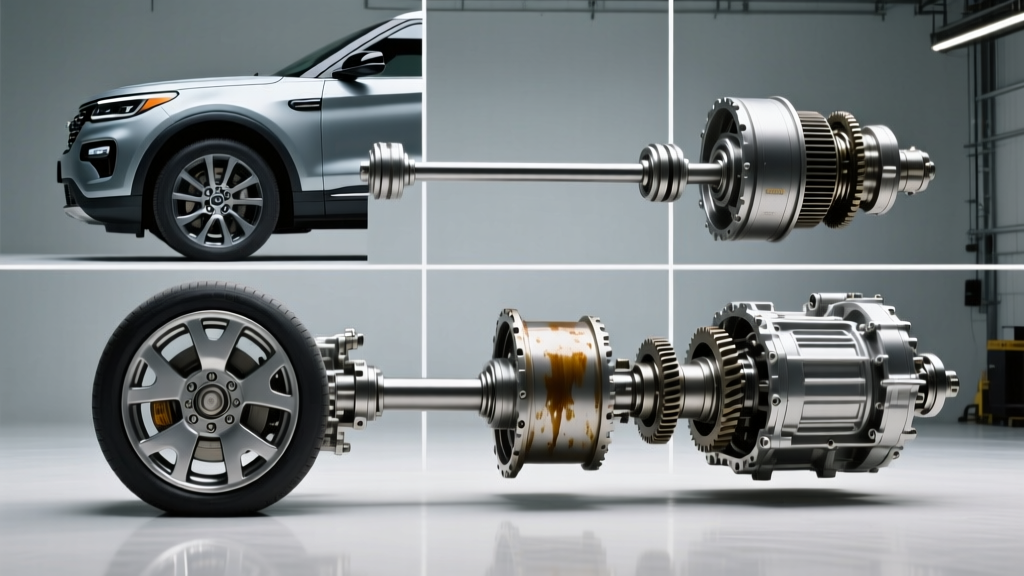
- Half-Shafts and CV Joints: Power exits the transaxle through two front constant velocity (CV) axles. To mitigate torque steer inherent in transverse FWD layouts, the passenger-side axle often utilizes an intermediate shaft supported by a bracket-mounted bearing, equalizing the length of the left and right driveshafts.
When the DME detects rotational variance, hydraulic pressure loss, or mechanical binding in any of these FWD-specific nodes, it defaults to a reduced-power state to protect the transaxle and front differential from catastrophic shock-loading.
Top FWD-Specific Culprits Behind the Warning
When diagnosing a BMW X1 drivetrain malfunction, independent shops and advanced DIYers must look beyond generic engine misfires and focus on the unique mechanical realities of the FWD layout.
1. Front Half-Shaft and Inner CV Joint Binding
The inner CV joints on the X1 utilize a tripod bearing design. Over time, the inner CV boot can tear or degrade, allowing moisture ingress and grease expulsion. As the tripod bearings wear, they develop flat spots and begin to bind under heavy acceleration. The DME monitors front wheel speeds via the ABS tone rings. If the binding causes a micro-hesitation in wheel rotation, the DME interprets this as severe front-wheel slip or a failing wheel speed sensor, instantly triggering the Drivetrain Malfunction warning and cutting throttle response.
Diagnostic Tip: Raise the vehicle on a lift and rotate the front wheels by hand while feeling the inner CV boots. A 'notchy' or gritty feeling indicates tripod bearing spalling. Inspect the ABS tone rings integrated into the outer CV joints for debris or cracking, which will also cause plausibility faults.
2. Aisin AW F8F35 Valve Body Solenoid Degradation
The Aisin 8-speed transaxle is robust, but its valve body is highly sensitive to fluid degradation and clutch material debris. Solenoids SLT (Line Pressure) and SLU (Lock-Up Control) frequently suffer from micro-sieving or electrical coil degradation past 70,000 miles. When the SLT solenoid fails to maintain adequate line pressure during the 2-3 or 3-4 shift, the EGS detects a transmission ratio error. Because the transaxle is the core of the FWD power delivery, the EGS immediately commands the DME to limit engine torque, resulting in the dashboard warning.
3. Intermediate Shaft Support Bearing Failure
On higher-output X1 models (such as the xDrive28i, which operates primarily in FWD mode under normal cruising), the passenger-side intermediate shaft relies on a rubber-isolated support bearing. When this bearing collapses, the shaft drops slightly, altering the operating angle of the CV joints and causing severe harmonic vibration. More importantly, this misalignment can cause the ABS tone ring to wobble past the wheel speed sensor air gap, generating intermittent speed signals that trick the traction management system into triggering limp mode.
Diagnostic Data Table: OBD2 Codes vs. FWD Components
Generic OBD2 scanners will rarely pull the proprietary BMW hex codes required for FWD diagnosis. Using ISTA+ (Integrated Service Technical Application) or a high-end bidirectional scanner like Autel or Launch is mandatory. Below is a correlation matrix of common faults mapped to FWD hardware.
| BMW Hex / ISTA Code | Description | FWD Component Target | Actionable Fix |
|---|---|---|---|
| 4805A4 | Wheel speed sensor, front left: Plausibility | Outer CV Joint Tone Ring / Hub Bearing | Inspect tone ring for cracks; verify hub bearing end-play. |
| 51A20D | Transmission ratio monitoring, gear 3 | Aisin Valve Body (SLT Solenoid) / Clutch Pack C1 | Perform fluid flush; test solenoid resistance (5.0-5.6 Ohms). |
| 480A12 | Wheel speed sensor, front right: Signal gap | Intermediate Shaft Bearing / Sensor Air Gap | Replace intermediate shaft support bracket and bearing. |
| 51A314 | Clutch slip monitoring, torque converter | Torque Converter Lock-Up Clutch / Front Diff Fluid | Verify ATF level; replace torque converter if slip persists. |
Step-by-Step Troubleshooting Protocol
When a customer or enthusiast presents an X1 with this warning, follow this strict FWD-centric diagnostic sequence to avoid unnecessary part replacement:
- Read and Clear via ISTA+: Pull the exact fault memory. Do not guess based on the dashboard message. Note the freeze frame data, specifically vehicle speed and engine load at the time of the fault.
- Physical FWD Inspection: With the vehicle lifted, check both front CV axle boots. Look for grease slung onto the subframe or transaxle casing. Grab the inner tripod housings and check for excessive radial play.
- Oscilloscope Testing: If the codes point to wheel speed plausibility (e.g., 4805A4), back-probe the front ABS sensors. Drive the vehicle on a lift at 20 mph and view the waveform. A dropped signal indicates a damaged tone ring on the CV axle, not necessarily a bad sensor.
- Transaxle Hydraulic Test: If EGS codes are present, monitor the actual vs. target line pressure in ISTA+ during a road test. If actual pressure drops below target during the 2-3 shift, the valve body is compromised.
Repair Costs, Fluid Specs, and 2026 Maintenance Outlook
Addressing a BMW X1 drivetrain malfunction requires adherence to strict factory specifications. The FWD transaxle and front differential share fluid in the Aisin AW F8F35, making fluid quality paramount. BMW labels this fluid as 'Lifetime,' but transmission manufacturers and independent experts strongly recommend a drain and fill every 60,000 miles to prevent valve body solenoid failures.
Critical Torque and Capacity Specifications
- Transaxle Fluid Capacity: ~7.0 Liters (Dry fill is higher, but a standard drain-and-fill yields approx. 4.5 - 5.0 Liters).
- Fluid Specification: BMW ATF 6 (OEM Part Number: 83222158252 or equivalent Aisin AW-1).
- Front Axle Nut Torque: M24x1.5 collar nut. Torque to 210 Nm, then mark and turn an additional 90 degrees. (Always replace the axle nut; it is a one-time-use stretch fastener).
- Intermediate Shaft Support Bearing Bolts: Torque to 38 Nm.
- Transaxle-to-Engine Block Bolts: M10 bolts torque to 45 Nm; M12 bolts torque to 80 Nm.
2026 Cost Expectations
As the F48 generation ages out of warranty and the U11 enters its mid-cycle phase, aftermarket support has matured. A complete front CV axle assembly (OEM supplier like GKN or SKF) now ranges from $180 to $280 per side, significantly reducing the cost compared to dealership pricing of over $600. An Aisin valve body replacement, including fluid and adaptation resets via ISTA+, typically costs between $1,400 and $1,900 at an independent Euro-specialist shop.
Ultimately, the 'Drivetrain Malfunction' warning on the X1 is a sophisticated safeguard for its unique FWD architecture. By focusing your diagnostics on the transverse power flow, CV axle integrity, and transaxle hydraulics, you can accurately isolate the fault, restore full power, and avoid the costly misdiagnoses that plague technicians unfamiliar with BMW's front-wheel-drive evolution.