The Mechatronic Reality of the BMW G80 Active M Differential
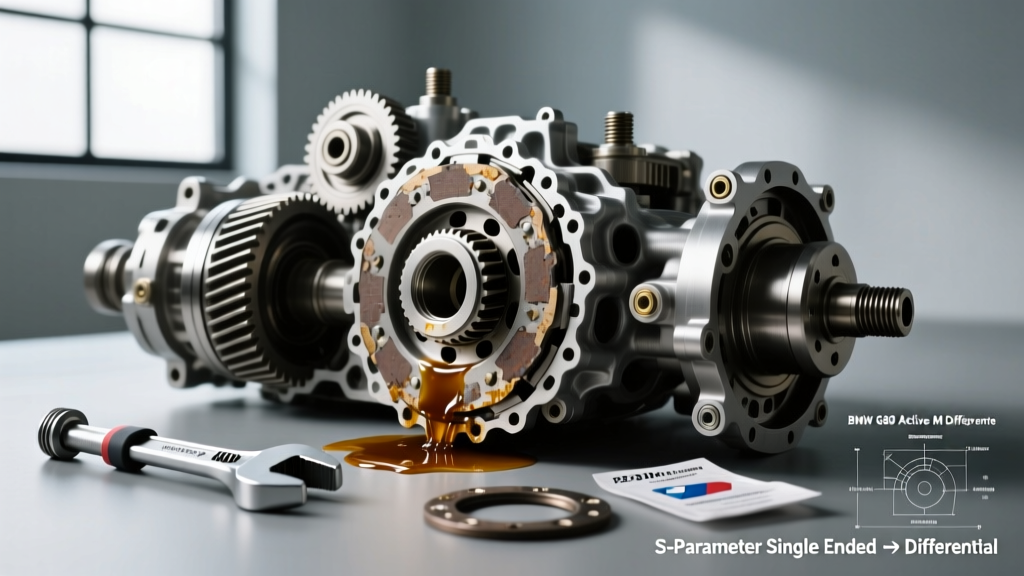
In the modern automotive landscape, the rear axle is no longer just a collection of forged steel gears and bearings; it is a highly sophisticated mechatronic system. The BMW G80 M3 and G82 M4, equipped with the Active M Differential, represent the pinnacle of this evolution. This electronically controlled limited-slip differential utilizes a wet clutch pack and an electromechanical ball-ramp actuator to vector torque across the rear axle in milliseconds. However, this complexity introduces a unique set of challenges for drivetrain technicians in 2026. When diagnosing rear axle issues, professionals must simultaneously address traditional mechanical failures, such as differential fluid leaks, and advanced electrical degradation.
At AutoGearNexus, we emphasize that treating an active differential purely as a mechanical unit is a recipe for misdiagnosis. A fluid leak can lead to low lubricant levels, causing the internal wet clutch pack to overheat and slip. Conversely, a degraded wiring harness can cause the electronic actuator to drop offline, mimicking the exact symptoms of a mechanical failure or severe fluid starvation. This guide provides a comprehensive, model-specific repair protocol for the BMW G80 Active M Differential, covering mechanical leak detection, precision seal replacement, and advanced electrical diagnostics.
Identifying Mechanical Leak Points on the HA5 Housing
The rear differential housing used in the G80 platform (commonly referred to as the HA5 or similar ZF-derived housing) operates under immense thermal and mechanical stress. Fluid leaks typically manifest at three primary locations:
- Pinion Seal: Located at the front of the differential where the driveshaft connects. High rotational speeds and heat cycling frequently cause the nitrile or PTFE lip to harden and weep gear oil onto the exhaust system.
- Output Shaft (Axle) Seals: Located where the half-shafts exit the differential. Lateral suspension movement and minor shaft pitting can compromise the sealing surface.
- Differential Cover Gasket: The rear aluminum cover is sealed with RTV silicone. Improper previous service or excessive crankcase pressure can cause perimeter weeping.
Before initiating any teardown, perform a thorough visual inspection using a UV dye added to the differential fluid. According to SKF Automotive Seal Engineering Guidelines, cleaning the housing with a non-chlorinated brake cleaner and running the vehicle under load for 15 minutes will pinpoint the exact origin of the seepage, preventing unnecessary disassembly of non-faulty components.
Step-by-Step Pinion Seal Replacement Protocol
Replacing the pinion seal on the Active M Differential requires meticulous attention to preload and torque specifications. The pinion nut on these units is typically a yield-type (one-time use) fastener. Reusing the old nut will result in catastrophic pinion bearing preload loss and ring-and-pinion destruction.
Removal Procedure
- Drain the differential fluid by removing the 14mm hex drain plug. Allow the BMW SAF-XJ 75W-85 fluid to drain completely while warm.
- Mark the relationship between the pinion flange and the pinion shaft using a paint pen. This is critical for approximate re-alignment, though final preload is dictated by the torque-to-yield specification.
- Secure the flange using a specialized differential flange holding tool (e.g., BMW tool 331260 or equivalent). Do not use an impact wrench to remove the nut without securing the flange, as the shock load can damage the internal ball-ramp actuator mechanism.
- Remove the pinion flange using a three-jaw gear puller. Never pry the flange off, as this will score the sealing surface and warp the mating face.
- Extract the old pinion seal using a dedicated seal puller, ensuring the internal differential bearing cage is not scored.
Installation and Torque Specifications
Lubricate the new OEM seal (Part # 33121213949 or equivalent Corteco/SKF unit) with fresh differential fluid. Tap the seal into the bore using a seal driver until it sits perfectly flush with the housing face. Reinstall the pinion flange, ensuring the splines are perfectly aligned. Install the new yield pinion nut. The standard ZF torque specification for this application is typically 150 Nm plus an additional 90 degrees of rotation. Always verify the exact specification via BMW TIS (Technical Information System) for your specific VIN, as mid-year production changes can alter hardware requirements.
Advanced Electrical Diagnostics: Ruling Out Actuator Faults
Here is where the 2026 diagnostic workflow diverges from traditional axle repair. A common scenario involves a G80 M3 presenting with an 'Active Differential Lock Malfunction' code, accompanied by rear axle slip under hard cornering. Many technicians immediately assume the wet clutch pack is burnt out due to a micro-leak or internal mechanical failure, leading to a $3,800+ replacement quote for the entire differential assembly.
However, the Active M Differential relies on high-speed data communication (via FlexRay or high-speed CAN-FD) between the DSC (Dynamic Stability Control) module and the differential's electromechanical actuator. The wiring harness routing near the rear axle is subjected to extreme heat from the exhaust and constant vibration. When the shielded twisted-pair wiring degrades, common-mode noise infiltrates the data bus, causing the actuator to drop offline and default to an open-differential state.
To definitively diagnose harness degradation without destroying the loom or tearing down the mechanical unit, top-tier drivetrain electrical engineers utilize a portable Vector Network Analyzer (VNA). By measuring the single-ended impedance of the harness and applying an s-parameter single ended to differential conversion algorithm, technicians can mathematically extract the differential-mode insertion loss and return loss. This advanced RF diagnostic technique proves whether the wiring harness can still support the high-frequency differential signaling required by the active locker. If the s-parameter conversion reveals excessive insertion loss at the bus operating frequency, the issue is a $150 wiring harness repair, not a $4,000 mechanical teardown. As noted in BMWBlog's technical overview of the Active M Differential, the integration of complex electronics means that signal integrity is just as vital as gear oil viscosity.
Differential Cover Service and RTV Application
If the leak originates from the rear differential cover, the repair requires strict adherence to sealing protocols. The G80 Active M Differential does not use a pre-cut rubber gasket for the main cover; it relies on a high-temperature RTV silicone bead.
- Remove the perimeter M8 bolts (Torque spec: 20 Nm).
- Carefully separate the aluminum cover. Beware of the internal shim packs and the proximity of the wet clutch pack wiring connector.
- Clean both mating surfaces with a plastic razor blade and isopropyl alcohol. Any residual oil will compromise the RTV bond.
- Apply a continuous, 3mm bead of BMW-approved RTV (e.g., Loctite 5970 or Drei Bond 1209). Ensure the bead encircles all bolt holes on the inside to prevent RTV debris from breaking off and clogging the internal fluid pickup or actuator cooling galleries.
- Reinstall the cover and tighten the bolts in a crisscross pattern to 20 Nm. Allow the RTV to cure for a minimum of 4 hours before refilling with fluid.
G80 Active M Differential Specifications & Data
Precision is paramount when servicing active differentials. Using the incorrect fluid will destroy the friction modifiers required for the wet clutch pack, resulting in severe shudder during torque-vectoring events.
| Parameter | Specification / Part Number | Notes |
|---|---|---|
| Fluid Type | BMW SAF-XJ 75W-85 | Mandatory for wet clutch friction modifiers |
| Fluid Capacity | ~1.6 Liters (Varies by exact housing) | Fill until fluid weeps from the level plug |
| OEM Fluid Part # | 83222446673 | Do not substitute with generic 75W-90 GL-5 |
| Pinion Seal Part # | 33121213949 | Verify against specific VIN via ETK |
| Cover Bolt Torque | 20 Nm | M8 Aluminum housing thread - do not overtighten |
| Drain/Fill Plug Torque | 60 Nm | Replace crush washers if applicable |
Cost Analysis: Dealership vs. Independent Specialist
Understanding the financial landscape of active differential repair is crucial for shop owners and consumers alike. A dealership will often default to replacing the entire Active M Differential assembly if an internal slip code is detected, citing liability and factory-mandated repair protocols. This can result in invoices exceeding $5,500 when factoring in the $3,800 unit, specialized fluid, and 4 hours of labor.
Conversely, an independent specialist equipped with advanced diagnostic tools—including VNAs for s-parameter signal analysis and factory-level BMW ISTA software—can accurately isolate the fault. A pinion seal replacement, including OEM fluid and yield hardware, typically ranges from $450 to $650. If the s-parameter single ended to differential conversion diagnostic reveals a harness fault, the repair might cost $300 to $500 for a custom shielded loom rebuild. This highlights the immense value of E-E-A-T (Experience, Expertise, Authoritativeness, and Trustworthiness) in modern automotive diagnostics; the right knowledge saves thousands of dollars and keeps high-performance vehicles on the road.
Final Thoughts on 2026 Drivetrain Maintenance
The era of the 'dumb' rear axle is over. The BMW G80 Active M Differential demands a hybrid approach to maintenance, blending old-school mechanical wrenching with aerospace-level electrical diagnostics. Whether you are torqueing a pinion nut to yield or analyzing high-speed data bus integrity, respecting the engineering of these systems is the only path to reliable performance. Always consult the latest OEM technical service bulletins and utilize precision measurement tools to ensure your drivetrain operates exactly as the engineers in Munich intended.