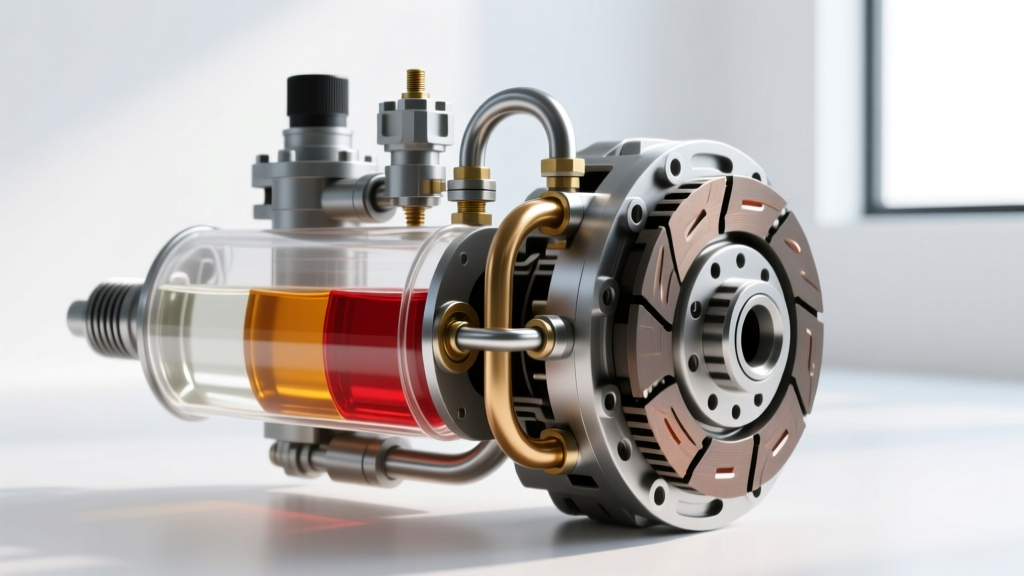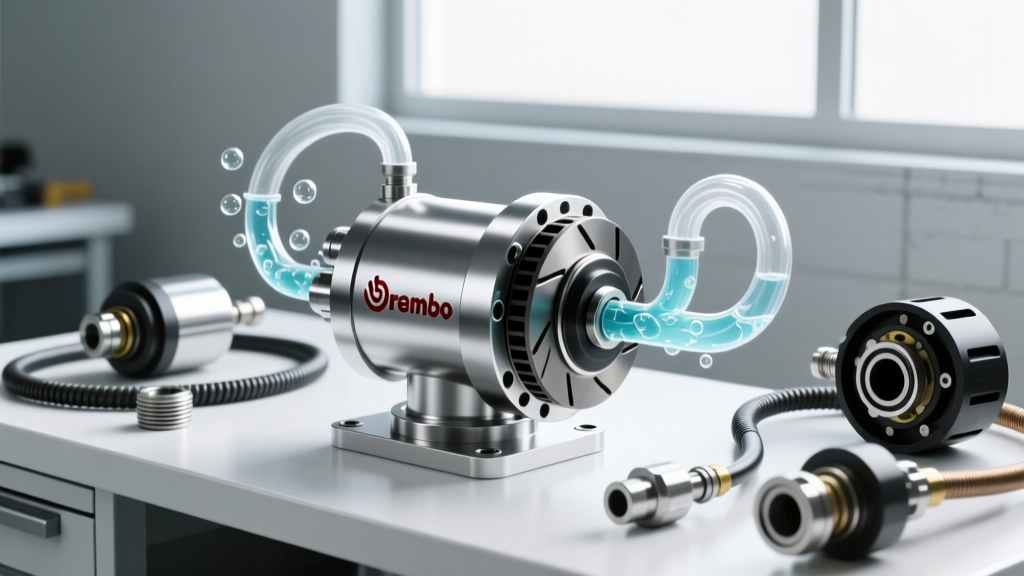
When upgrading to a heavy-duty clutch assembly for a Tremec T56 Magnum, a Porsche G50 transaxle, or a high-torque sequential gearbox, the hydraulic actuation system becomes the critical bottleneck of your drivetrain. A spongy clutch pedal destroys shift quality, accelerates synchro wear, and compromises launch consistency. At the heart of many high-performance and motorsport builds is a Brembo clutch master cylinder (commonly the 15/16" inline or 19mm radial variants). However, even the most precision-machined Italian hydraulics will feel utterly useless if air becomes trapped in the hydraulic lines.
Air in a clutch hydraulic circuit behaves as a compressible gas, absorbing the mechanical energy of your foot before it ever reaches the clutch fork or Concentric Slave Cylinder (CSC). In this expert guide, we break down the physics of hydraulic sponginess, provide a definitive diagnostic matrix, and detail the exact bleeding protocols required to achieve a rock-solid pedal feel in 2026 and beyond.
The Physics of Sponginess: Why Air Invades Brembo Systems
Clutch hydraulic systems operate under extreme thermal and mechanical stress. Unlike brake systems, which benefit from high fluid volume and frequent cycling, clutch circuits often feature long, upward-routed hard lines that act as natural traps for micro-bubbles. Furthermore, DOT 4 and DOT 5.1 polyglycol-based fluids are highly hygroscopic. As they absorb ambient moisture over time, the fluid's boiling point drops. Under the intense heat of the engine bay—particularly near the exhaust headers of a V8 or flat-plane crank V12—localized boiling can occur, creating vapor cavitation inside the slave cylinder or hard lines.
When you install a new Brembo clutch master cylinder, the internal valving and porting are designed for rapid fluid displacement. If the bench-bleeding and line-purging procedures are rushed, microscopic air pockets become wedged in the master cylinder's compensation port or the banjo fitting recesses, leading to a pedal that slowly sinks to the floor during prolonged stops.
Diagnostic Matrix: Air vs. Mechanical Failure
Before attempting to bleed the system for the fourth time, you must verify that air is actually the culprit. Misdiagnosing a mechanical failure as "air in the lines" is the most common mistake amateur builders make. Use the following matrix to isolate the root cause of a soft or inconsistent pedal.
| Symptom Profile | Likely Root Cause | Diagnostic Action |
|---|---|---|
| Pedal feels spongy, pumps up firm but drops after 10 seconds | Air trapped in master cylinder or upward line loops | Perform reverse-bleed; inspect master cylinder porting |
| Pedal is firm initially but slowly sinks to the floor while holding | Internal master cylinder seal bypass or leaking slave cylinder | Check for external fluid leaks; rebuild or replace master cylinder |
| Pedal feels firm but clutch fails to fully disengage | Firewall flex, worn clutch fork pivot ball, or incorrect pushrod length | Measure firewall deflection under load; inspect bellhousing geometry |
| Pedal return is sluggish or hangs near the floor | Collapsed flexible hose, binding pedal box, or weak return spring | Replace rubber flex line with braided stainless; lubricate pedal pivot |
The Bench-Bleed Imperative for 15/16" and 19mm Units
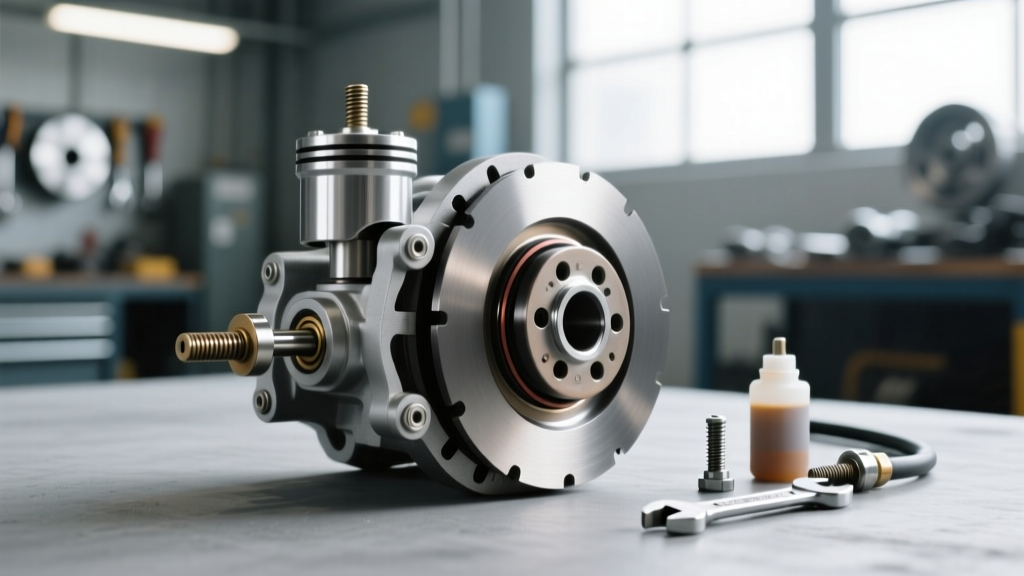
The single most skipped step in hydraulic clutch installation is bench-bleeding the master cylinder. Whether you are using the ubiquitous Brembo 15/16" inline unit (Part # 05.5110.10) or a 19mm radial master cylinder, installing it dry guarantees that air will be pushed into the hard lines, where it is notoriously difficult to extract.
Step-by-Step Bench Bleeding Protocol
- Secure the Unit: Mount the Brembo master cylinder in a vise using soft jaws to avoid scoring the aluminum bore.
- Fill and Cycle: Fill the reservoir with fresh, high-temp DOT 4 fluid. Using a blunt punch or a dedicated bleeding tool, slowly depress the piston. You will see large air bubbles escape from the fluid outlet port.
- Cap and Repeat: Allow the piston to return slowly. Do not let it snap back, as this will draw air back through the compensation port. Repeat until the fluid exiting the port is completely devoid of bubbles.
- Torque the Banjo: When connecting the hard line or braided hose to the master cylinder, always use fresh 10mm ID copper crush washers. Torque the banjo bolt to exactly 18-22 Nm (13-16 lb-ft). Over-torquing can warp the Brembo aluminum housing or strip the threads; under-torquing will cause weeping.
Reverse Bleeding: The Secret to Clutch Line Evacuation
Traditional "pump and hold" bleeding or vacuum bleeding from the reservoir often fails in clutch systems because the slave cylinder is typically located lower than the master cylinder, but the hard lines often route upward over the transmission bellhousing before dropping down. Air naturally rises, meaning it gets trapped in the high points of the line, completely bypassing the suction of a vacuum bleeder at the master cylinder reservoir.
Reverse bleeding forces fluid from the lowest point (the slave cylinder bleeder valve) upward to the master cylinder reservoir, carrying trapped air with it. This is the industry standard for motorsport teams running Tremec and sequential gearboxes.
Expert Tip: When reverse bleeding, use a dedicated reverse bleeder like the Phoenix Systems MaxPro or a modified Motive Products Power Bleeder. Inject the fluid slowly. If you inject too rapidly, you will aerate the fluid inside the lines, creating a micro-foam that is nearly impossible to purge, resulting in a permanently spongy pedal.
The Reverse Bleed Procedure
- Attach the reverse bleeder hose to the slave cylinder bleeder screw (often an 8mm or 10mm hex on aftermarket CSCs and external slaves).
- Open the bleeder screw and slowly inject fresh fluid. Watch the master cylinder reservoir closely to ensure it does not overflow.
- Once clean, bubble-free fluid enters the reservoir, close the bleeder screw.
- Perform 3-4 slow pedal strokes to seat the master cylinder piston and push any remaining micro-bubbles out of the compensation port.
High-Temperature Fluid Selection
The fluid you choose dictates the longevity of your bleed. For high-performance applications, standard OEM DOT 3 fluid is unacceptable due to its low wet boiling point. We recommend upgrading to specialized racing fluids that maintain viscosity under high thermal loads.
| Fluid Brand & Type | Dry Boiling Point | Wet Boiling Point | Best Application |
|---|---|---|---|
| Motul RBF 660 (DOT 4) | 328°C (622°F) | 204°C (400°F) | Track days, time attack, heavy street use |
| Castrol SRF (DOT 4 / Silicone Ester) | 320°C (608°F) | 270°C (518°F) | Endurance racing, extreme heat environments |
| Brembo Sport.EVO 500++ (DOT 4) | 271°C (520°F) | 188°C (370°F) | Aggressive street, canyon carving, OEM+ upgrades |
Advanced Troubleshooting: When the Pedal Still Feels Soft
If you have successfully bench-bled the Brembo master cylinder, reverse-bled the lines with Motul RBF 660, and the pedal still exhibits compliance, you are likely dealing with mechanical deflection rather than hydraulic air.
Firewall Flex and Pedal Box Deflection
Many unibody chassis (notably the Nissan S-chassis, Mitsubishi EVO, and Subaru WRX) suffer from notorious firewall flex. When the heavy-duty pressure plate clamps down, the hydraulic resistance pushes back against the master cylinder, literally bending the sheet metal firewall inward. This absorbs pedal travel. The fix is to install a welded or bolted firewall reinforcement plate, or relocate the master cylinder to a rigid pedal box setup.
Clutch Fork Pivot Ball Wear
In external slave cylinder setups utilizing a traditional clutch fork, the pivot ball and the fork pad are subject to immense friction. If the pivot ball wears a groove into the fork, or if the factory plastic pivot ball shatters, the slave cylinder stroke will be wasted taking up this new mechanical clearance before it ever begins to disengage the clutch. Always upgrade to a hardened steel pivot ball and a bronze fork pad when rebuilding a T56 or TKO transmission bellhousing.
Conclusion
Achieving a flawless, communicative clutch pedal requires more than just bolting on premium hardware. By understanding the hygroscopic nature of brake fluids, strictly adhering to bench-bleeding protocols, utilizing reverse-bleeding techniques, and eliminating mechanical deflection, your Brembo clutch master cylinder will deliver the precise, linear actuation required for high-performance driving. Treat your hydraulic system with the same reverence as your engine's oiling system, and your drivetrain will reward you with flawless shifts for years to come.