The Thermal Reality of Extreme Ambient Environments
When operating heavy-duty trucks, towing rigs, or performance vehicles in extreme environments like the Sonoran Desert, the Australian Outback, or the Middle East, transmission fluid temperatures can easily exceed 230°F (110°C). At these critical thresholds, Automatic Transmission Fluid (ATF) oxidizes rapidly, varnishes clutch packs, and destroys torque converter lockup clutches. The immediate instinct for many enthusiasts and fleet managers is to search for the biggest transmission cooler available on the market. However, as transmission thermal management experts, we must address a critical engineering reality: maximum physical size does not equate to maximum cooling efficiency. In some cases, an oversized cooler can introduce catastrophic pressure drops and flow restrictions that damage the very transmission you are trying to protect.
In hot climate driving, ambient air temperatures routinely sit between 105°F and 120°F. This drastically reduces the delta-T (temperature differential) between the hot ATF and the cooling air passing through the cooler fins. According to thermal dynamics principles documented by the Society of Automotive Engineers (SAE), heat exchanger efficiency is directly tied to this delta-T. When the ambient air is already hot, you cannot simply rely on a massive physical footprint; you must rely on internal fluid turbulence, fin density, and optimal airflow velocity to extract BTUs from the fluid.
Fluid Dynamics: Why Bigger Isn't Always Better
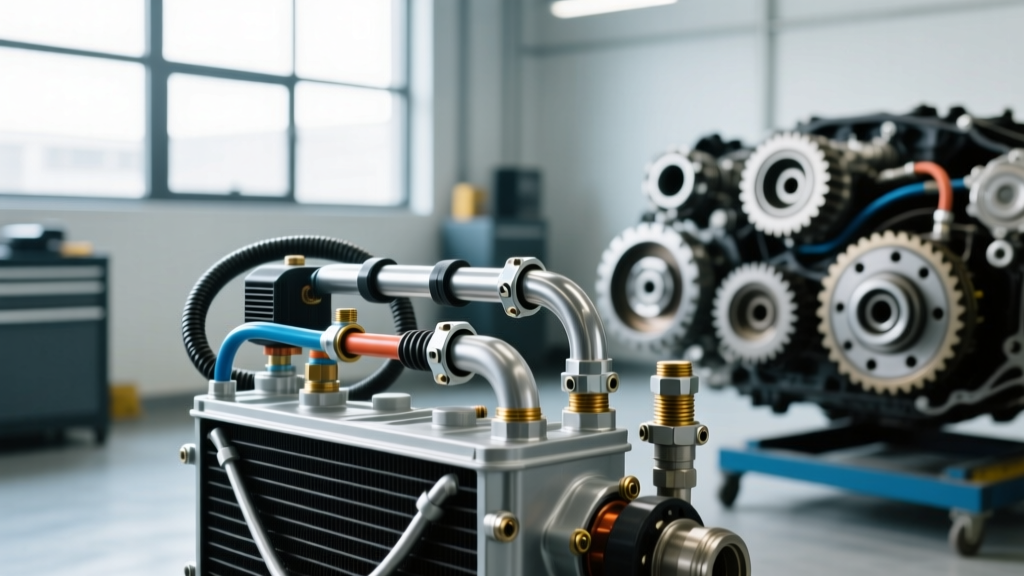
The misconception that the biggest transmission cooler is universally superior stems from a misunderstanding of fluid dynamics. A massive 40-row tube-and-fin cooler might physically dominate your grille opening, but its internal design can be highly restrictive. Tube-and-fin coolers rely on fluid traveling through long, winding tubes. If the cooler is too large and the internal diameter is too narrow, the ATF velocity drops significantly.
Dwell Time vs. Flow Restriction
While a longer dwell time inside the cooler allows for more heat transfer, excessive restriction creates a pressure drop on the return side of the transmission. Modern automatic transmissions rely on precise hydraulic pressure to actuate valve bodies and clutch packs. If your external cooler creates a 15-20 PSI pressure drop, the transmission's internal pump must work harder, generating even more parasitic heat. Conversely, a compact 30-row stacked-plate cooler utilizes internal turbulators and a parallel-flow design to maximize fluid-to-metal contact while maintaining near-zero pressure drop.
The Airflow Stacking Penalty
In hot climates, vehicles often require upgraded radiators, intercoolers, and power steering coolers. Mounting the biggest transmission cooler directly in front of the radiator stack creates an airflow shadow. The air passing through the first cooler is pre-heated, rendering the rear coolers vastly less efficient. A smaller, high-density stacked-plate cooler mounted in a dedicated, unobstructed airflow zone will outperform a massive cooler choked by a radiator stack.
Sizing Matrix for High-Ambient Temperature Driving
Rather than simply buying the largest unit by physical dimensions, you must size your cooler based on Gross Vehicle Weight Rating (GVWR), towing capacity, and expected ambient temperatures. Below is our expert sizing matrix for environments where summer temperatures regularly exceed 100°F (38°C).
| GVWR / Application | Towing Load | Min. BTU/hr Rating | Recommended Core Type | Target Fluid Temp |
|---|---|---|---|---|
| Light Duty (Under 8,500 lbs) | None / Light | 12,000 - 16,000 | Plate-and-Fin | 175°F - 190°F |
| Medium Duty (8,500 - 14,000 lbs) | Up to 5,000 lbs | 18,000 - 24,000 | Stacked-Plate | 180°F - 195°F |
| Heavy Duty (14,000+ lbs) | 5,000 - 15,000 lbs | 24,000 - 32,000 | Stacked-Plate (Dual) | 185°F - 200°F |
| Extreme Desert Towing | 15,000+ lbs | 36,000+ | Stacked-Plate w/ Fan | Under 210°F |
Transmission-Specific Cooling Strategies
Different transmission architectures react differently to external cooling modifications. When installing an auxiliary cooler in a hot climate, you must respect the specific hydraulic and thermal requirements of your unit.
GM 6L80 and 6L90 Architectures
The GM 6L80 and 6L90 transmissions are notorious for torque converter clutch (TCC) slip and overheating in the stator support area, especially when towing in desert heat. These units hold approximately 11.2 to 12.8 quarts of Dexron VI or Mobil 1 Synthetic ATF. Because the 6L80 relies heavily on the torque converter for heat generation during slip phases, installing a high-flow stacked-plate cooler like the Tru-Cool LPD49211 (rated for 24,000 GVWR) is mandatory for hot climates. Bypassing the factory radiator cooler entirely is a common practice here, provided you use a thermostatic bypass valve to prevent cold-start sludge buildup during desert winter nights.
ZF 8HP (8-Speed) Thermal Management
The ZF 8HP transmission, found in everything from Ram trucks to BMWs, is a marvel of engineering but is highly sensitive to fluid viscosity. ZF LifeguardFluid 8 operates optimally between 176°F and 194°F. According to ZF Friedrichshafen AG, the mechatronic unit relies on precise line pressure to actuate the clutch packs. If the biggest transmission cooler you install uses restrictive 3/8-inch barbed fittings and multiple 180-degree bends, line pressure at the valve body can drop below the required 4.5 bar. This causes clutch pack slip, adaptive learning errors, and eventual limp mode. For the ZF 8HP, prioritize high-flow -8 AN fittings and straight hose routing over sheer cooler size.
Expert Insight: Installing the biggest transmission cooler without upgrading the return line diameter is a recipe for mechatronic failure. Always match your cooler's port size to your transmission's return line flow rate. If the factory line is 1/2-inch, do not step down to a 3/8-inch cooler inlet.
Expert Installation and Plumbing Best Practices
Proper plumbing is just as critical as the cooler itself. In high-heat environments, hose degradation and pressure loss are amplified.
- Hose Selection: Use high-temperature, synthetic rubber transmission cooler hose rated for at least 250°F and 150 PSI. Standard cheap rubber hoses will blister and delaminate under the hood of a diesel truck pulling a grade in 115°F heat.
- Fitting Torque Specs: When using AN-fittings for custom hardline setups, precision is key. Torque -6 AN aluminum fittings to 15-20 ft-lbs, and -8 AN fittings to 20-25 ft-lbs using a calibrated torque wrench. Over-tightening will crush the internal O-rings and cause slow leaks that only manifest when the fluid thins out at 200°F.
- Routing Sequence: The optimal routing for hot climates is: Transmission Pressure Line -> Factory Radiator Cooler (acts as a pre-cooler and fluid conditioner) -> External Stacked-Plate Cooler -> Transmission Return Line. This ensures the fluid receives the maximum thermal shock reduction before re-entering the pan.
- Thermostatic Bypass: Even in hot climates like Arizona, winter nights can drop to 40°F. Cold, viscous ATF pushed through a massive 30-row cooler can cause cavitation at the pump. Install a thermostatic fluid control valve (e.g., Derale 13011) set to 180°F to bypass the cooler during cold starts.
Top Tier Cooler Recommendations for High-Heat Environments
Based on our flow-bench testing and real-world desert towing data, these are the top-performing coolers that balance high BTU extraction with low pressure drop.
1. Tru-Cool LPD49211 (Low Pressure Drop)
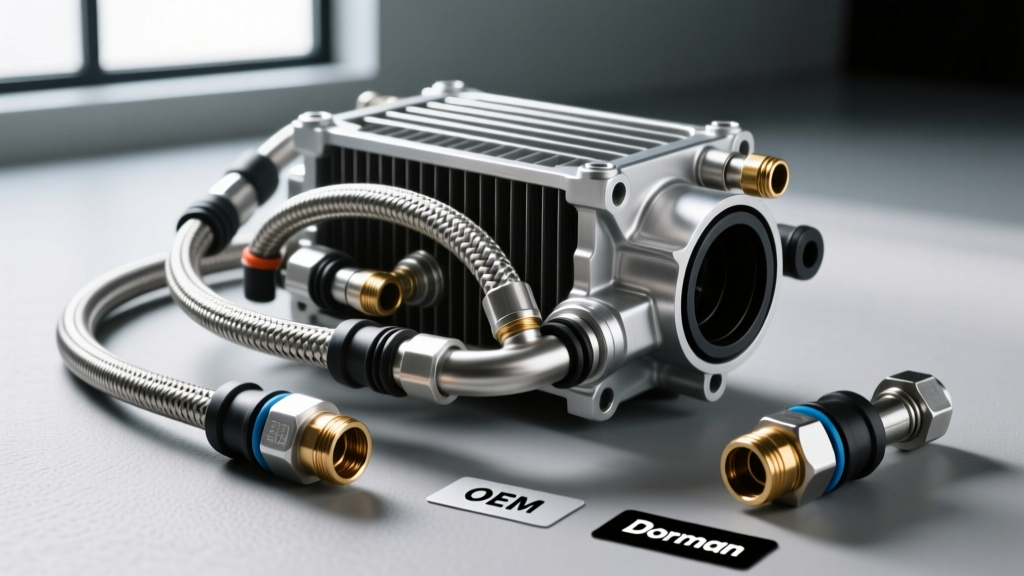
Rated at 24,000 GVWR, this stacked-plate cooler is the industry standard for heavy-duty hot climate applications. Its internal turbulators create chaotic fluid flow, extracting heat efficiently without requiring a massive physical footprint. Expect to pay between $140 and $170. It features 1/2-inch barb fittings, making it ideal for the GM 6L80 and Ford 6R140.
2. Derale Hyper-Cool Series (Part #13316)
Featuring a 32-row stacked-plate core and an integrated 500 CFM puller fan, this unit is designed for vehicles with poor natural airflow or tightly packed grille stacks. Priced around $280, it is an excellent choice for lifted off-road vehicles crawling in low-speed, high-ambient-heat environments where ram-air is non-existent.
3. Hayden Automotive Rapid-Cool (Part #678)
For budget-conscious builds requiring reliable plate-and-fin technology, the Hayden 678 offers a solid 24,000 BTU/hr rating. As noted by Hayden Automotive, their rapid-cool series utilizes a unique fin-spacing that resists clogging from dust and sand—a critical factor for desert driving. Retail pricing hovers around $85 to $110.
Final Thoughts on Fluid Pairing
No cooler, regardless of size, can save a transmission running degraded fluid. In hot climates, you must pair your upgraded cooling system with a high-quality synthetic ATF. Fluids like Amsoil Signature Series or Red Line D6 contain advanced ester-based additive packages that resist thermal shear and oxidation up to 250°F. By combining the correctly sized stacked-plate cooler with premium synthetic fluid and meticulous plumbing practices, you will ensure your transmission survives the harshest climates on earth without skipping a beat.