The Hidden Economics of Torque Converter Bearing and Seal Failures
When a heavy-duty diesel truck experiences a torque converter failure, the immediate assumption often points to the clutch material or the fin angle. However, as transmission specialists heading into 2026, we see a massive percentage of catastrophic failures originating from two seemingly minor components: the stator support bearings and the turbine hub seals. When these components fail, the cost is never just the price of a $15 seal or a $30 Torrington bearing. The true cost lies in the Remove and Replace (R&R) labor, the specialized fluids, and the inevitable collateral damage to the transmission input shaft or front pump.
In this comprehensive cost analysis, we break down the financial impact of torque converter bearing and seal issues. More importantly, we evaluate whether investing in a premium upgrade, such as a banks billet torque converter, provides a measurable return on investment compared to dropping in a standard OEM remanufactured unit.
Anatomy of the Failure: Bearings and Seals Under Load
To understand the repair costs, you must first understand the mechanical environment inside the converter. In high-torque applications like the Allison 1000 (paired with the Duramax) or the 68RFE (paired with the 6.7L Cummins), the torque converter is subjected to immense axial and radial forces.
Stator Support Bearings and Bushings
The stator assembly rides on the stator support tube extending from the transmission front pump. It relies on Torrington thrust bearings and specialized bushings to manage axial loads during the stall and coupling phases. When lubrication is starved—often due to a failing seal or degraded fluid viscosity—these bearings overheat, score the support tube, and send metallic debris directly into the transmission cooler and valve body. A $40 bearing failure quickly evolves into a $4,000 complete transmission rebuild.
Turbine Hub Seals and TCC Apply Rings
The turbine hub seals against the stator support to maintain the hydraulic pressure required for the Torque Converter Clutch (TCC) lockup. Modern heavy-duty trucks utilize PTFE (Teflon) or Viton O-ring seals. If the converter cover flexes under heavy towing loads, the turbine hub wobbles microscopically. This harmonic vibration acts like sandpaper, wearing out the seal and scoring the hardened stator support tube. The result is TCC slip, severe shudder, and burnt transmission fluid.
The Flex Factor: Why Standard Rebuilds Fail Prematurely
Why do bearing and seal issues keep recurring even after a fresh replacement? The culprit is usually the converter cover itself. Standard OEM remanufactured torque converters utilize stamped steel covers. When subjected to the 800+ lb-ft of torque common in tuned 2026 diesel trucks, these stamped covers flex and distort. This flexing misaligns the internal bearings and destroys the turbine hub seals in as little as 30,000 miles.
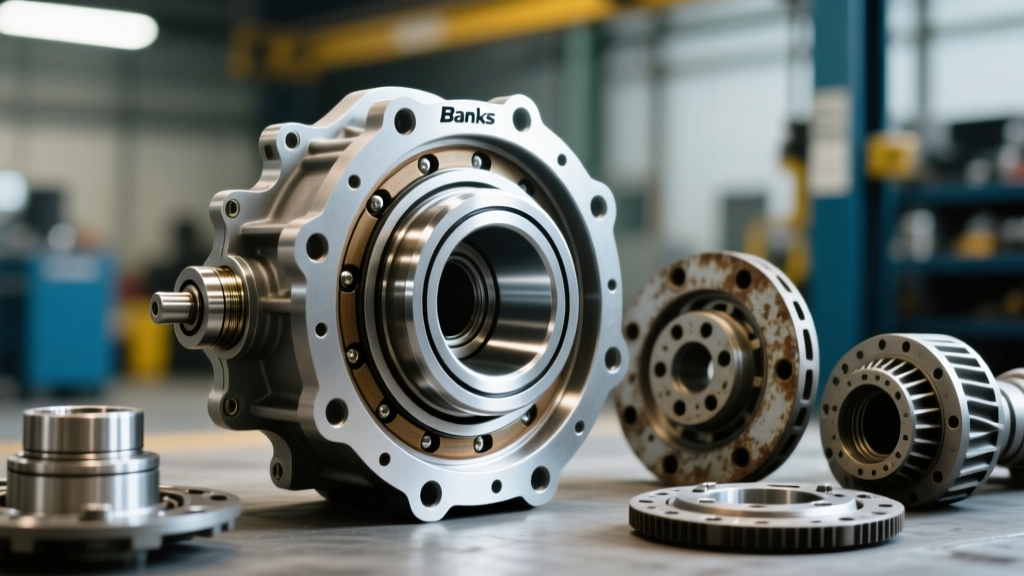
This is where the engineering of a Banks billet torque converter alters the financial equation. By utilizing a CNC-machined 6061-T6 billet aluminum or billet steel cover, the unit exhibits near-zero flex under extreme load. The rigid cover ensures that the internal Torrington bearings remain perfectly aligned and the PTFE hub seals maintain a flawless, concentric mating surface with the stator support tube. You are not just paying for stronger clutch material; you are paying for the dimensional stability required to make bearings and seals last.
2026 Cost Breakdown: OEM Reman vs. Billet Upgrade
Let us look at the hard numbers. The following table compares the component and replacement costs of a standard OEM remanufactured unit versus a premium billet upgrade when addressing bearing and seal failures.
| Cost Factor / Component | Standard OEM Remanufactured | Premium Billet Upgrade (e.g., Banks) |
|---|---|---|
| Torque Converter Unit Cost | $450 - $650 | $950 - $1,350 |
| Cover Material & Rigidity | Stamped Steel (Prone to Flex) | CNC Billet Steel/Aluminum (Zero Flex) |
| Bearing Quality | Standard Replacement Torrington | Heavy-Duty Upgraded Thrust Bearings |
| Hub Seal Material | Standard PTFE / Viton | Precision-Machined Seal Grooves |
| Expected Seal/Bearing Lifespan | 40,000 - 70,000 Miles (Tuned) | 150,000+ Miles |
| Core Charge Requirement | $150 - $250 | $200 - $350 |
Labor, Fluid, and Ancillary Expenses
The torque converter itself is only a fraction of the invoice. Replacing a failed converter bearing or seal requires pulling the transmission. In 2026, shop labor rates for heavy-duty diesel work average between $145 and $185 per hour.
- R&R Labor: Dropping an Allison 1000 or 68RFE in a 4WD truck requires removing the transfer case, crossmembers, and exhaust components. Book time averages 7.2 to 8.5 hours. At $165/hr, expect to pay $1,188 to $1,402 in labor alone.
- Transmission Fluid: These systems hold 12 to 14 quarts of specialized fluid (e.g., TES-295 approved synthetic or ATF+4). At $20 to $28 per quart, fluid costs add $280 to $392.
- Ancillary Seals: Any competent shop will replace the transmission front pump seal, the rear main seal, and the pilot bearing while the assembly is out. Add $85 to $120 for these miscellaneous parts.
- Flexplate Inspection: If a bearing seized, it likely warped the flexplate. A new OEM flexplate and hardware (torqued to 37 lb-ft with Loctite on Allison applications) adds $180 to $250.
Total Out-the-Door Cost: A standard OEM replacement job will cost roughly $2,200 to $2,500. Upgrading to a Banks billet unit pushes the initial invoice to $2,700 to $3,100.
Diagnostic Guide: Catching Seal and Bearing Issues Early
Catching these failures before they destroy the front pump or input shaft is critical to keeping your labor costs confined to a simple R&R rather than a full transmission rebuild. According to Sonnax transmission engineering guidelines, hydraulic leaks and bearing degradation present specific symptoms.
Symptoms of Bearing Failure
- Neutral Whine or Growl: A distinct metallic growl that changes pitch with engine RPM while in Park or Neutral. This indicates the stator bearing is starved of lubrication and is physically grinding against the support tube.
- Harmonic Vibration at Stall: As the bearing loses its tolerance, the impeller and turbine can make physical contact, causing a severe shudder when the brake is applied and the throttle is blipped.
- Glitter in the Pan: If you drop the transmission pan and find fine, copper-colored or silver glitter on the magnets, the stator bushing or thrust bearing is actively disintegrating.
Symptoms of Seal Failure
- TCC Slip Codes: Codes such as P0741 (Torque Converter Clutch System Stuck Off) or P0299 (Turbo Underboost, often related to TCC slip on modern diesels) indicate the hub seal is leaking apply pressure.
- Highway Speed Shudder: A rhythmic shaking between 45 and 65 MPH under light throttle. The seal is failing to maintain the hydraulic boundary, causing the clutch to rapidly engage and disengage.
- Delayed Engagement: Leaking internal seals can bleed off line pressure, resulting in a sluggish 2-to-3 second delay when shifting from Park to Drive.
The Verdict: Calculating Long-Term ROI
When viewed through the narrow lens of a single repair invoice, a standard OEM remanufactured torque converter appears to be the budget-friendly choice. However, the Allison Transmission service network and independent diesel specialists universally agree: the root cause of repeated seal and bearing failures is converter cover flex.
If you are driving a stock, un-tuned truck that strictly tows within factory limits, an OEM unit with fresh Torrington bearings and PTFE seals will likely survive. But if you have added tuning, larger injectors, or frequently tow heavy fifth-wheel trailers through mountain passes, the stamped steel cover of an OEM unit will flex. It will destroy the new hub seal, and you will be paying that $1,400 R&R labor charge all over again in 40,000 miles.
Investing the extra $500 to $700 upfront for a rigid, precision-machined billet torque converter eliminates the flex that kills bearings and seals. In the heavy-duty diesel world, the cheapest repair is the one you only have to pay for once. Upgrading to a billet unit is not just a performance modification; it is a calculated financial defense against the staggering labor costs of modern drivetrain repair.