The Drivetrain Multiplier: What Are Gear Ratios?
When planning a power-adder, suspension lift, or larger tire upgrade, enthusiasts frequently ask, "what are gear ratios and why do they dictate my build?" In the simplest terms, your axle gear ratio (or final drive ratio) is the mechanical multiplier between your transmission's output shaft and the drive wheels. It determines how many times the driveshaft must rotate to turn the wheels exactly one time. A 4.10 ratio means the driveshaft spins 4.10 times for every single wheel revolution, providing massive low-end torque multiplication at the expense of high-RPM highway cruising.
Understanding your baseline is non-negotiable before modifying a vehicle. If you install 35-inch tires on a truck with 3.08 highway gears, you will effectively neuter the engine's torque curve, causing modern transmissions to hunt for gears and overheat. This performance and upgrade guide will walk you through precise axle ratio identification methods, transmission interplay, and the exact hardware specs required for a successful re-gear.
3 Definitive Methods for Axle Ratio Identification
Before ordering a new ring and pinion set, you must verify your current differential setup. Do not rely on previous owner claims; verify the hardware using one of these three methods.
1. Decoding Factory Tags and RPO Codes
The least invasive method is checking factory documentation. For General Motors trucks and SUVs, locate the Service Parts Identification sticker in the glovebox. Look for specific RPO (Regular Production Option) codes:
- GU4: 3.08 Ratio
- GU6: 3.42 Ratio
- GT4: 3.73 Ratio
- GT5: 4.10 Ratio
For Ford vehicles (like the F-150 or Mustang), check the driver's side door jamb sticker for the "AXLE" code. A two-digit code like "27" typically denotes a 3.31 open differential, while a code like "3L73" indicates a 3.73 ratio with a Limited Slip differential (the 'L' denotes locking/limited slip). Always cross-reference these codes with a manufacturer database, as codes can shift between model years.
2. The Driveshaft Spin Test
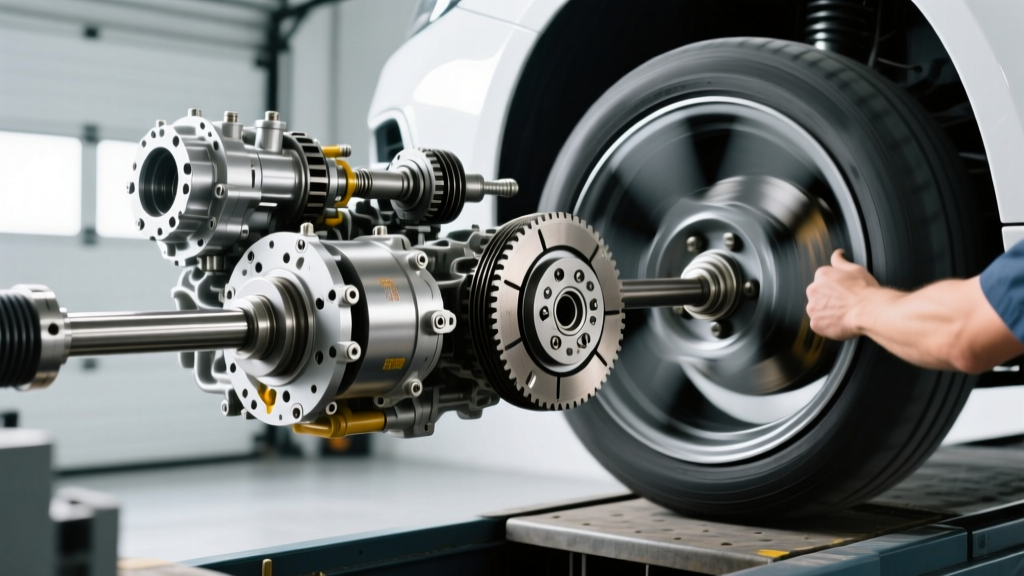
If the differential has been swapped or the tags are missing, the tire spin method is highly accurate. Safely elevate the drive axle so both tires are off the ground. Place a piece of tape on the driveshaft and another at the 12 o'clock position on the tire.
- For Limited Slip / Locking Differentials: Rotate one tire exactly one full revolution (360 degrees) and count the driveshaft rotations. If it turns roughly 3.75 times, you have a 3.73 gear set.
- For Open Differentials: You must rotate the tire exactly two full revolutions (or lock the opposite wheel from turning) and count the driveshaft rotations for one effective wheel turn. If you only spin it once on an open diff, you must multiply your driveshaft count by two.
3. Ring Gear Stamping Verification
The most foolproof method requires removing the differential cover. Drain the fluid and inspect the outer edge of the ring gear. Manufacturers stamp the exact tooth count directly into the steel. According to engineering standards from Dana Incorporated, you will typically see two numbers separated by a space or slash, such as "41 11". Simply divide the ring gear teeth (41) by the pinion gear teeth (11) to get your exact ratio (3.727, commonly sold as 3.73).
Transmission Interplay: ZF 8HP, 6L80, and 4L60E
Your axle ratio does not operate in a vacuum; it must be paired correctly with your transmission's overdrive ratios. Modern automatics feature incredibly deep overdrives to meet CAFE fuel economy standards, which drastically alters your ideal final drive target.
| Transmission Model | Top Gear (Overdrive) | Ideal Axle (Stock Tires) | Ideal Axle (35" Tires) |
|---|---|---|---|
| ZF 8HP (Ram/Challenger) | 0.67:1 (8th) | 3.08 - 3.21 | 4.10 - 4.56 |
| GM 6L80 (Trucks/Camaro) | 0.67:1 (6th) | 3.23 - 3.42 | 4.10 - 4.30 |
| GM 4L60E (Older GM) | 0.70:1 (4th) | 3.73 - 4.10 | 4.88 - 5.13 |
As highlighted by drivetrain experts at Tremec, pairing a steep 4.56 axle ratio with a ZF 8HP transmission's 0.67 overdrive results in a highly manageable highway RPM, whereas keeping a 3.08 axle with 35-inch tires will force the ZF transmission to constantly downshift out of 8th gear on mild inclines, destroying fuel economy and increasing transmission fluid temperatures.
The Re-Gear Blueprint: Parts, Torque Specs, and Costs
Once you have completed your axle ratio identification and selected your new target, it is time to source hardware. A proper re-gear requires more than just the ring and pinion; it requires a master install kit and precision setup tools.
Hardware and Pricing Breakdown
For a popular application like the Ford 8.8-inch rear end, a high-quality 4.10 gear set (such as the Yukon Gear YG F8.8-410) will cost between $230 and $280. According to Yukon Gear & Axle, pairing this with a Master Overhaul Kit (including Timken bearings, seals, and shims) adds another $100 to $140. Professional installation and setup labor typically ranges from $600 to $900 per axle, bringing the total cost for a rear-only re-gear to roughly $950 - $1,350.
Critical Torque Specifications
Setting up a differential requires strict adherence to torque specs and bearing preload measurements. Guesswork will result in catastrophic gear whine or immediate failure.
- Ring Gear Bolts: Typically 75-85 lb-ft. Always apply Red Loctite 271 and torque in a crisscross pattern to prevent warping the ring gear.
- Pinion Nut (Crush Sleeve): This is where most DIYers fail. On a Ford 8.8, the pinion nut must be tightened to roughly 200-250 lb-ft to crush the internal steel sleeve and achieve proper bearing preload (measured in inch-pounds of rotational drag, usually 15-25 in-lbs for new bearings).
- Pinion Nut (GM 10-Bolt): Generally requires 150-200 lb-ft to achieve the target 15-25 in-lbs of rotational preload.
Expert Upgrade Tip: If you are building a drag car or a heavy off-roader, discard the factory crush sleeve. Install a solid pinion spacer (like the Ratech 4110 for the Ford 8.8). Solid spacers eliminate the risk of the crush sleeve over-compressing during hard launches, which instantly destroys pinion bearing preload and shatters the ring and pinion teeth.
Calculating Effective Final Drive for Larger Tires
If your performance upgrade involves larger tires, your physical gear ratio remains the same, but your effective gear ratio changes drastically. To calculate your new effective ratio, use this formula:
(Old Tire Diameter / New Tire Diameter) x Original Gear Ratio = Effective Gear Ratio
For example, if your truck originally sat on 31-inch tires with a 3.73 axle ratio, and you upgrade to 35-inch mud-terrains:
(31 / 35) x 3.73 = 3.30 Effective Ratio
Your truck now drives as if it has 3.30 highway gears, completely sapping your acceleration. To restore the factory performance feel, you would reverse the math to find the ideal physical gear set to install, which in this scenario points directly to a 4.10 or 4.30 ring and pinion upgrade.
Final Thoughts on Drivetrain Optimization
Understanding what are gear ratios and how they interact with your specific transmission and tire package is the hallmark of a well-planned build. Whether you are decoding an RPO tag in a Chevy glovebox or measuring rotational drag on a Ford 8.8 pinion nut, precision in identification and installation ensures your power actually makes it to the pavement. Always invest in high-grade bearings, respect the torque specs, and calculate your final drive before turning a single wrench.