The Architectural Divide: AWD vs 4WD Systems Explained
When discussing drivetrain layouts, the terms All-Wheel Drive (AWD) and Four-Wheel Drive (4WD) are frequently—and incorrectly—used interchangeably by casual drivers. However, from a preventive maintenance and engineering standpoint, the mechanical differences between these two configurations dictate entirely distinct service intervals, fluid specifications, and failure modes. As we navigate the evolving automotive landscape in 2026, understanding these distinctions is critical for avoiding catastrophic component failure.
According to Car and Driver's comprehensive drivetrain breakdown, AWD systems are typically full-time, computer-controlled setups designed to optimize traction on varied pavement conditions by dynamically vectoring torque via wet-clutch packs or planetary gearsets. In contrast, traditional 4WD systems utilize a dedicated transfer case with a mechanical lock (often a dog clutch or chain-driven mechanism) intended for low-traction, off-road environments, and usually feature a neutral gear for flat-towing.
Expert Insight: The most costly drivetrain repairs occur when owners treat AWD wet-clutch systems like traditional 4WD mechanical lockers, or when they neglect the severe thermal degradation of specialized transfer case fluids in high-heat environments.
BMW xDrive (AWD) Architecture and the ATC Transfer Case
BMW’s xDrive system is a hallmark of modern AWD engineering. Rather than a mechanical locking mechanism, xDrive relies on an electronically controlled wet-clutch pack housed within the ATC (Active Transfer Case) series—commonly the ATC35L or ATC45L depending on the chassis (e.g., F15 X5, G05 X5, or G30 5 Series). The VTG (Variable Torque Generation) system uses a stepper motor and a reduction gear to squeeze the clutch pack, seamlessly shifting torque from 0:100 (front:rear) up to 50:50 in milliseconds.
Because the clutch pack operates under immense friction and heat, the fluid is not merely a lubricant; it is a vital friction modifier. Neglecting this fluid leads to clutch glazing, shuddering under acceleration, and eventually, the stripping of the internal actuator gear.
Traditional 4WD: Part-Time and Full-Time Systems
Conversely, traditional 4WD systems, such as the NV241OR found in heavy-duty off-road applications, utilize a heavy-duty roller chain and a mechanical dog clutch to lock the front and rear output shafts together. Maintenance here focuses on chain stretch prevention, bearing lubrication, and ensuring the encoder motor that shifts the system into 4-High or 4-Low remains free of moisture and corrosion.
The 85201 Climate Factor: Thermal Degradation in Mesa, AZ
For owners searching for BMW drivetrain repair 85201 services, the local environment plays a massive role in preventive maintenance schedules. The 85201 zip code (Mesa, Arizona) experiences extreme summer ambient temperatures regularly exceeding 110°F (43°C). When combined with stop-and-go traffic and the radiant heat from the exhaust system, undercarriage temperatures can easily push transfer case fluid past 230°F (110°C).
At these temperatures, standard aftermarket automatic transmission fluids (ATF) will rapidly oxidize and lose their friction-modifying properties. BMW specifies a highly proprietary fluid for the xDrive transfer cases to combat this, and deviating from it in high-heat climates is a primary catalyst for premature actuator failure.
Preventive Maintenance Matrix: AWD vs 4WD
Below is a comparative matrix detailing the critical preventive maintenance parameters for modern AWD systems (specifically BMW xDrive) versus traditional part-time 4WD systems.
| Parameter | BMW xDrive (AWD - ATC45L) | Traditional 4WD (e.g., NV241OR) |
|---|---|---|
| Primary Fluid Type | Shell TF0870 (BMW P/N 83222446673) | ATF+4 or NVG 246 Transfer Case Fluid |
| Fluid Capacity | 0.6L - 0.8L | 2.0L - 2.5L |
| Service Interval (Normal) | Every 60,000 miles | Every 50,000 miles |
| Service Interval (Severe/85201 Heat) | Every 30,000 - 40,000 miles | Every 30,000 miles |
| Common Failure Point | Delrin Actuator Gear Stripping / Wet Clutch Glazing | Drive Chain Stretch / Encoder Motor Corrosion |
| Drain/Fill Plug Torque | 30 Nm (22 lb-ft) | 20-25 Nm (15-18 lb-ft) |
Step-by-Step xDrive Transfer Case Preventive Service
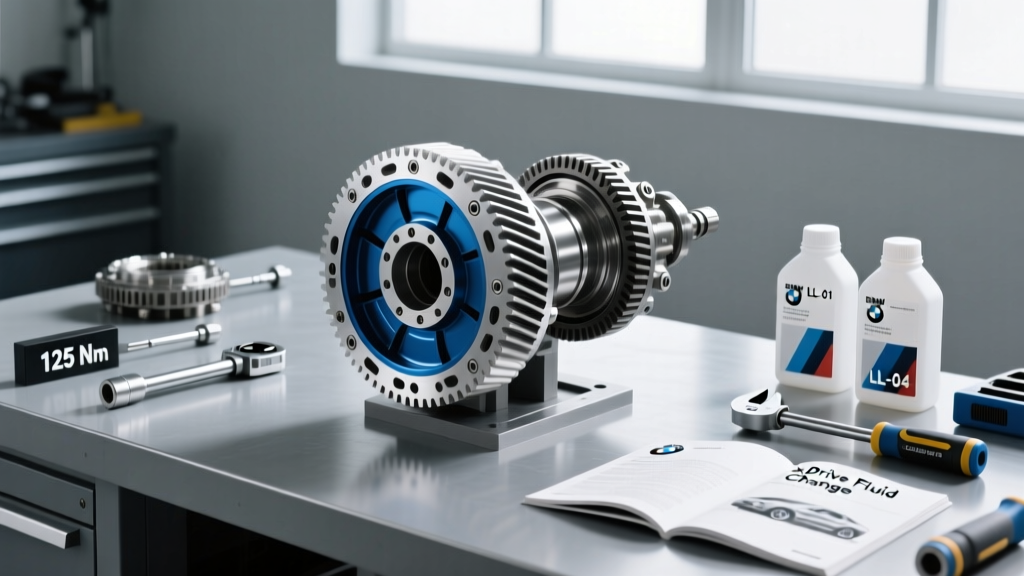
Performing a drain and fill on a BMW xDrive transfer case is a straightforward procedure, but it requires strict adherence to OEM specifications. Sourcing OEM fluids from reliable suppliers like FCP Euro's OEM fluid catalog is highly recommended to avoid counterfeit friction modifiers.
Fluid Specifications and Torque Requirements
- Vehicle Preparation: Raise the vehicle on a level lift. The transfer case must be perfectly level to ensure an accurate fill volume. Allow the exhaust system to cool to prevent burns, as the ATC is positioned directly adjacent to the mid-pipe.
- Drain Procedure: Locate the drain plug on the lower rear of the ATC housing. Using an 8mm hex bit, remove the plug. Expect to drain approximately 0.5L to 0.7L of fluid. Inspect the magnetic plug for excessive metallic particulate; a fine grey paste is normal, but chunky shavings indicate internal bearing or chain failure.
- Reinstall and Torque: Clean the drain plug and reinstall it. Torque to exactly 30 Nm (22 lb-ft). Over-torquing can crack the aluminum casing, leading to a $4,500+ replacement bill.
- Fill Procedure: Remove the upper fill plug (also 8mm hex). Using a pneumatic or manual fluid transfer pump, inject the Shell TF0870 fluid until it begins to weep out of the fill hole.
- Calibration: Reinstall the fill plug (30 Nm). Crucially, you must use a bi-directional OBD2 scan tool (such as ISTA/D or an advanced Autel/Snap-on scanner) to perform the Transfer Case Oil Wear Reset. Failing to reset the adaptation values will cause the ECU to assume the fluid is still degraded, altering clutch clamping pressures and accelerating wear.
Recognizing Early Drivetrain Failure Symptoms
Preventive maintenance is only effective if you can identify the early warning signs of component degradation before a total failure occurs. Whether you are driving an AWD BMW X5 or a traditional 4WD truck, the drivetrain will communicate its distress through specific mechanical feedback.
The 'Drivetrain Malfunction' Warning and Actuator Gear Wear
In BMW xDrive models, the most notorious failure point is the 18-tooth Delrin (plastic) gear inside the VTG actuator motor. As the transfer case fluid degrades and the wet clutches begin to slip, the ECU commands the stepper motor to apply more clamping force. This excessive load causes the plastic gear to strip. When this happens, the vehicle will throw a '4x4 System Malfunction' or 'Drivetrain Malfunction' code on the iDrive display, and the vehicle will default to 100% rear-wheel drive.
Preventive Action: By swapping the TF0870 fluid every 35,000 miles in extreme heat zones like the 85201 area, you maintain optimal clutch friction coefficients. This prevents the ECU from overworking the stepper motor, thereby saving the Delrin gear from premature stripping. If the gear does strip, a preventive repair kit (replacing just the $45 Delrin gear) is vastly superior to the dealer's standard protocol of replacing the entire $3,800 transfer case assembly.
Traditional 4WD: Chain Stretch and Binding
In traditional 4WD systems, the warning signs are more visceral. A worn transfer case chain will exhibit 'slamming' or 'clunking' when shifting from 2WD to 4WD, as the chain has stretched and skipped a tooth on the drive sprocket. Furthermore, if you operate a part-time 4WD system on dry pavement, the lack of a center differential will cause drivetrain binding, leading to catastrophic failure of the U-joints or the transfer case output shaft. Preventive maintenance here involves not just fluid changes, but strictly adhering to the operational limitations of the hardware.
Differential Maintenance: The Forgotten Drivetrain Components
No AWD or 4WD guide is complete without addressing the front and rear differentials. The transfer case splits the torque, but the differentials manage the lateral wheel speed variances.
- BMW xDrive Differentials: Typically require a 75W-90 Hypoid Gear Oil (e.g., BMW SAF-XO). Capacity is usually between 0.7L and 1.2L per axle. These should be serviced concurrently with the transfer case.
- 4WD Locking Differentials: If equipped with an electronic or air locker (e.g., ARB or Eaton E-Locker), the differential cover must be removed to inspect the wiring harness routing and ensure the locker mechanism is not binding due to contaminated gear oil.
Final Thoughts on Drivetrain Longevity
Whether you are managing the sophisticated wet-clutch vectoring of a modern BMW AWD system or the rugged chain-driven mechanics of a traditional 4WD truck, the philosophy of preventive maintenance remains identical: fluid is the lifeblood of the drivetrain. By respecting the severe-service intervals dictated by extreme climates, utilizing exact OEM fluid formulations, and adhering to precise torque specifications, you can easily push your drivetrain components well past the 200,000-mile mark without requiring major surgical intervention.