Understanding the Lexus FWD Architecture and Warranty Boundaries
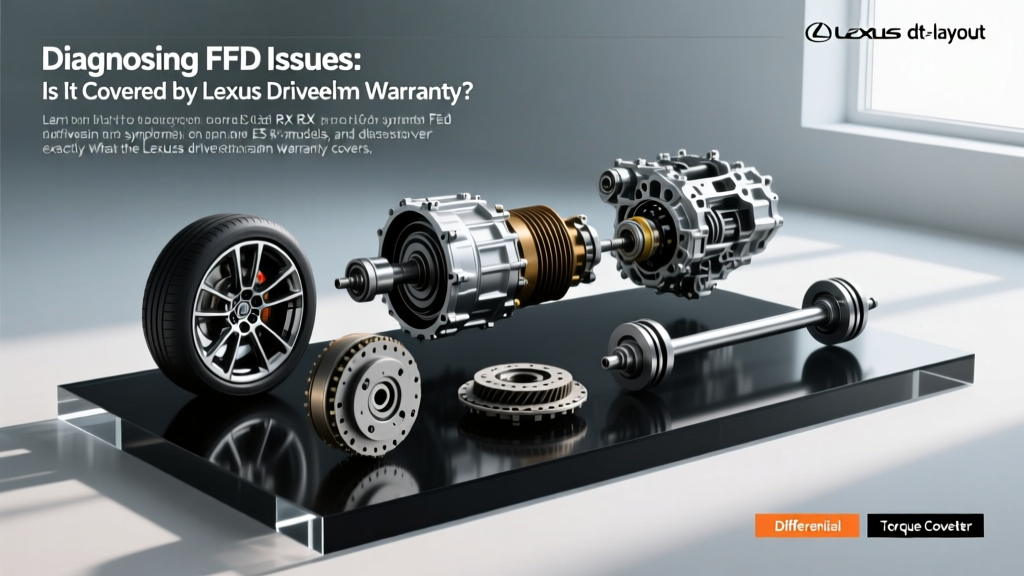
While Lexus built its legacy on rear-wheel-drive sedans and body-on-frame SUVs, a significant portion of the modern 2026 Lexus lineup relies on sophisticated front-wheel-drive (FWD) architectures. Models built on the TNGA-K platform—such as the Lexus ES350, UX200, and FWD variants of the RX and NX—utilize complex transaxle assemblies that integrate the transmission, differential, and final drive into a single housing. When these components fail, owners are often left wondering if the repair will be covered under the Lexus drivetrain warranty or if they will face a massive out-of-pocket expense.
Diagnosing FWD drivetrain symptoms requires a methodical approach to distinguish between catastrophic internal transaxle failures (which are typically covered) and external wear items like torn CV boots or degraded intermediate shaft bearings (which often spark warranty disputes). In this guide, we break down the exact diagnostic procedures, torque specifications, and OEM part data you need to troubleshoot FWD Lexus models and navigate warranty claims successfully.
Anatomy of the TNGA-K FWD Drivetrain
Before pulling out the pry bars and stethoscopes, it is critical to understand what is actually spinning the front wheels. The FWD Lexus lineup primarily uses two distinct transaxle families:
- The U880F 8-Speed Automatic Transaxle: Found in the ES350 and RX350 FWD models. It features an integrated front differential and relies on Toyota WS ATF fluid. Dry fill capacity is approximately 6.5 liters, while a standard drain and fill yields about 3.2 liters.
- The K120 Direct Shift-CVT: Exclusive to the UX200. This unit features a physical 'launch gear' to eliminate belt slip under heavy acceleration before seamlessly transitioning to the steel belt and pulley system at higher speeds.
Power exits the transaxle differential and is transferred to the wheels via half-shafts (CV axles). On V6 applications like the ES350, the passenger side utilizes an intermediate shaft with a center support bearing to equalize axle lengths, effectively mitigating torque steer under hard acceleration.
Symptom Diagnosis: Top 3 FWD Drivetrain Failures
1. Clicking and Popping on Tight Turns (Outer CV Joint Failure)
The Symptom: A rhythmic clicking or popping noise that increases in frequency with vehicle speed, specifically when the steering wheel is turned to full lock (e.g., pulling into a driveway).
The Diagnosis: This is the hallmark of outer Constant Velocity (CV) joint wear. The joint's internal bearings and races have developed excessive clearance. Before condemning the joint, inspect the thermoplastic CV boot. If the boot is torn and grease is slung across the inside of the wheel well, contamination has destroyed the joint.
Warranty Implication: The Lexus Official Warranty Guide explicitly lists CV boots and seals as 'wear and maintenance items.' If a technician documents that a torn boot caused the joint failure, the dealership may deny the claim under the Lexus drivetrain warranty. However, if the boot is perfectly intact and the joint fails internally due to a manufacturing defect before 70,000 miles, it is fully covered under the 72-month/70,000-mile Powertrain Warranty.
2. High-Speed Vibration Under Load (Intermediate Shaft & Inner Joint Issues)
The Symptom: A lateral shudder or vibration felt through the floorpan and steering wheel, typically occurring between 55-75 mph under moderate to heavy throttle application. The vibration often disappears when you lift off the accelerator.
The Diagnosis: This points to an inner CV joint tripod wear issue or a failing intermediate shaft center support bearing.
- Test 1: Lift the vehicle on a hoist and run it in gear (safely secured). Use a chassis ear or stethoscope on the intermediate shaft center bearing bracket. A growling or grinding noise confirms bearing failure.
- Test 2: Check for excessive radial play in the inner tripod joint housing. If the tripod rollers have developed flat spots, they will bind under load, causing the shudder.
Tech Spec: When replacing the intermediate shaft center bearing bracket on the ES350, the mounting bolts must be torqued to 49 N·m (36 ft·lbf). Over-torquing can distort the bearing race, leading to premature repeat failure.
3. Transaxle Whine or Differential Howl (Internal Gear Wear)
The Symptom: A high-pitched whine that correlates directly with vehicle speed, regardless of engine RPM or throttle position. It may change pitch slightly during coast-down (deceleration).
The Diagnosis: This indicates wear on the ring and pinion gears inside the transaxle's integrated differential, or a loss of preload on the differential tapered roller bearings. First, verify the fluid level and condition using the overflow plug on the side of the U880F transaxle case. If the WS ATF contains excessive metallic glitter (not just fine clutch material paste), internal hard-part failure is imminent.
Warranty Implication: Internal differential and gearset failures are the core of what the Lexus drivetrain warranty is designed to cover. As long as the vehicle is within the 72-month/70,000-mile window and there is no evidence of aftermarket tuning or incorrect fluid usage, the entire transaxle assembly will typically be replaced under warranty.
Decoding the Lexus Drivetrain Warranty Coverage
Consumers and service advisors frequently clash over what constitutes a 'drivetrain' component. According to Toyota/Lexus TechInfo documentation and the factory warranty manual, the Powertrain Warranty (which encompasses the drivetrain) covers specific internal and rotating components. Below is a breakdown of how FWD components are classified during a warranty audit.
| Component | Warranty Status (Within 70k Miles) | Common Denial Triggers |
|---|---|---|
| Transaxle Internal Gears/Clutches | Covered | Incorrect fluid, aftermarket TCU tuning |
| Integrated Differential & Bearings | Covered | Impact damage, severe overheating |
| CV Axle Shafts & Inner/Outer Joints | Covered | Torn CV boots, lifted suspension modifications |
| Intermediate Shaft & Center Bearing | Covered | Corrosion seizure, physical impact damage |
| CV Boots, Clamps, and Axle Seals | NOT Covered | Classified as wear/maintenance items |
| Transmission Fluid & Differential Fluid | NOT Covered | Classified as routine maintenance |
Real-World Repair Costs vs. OEM Part Data
If your vehicle has surpassed the 70,000-mile threshold, or if your claim is denied due to a torn boot, you will be responsible for the repair. Dealership prices can be staggering, making independent shop diagnostics vital. Below is a cost and specification matrix for common FWD Lexus drivetrain repairs based on 2026 market pricing.
| Component | OEM Part Number (ES350 Ref) | OEM MSRP (Approx) | Crucial Torque Specification |
|---|---|---|---|
| Front Left CV Axle Assembly | 43410-33070 | $480 - $620 | Axle Nut: 216 N·m (159 ft·lbf) |
| Front Right CV Axle Assembly | 43420-33070 | $480 - $620 | Axle Nut: 216 N·m (159 ft·lbf) |
| Intermediate Shaft Assembly | 43030-33010 | $750 - $900 | Center Bearing Bracket: 49 N·m |
| Transaxle Axle Seal (Driver Side) | 90311-A0001 | $25 - $40 | Press-fit (Requires seal driver tool) |
Pro-Tip: When installing new OEM CV axle nuts, they are strictly one-time-use prevailing torque nuts. Never reuse an old axle nut, and always use a calibrated torque wrench to achieve the exact 216 N·m spec. Under-torquing will result in hub bearing failure, while over-torquing can stretch the stud and snap the shaft.
Expert Troubleshooting Flowchart: FWD Noise Isolation
Use this logical sequence to isolate FWD drivetrain noises before authorizing expensive teardowns:
- Step 1: Isolate the Environment. Does the noise occur only when turning?
- Yes: Suspect Outer CV Joint. Inspect boots.
- No: Proceed to Step 2.
- Step 2: Load Dependency. Does the vibration/noise happen only under acceleration and disappear on coast-down?
- Yes: Suspect Inner CV Joint Tripod wear or Intermediate Shaft bearing.
- No: Proceed to Step 3.
- Step 3: Speed Dependency. Is the whine present at all times, scaling exactly with vehicle speed regardless of RPM or throttle?
- Yes: Suspect Internal Differential Ring/Pinion wear or Hub Bearing failure.
- No: Check engine/transmission mounts for harmonic transfer.
Protecting Your Drivetrain and Your Wallet
The NHTSA Vehicle Safety Database shows very few systemic recalls for TNGA-K transaxle internals, meaning these FWD units are generally robust. The vast majority of 'drivetrain failures' on FWD Lexus models stem from neglected CV boots or ignored fluid leaks at the axle seals. To ensure your Lexus drivetrain warranty remains ironclad, inspect your CV boots every 10,000 miles during routine tire rotations. If you spot a minor tear early, a $40 boot kit and an hour of labor can save you from a denied warranty claim on a $2,000 transaxle replacement. When diagnosing FWD issues, always rely on precise torque specs, OEM fluids, and documented maintenance records to keep your luxury vehicle driving exactly as engineered.