The Engineering Dichotomy: AWD System Operation vs. the Miata Drivetrain
In the automotive engineering world, few debates are as polarizing as the approach to maximizing traction. On one end of the spectrum lies the intricate, computationally heavy world of all-wheel drive (AWD) system operation. On the other end sits the purist’s benchmark for lightweight, momentum-based rear-wheel drive: the Miata drivetrain. As we navigate the 2026 automotive landscape, where active torque vectoring and hybrid-assisted AWD architectures dominate the performance sector, understanding the fundamental mechanical differences between these two philosophies is crucial for enthusiasts, builders, and engineers alike.
This technical deep-dive explores the core mechanics of modern AWD system operation, contrasts it with the elegantly simple RWD layout of the Mazda MX-5 Miata (specifically the ND2 generation), and examines the extreme engineering required when builders attempt to merge the two via AWD conversions.
Core Mechanics of All-Wheel Drive System Operation
All-wheel drive system operation relies on the continuous or on-demand distribution of torque across both the front and rear axles. Unlike part-time 4WD systems that lock the front and rear driveshafts together via a transfer case, modern AWD systems utilize complex differentials and clutch packs to allow for speed differentiation between the front and rear wheels during cornering.
Transverse Platforms: The Haldex Gen 5 Architecture
For transverse-engine applications (such as the VW Golf R or Audi S3), the industry standard for AWD system operation has long been the Haldex coupling. Now in its fifth generation, the Haldex system operates without a traditional hydraulic accumulator. Instead, it utilizes an electronically controlled centrifugal pump. When the vehicle’s ECU detects slip or anticipates the need for rearward torque bias (based on steering angle, throttle position, and yaw rate), it commands a proportional valve to restrict the return flow of the hydraulic fluid. This rapidly builds pressure—up to 150 bar (2,175 psi)—against a multi-plate clutch pack, engaging the rear driveshaft. The system can shift from a 100% front-wheel-drive bias to a 50/50 torque split in milliseconds.
Longitudinal Platforms: Torsen and Crown Gear Center Diffs
Longitudinal AWD systems, such as those found in traditional ZF and Audi Quattro architectures, often rely on mechanical torque-biasing center differentials. The Torsen (Torque Sensing) Type C center differential utilizes a complex arrangement of worm gears and helical side gears. Because worm gears can drive a spur gear, but a spur gear cannot back-drive a worm gear, the system inherently resists speed differentiation under load. This provides a mechanical torque bias ratio (TBR) of up to 4:1 or 5:1, instantly sending power to the axle with the most grip without the latency of hydraulic clutch engagement.
Anatomy of the RWD Miata Drivetrain (ND2 Generation)
To understand the contrast in AWD system operation, we must dissect the gold standard of lightweight RWD: the ND2 Miata drivetrain. Mazda’s philosophy centers on minimizing parasitic loss and rotational mass, allowing a relatively low-output 2.0L Skyactiv-G engine (181 hp) to deliver exponential driving dynamics.
The Powerplant Frame (PPF) and Driveshaft Alignment
Unlike most AWD or standard RWD vehicles that use a center support bearing for a multi-piece driveshaft, the Miata drivetrain utilizes a rigid Powerplant Frame (PPF). This massive structural brace bolts directly to the rear of the transmission and the front of the differential housing. The PPF ensures that the transmission output shaft and the differential input shaft remain in perfect geometric alignment under heavy cornering loads and suspension articulation. In the ND2 generation, Mazda transitioned from a cast aluminum PPF to a stamped steel unit to improve NVH (Noise, Vibration, and Harshness) characteristics and structural rigidity.
- PPF to Differential Bolts (M10x1.25): Torque spec of 36-43 lb-ft (49-58 Nm).
- Driveshaft to Diff Flange Bolts: Torque spec of 36-43 lb-ft (49-58 Nm), requiring strict adherence to prevent high-speed harmonic vibrations.
- Rear Axle Nuts (M22): Torque spec of 188 lb-ft (255 Nm), critical for maintaining CV joint and wheel bearing preload.
The Torsen T2 Limited-Slip Differential
While AWD systems manage front-to-rear slip, the Miata drivetrain manages left-to-right slip via a mechanical Torsen T2 Limited-Slip Differential (LSD) housed within a 7.5-inch ring gear assembly. The T2 design uses helical gears to provide a torque bias ratio of approximately 2.5:1. When the inside rear wheel begins to slip during corner exit, the helical gears bind, automatically multiplying torque to the outside wheel that has traction. This mechanical immediacy is a hallmark of the Miata’s predictable oversteer characteristics, requiring zero electronic intervention.
Data Comparison: AWD Architecture vs. Miata RWD
The following table highlights the stark engineering differences between a modern active AWD system and the ND2 Miata drivetrain.
| Engineering Metric | Modern Active AWD System (e.g., Haldex/Torsen) | Miata RWD Drivetrain (ND2 Manual) |
|---|---|---|
| Total Drivetrain Weight | ~350 - 450 lbs (includes transfer case, front diff, rear diff, dual driveshafts) | ~185 lbs (transmission, PPF, single driveshaft, rear diff) |
| Parasitic Drivetrain Loss | 15% - 20% (up to 35 hp lost to rotating mass and gear friction) | 8% - 10% (approx. 14-18 hp lost) |
| Differential Configuration | Front Open/LSD, Active Center, Rear Open/LSD | Rear Torsen T2 LSD Only |
| Total Fluid Capacity (Drivetrain) | 3.5 - 5.5 Liters (PTU, Rear Diff, Haldex, Transfer Case) | ~2.2 Liters (1.4L Trans + 0.8L Diff) |
| Maintenance Complexity | High (Requires specialized Haldex filter servicing, PTU fluid flushes) | Low (Standard drain and fill procedures) |
The Mad Science: AWD Conversions for the Miata Drivetrain
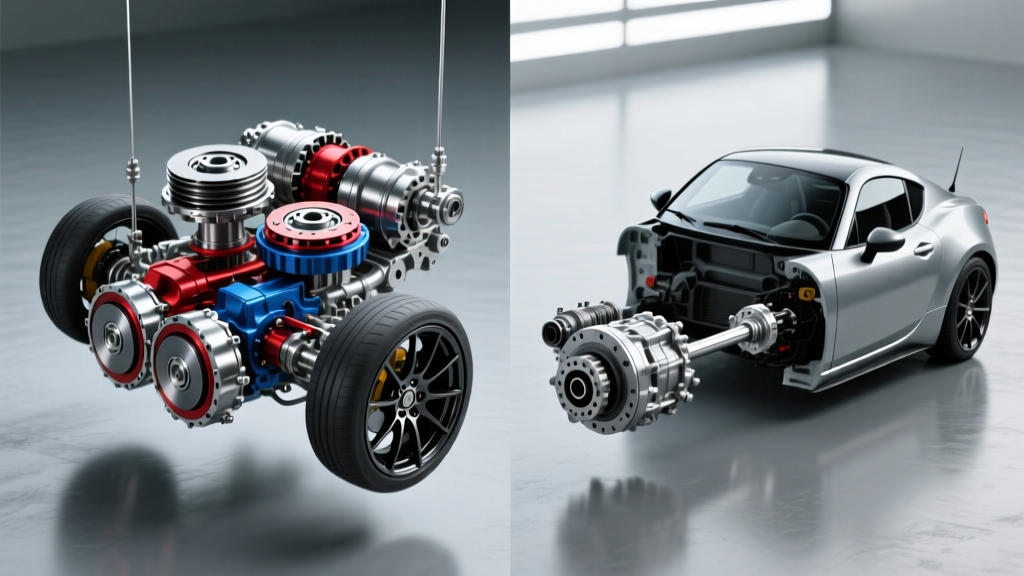
Despite the purist appeal of RWD, the aftermarket has long been obsessed with the idea of an AWD Miata. Fusing AWD system operation with the Miata drivetrain is an exercise in extreme fabrication. As documented by custom fabrication experts like Flyin' Miata and various builds featured on Miata.net, creating an AWD MX-5 requires completely re-engineering the vehicle's floor pan and subframe architecture.
The Subaru/Evo Subframe Swap Method
The most viable method for introducing AWD system operation to a Miata chassis involves discarding the Mazda drivetrain entirely and grafting in a Subaru WRX STI or Mitsubishi Lancer Evolution subframe and powertrain. This requires:
- Custom Floorpan Fabrication: Cutting out the Miata’s transmission tunnel and rear floor to accommodate the wider Subaru/Evo transmission and rear differential.
- Custom Driveshafts: Mating the donor transfer case to the Miata’s wheelbase, often requiring custom-length CV driveshafts from specialists like Driveshaft Specialist (DST).
- Suspension Geometry Correction: Adapting the Miata’s double-wishbone (front) and multi-link (rear) suspension to the AWD hub assemblies, which alters scrub radius and roll centers.
The financial reality of such a conversion is steep. A turn-key AWD Miata drivetrain swap utilizing a modern Subaru FA20DIT or EJ257 powertrain typically ranges from $22,000 to $35,000 in labor and parts, effectively tripling the value of the base vehicle.
Maintenance Realities and Fluid Specifications
Understanding AWD system operation also means understanding its maintenance burdens compared to the Miata drivetrain. Neglecting fluid services in an AWD system can lead to catastrophic failure of the Power Transfer Unit (PTU) or the Haldex clutch packs.
AWD System Maintenance (Haldex Gen 5 Example)
- Haldex Fluid & Filter: Must be replaced every 40,000 miles. The Gen 5 system uses a specific strainer that, if clogged, starves the centrifugal pump, leading to a complete loss of rear-wheel drive engagement.
- PTU (Power Transfer Unit) Fluid: Often neglected because many manufacturers lack a designated drain plug, requiring fluid extraction via a pump. Should be serviced every 50,000 miles with 75W-85 GL-4 gear oil to prevent bearing seizure.
Miata Drivetrain Maintenance (ND2 Example)
- Rear Differential: Requires 0.8 Liters of Mazda Genuine 75W-140 GL-5 Limited Slip Gear Oil. Service interval is 60,000 miles, though track-driven examples should service every 15,000 miles due to the high thermal load placed on the 7.5-inch ring gear.
- Manual Transmission: Requires 1.4 Liters of Mazda Long Life Gear Oil G7 (or a high-quality 75W-80 GL-4 equivalent). The ND2 manual is highly sensitive to fluid viscosity; using GL-5 in the transmission can degrade the brass synchronizers over time.
Conclusion: Traction Through Complexity vs. Traction Through Mass
The study of all-wheel drive system operation reveals a triumph of modern computational engineering and hydraulic control. Systems like Haldex and Torsen allow heavy, high-horsepower vehicles to exploit immense grip levels regardless of surface conditions. However, when compared to the Miata drivetrain, the AWD architecture highlights the penalties of mass, parasitic loss, and mechanical complexity. The Miata proves that by minimizing weight and optimizing driveline geometry via the PPF and a mechanical LSD, a vehicle can achieve world-class dynamic responses without the need for front-driven axles. Whether you are maintaining a complex AWD daily driver or wrenching on a lightweight RWD roadster, respecting the specific torque specs, fluid requirements, and mechanical limits of your drivetrain is the key to long-term reliability on the road and the track.