The Complexity of AWD Center Differentials
In modern all-wheel-drive (AWD) architectures, the center differential is the critical nexus managing front-to-rear torque distribution. While clutch-pack systems and viscous couplings have their places, the helical limited slip differential (often recognized by the Torsen trademark or aftermarket equivalents like Quaife) remains the gold standard for high-performance and heavy-duty AWD applications. Vehicles utilizing these systems—ranging from the Audi Quattro lineup to GM Lambda-platform SUVs equipped with BorgWarner transfer cases—rely on complex worm-gear geometry to provide instantaneous torque biasing without the wear-prone friction plates found in traditional limited-slip differentials (LSDs).
However, when an AWD system exhibits binding, whining, or erratic torque distribution, misdiagnosis is rampant among general technicians. Because the helical limited slip differential operates on entirely different mechanical and tribological principles than clutch-type LSDs, applying standard diagnostic logic or incorrect fluid treatments will rapidly degrade the system. As of 2026, with AWD systems managing higher torque outputs from turbocharged and hybridized powertrains, understanding the precise fluid dynamics and mechanical tolerances of helical center diffs is mandatory for accurate troubleshooting.
The Friction Modifier Fallacy: Why Helical Diffs Bind and Whine
The most common catastrophic error in AWD center differential service is the misuse of friction modifiers (FM). Traditional clutch-type LSDs require additives (like Ford XL-3 or GM LSD Additive) to prevent chatter by altering the static-to-dynamic friction coefficient of the clutch plates. Helical limited slip differentials do not use clutch packs to bias torque. Instead, they rely on the axial thrust generated by helical worm gears pressing against thrust washers and the differential housing.
According to engineering documentation from JTEKT Torsen Engineering, the torque biasing ratio (TBR) in a helical diff is a direct mathematical function of the gear helix angle and the friction coefficient of the gear steel against the housing/washers. If a technician mistakenly adds a friction modifier to the center diff fluid, the micro-friction required for the thrust washers to "lock" and bias torque is eliminated. The result? The helical limited slip differential effectively becomes an open differential under load, leading to severe front-to-rear axle slip, erratic traction control interventions, and eventual overheating of the gearset.
Symptom Matrix: Fluid Degradation vs. Mechanical Failure
Diagnosing a failing center differential requires isolating fluid-induced anomalies from hard-part mechanical failures. Use the following matrix to guide your initial teardown or fluid-analysis decisions.
| Observed Symptom | Probable Fluid-Related Cause | Probable Mechanical Cause | Diagnostic Verification Test |
|---|---|---|---|
| Low-speed binding or "hopping" in tight turns | Incorrect fluid viscosity or accidental FM contamination causing erratic thrust washer engagement. | Scored thrust washers or excessive axial endplay preventing smooth gear separation. | Drain and inspect fluid for bronze flakes. Perform two-wheel lift binding test. |
| High-frequency whine under load (deceleration) | Severe gear oil shearing; fluid has dropped below 75W viscosity, starving gear tooth contact patches. | Pitting on the helical worm gear flanks or improper ring-and-pinion backlash in the transfer case. | Send fluid sample for tribology analysis. Check gear backlash with a dial indicator. |
| AWD system fails to transfer torque to the slipping axle | Fluid overheating and cavitation, eliminating the hydraulic boundary layer required for thrust generation. | Stripped worm gear teeth or shattered thrust bearing due to shock loading. | Dyno test with independent axle speed sensors to verify torque biasing ratio (TBR). |
Deep Dive: Diagnosing Transfer Case and Center Housing Anomalies
Thrust Washer Wear and Axial Endplay
In applications like the BorgWarner 4485 and 4494 transfer cases found in GM AWD crossovers, the helical planetary gearset acts as the center differential. Over time, the constant axial thrust generated during torque biasing wears down the bronze or steel thrust washers. According to BorgWarner Transfer Case Systems documentation, if the axial endplay of the helical gearset exceeds 0.006 inches (0.15 mm), the gears cannot generate sufficient separating force to bind against the housing. The differential will fail to transfer torque to the axle with grip. During a teardown, measuring this endplay with a dial indicator is a critical pass/fail metric before reassembling the center housing.
Gear Oil Shearing and Thermal Breakdown
Helical center diffs generate immense localized heat due to the sliding friction inherent in worm-gear geometry. Standard off-the-shelf 75W-90 GL-5 gear oils often lack the shear stability required for these specific AWD applications. Under sustained high-torque conditions (such as towing or aggressive track use), the polymers in conventional gear oils shear down, effectively turning a 75W-90 oil into a 75W-80 or lighter. This viscosity loss collapses the hydrodynamic fluid film, leading to metal-on-metal contact on the helical gear flanks. High-end synthetic fluids, such as those detailed in AMSOIL Severe Gear Technical Data, utilize shear-stable base stocks that maintain their kinematic viscosity even after 50,000 miles of severe AWD operation.
Step-by-Step Diagnostic Protocol for AWD Technicians
When a vehicle presents with AWD driveline bind, whine, or traction loss, follow this strict diagnostic protocol to preserve the integrity of the helical limited slip differential.
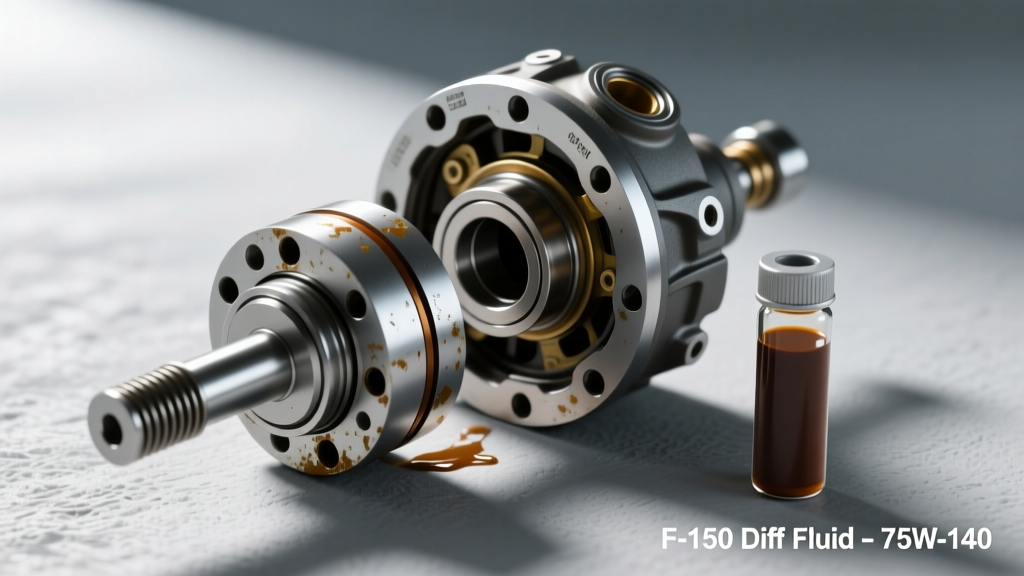
- Step 1: Fluid Extraction and Visual Analysis. Remove the center diff or transfer case drain plug (typically an M14x1.5 magnetic plug, torqued to 30-35 Nm). Inspect the magnetic plug. Fine grey paste is normal wear. However, visible bronze or copper flakes indicate catastrophic thrust washer failure, requiring immediate teardown.
- Step 2: The Two-Wheel Lift Test. Lift one front and one rear wheel (diagonally) on a hoist. With the transmission in gear and the engine idling (or using a spin-tool on the driveshaft), the lifted wheels should not spin freely if the helical diff is functioning. If they spin without resistance, the TBR has collapsed due to fluid contamination or internal mechanical failure.
- Step 3: Fluid Flush and Correction. If the fluid is contaminated with friction modifier or has sheared, perform a complete drain and fill. Do not flush with automated machines, as cross-contamination from clutch-type LSD fluids in the machine's lines will ruin the helical diff. Use a manual pump.
- Step 4: Torque Biasing Verification. After refilling with the correct non-FM synthetic 75W-90 or OEM-specific AWD fluid, perform a controlled slip test on a low-friction surface (e.g., wet grass or snow) to verify that the system smoothly biases torque without driveline shock.
Approved Fluid Specifications and Service Intervals (2026 Update)
Using the correct fluid is not just a recommendation; it is a mechanical requirement for the survival of a helical limited slip differential. Below are the approved fluid profiles for common AWD center diff architectures.
- Audi Quattro (Torsen Type C / Crown Gear): Requires OEM Audi G 052 145 S2 or a high-quality synthetic 75W-90 GL-5 without friction modifiers. Capacity varies by transmission (e.g., 01E manual vs. ZF 8HP automatic integration), typically ranging from 0.9L to 1.2L for the center diff housing.
- GM Lambda Platform (BorgWarner 4485/4494): Requires ACDelco AWD Transfer Case Fluid (Part# 10-4035). Do not substitute with standard 75W-90 gear oil, as the proprietary additive package is tuned specifically for the helical planetary thrust washers in these transfer cases. Capacity is approximately 1.9L.
- Subaru STI (DCCD - Driver Controlled Center Differential): While the DCCD utilizes a combination of helical gears and electronic clutches, the mechanical helical portion requires a high-shear 75W-90 GL-5. Motul Gear 300 75W-90 is a preferred aftermarket choice for its exceptional thermal stability under rally and track conditions.
Conclusion
Troubleshooting a helical limited slip differential in an AWD center housing requires a departure from traditional drivetrain logic. By understanding that torque biasing is a function of gear geometry and thrust friction—not clutch packs—technicians can avoid the destructive trap of friction modifiers. Coupled with rigorous fluid shear analysis and precise endplay measurements, these diagnostic steps ensure that complex AWD systems continue to deliver seamless, reliable traction across all driving conditions.