The Hidden Complexity of AWD Center Differentials
When drivers report an auto differential abnormal noise, the immediate suspicion often falls on the front or rear axle differentials. However, in All-Wheel-Drive (AWD) vehicles, the center differential—or the active transfer clutch acting as one—is frequently the true culprit. Unlike open front or rear diffs, the center differential manages torque distribution and rotational speed differences between the front and rear axles. Whether your vehicle utilizes a mechanical Torsen gearset, a silicone-based viscous coupling, or an electronically controlled Haldex clutch pack, a failing center unit will manifest distinct auditory and kinesthetic symptoms.
As we navigate the 2026 automotive landscape, where traditional mechanical AWD systems coexist with complex hybrid torque-vectoring setups, accurate diagnosis requires a deep understanding of fluid dynamics, gear metallurgy, and clutch pack tolerances. This guide provides a master-level diagnostic protocol for isolating center differential faults before they cascade into catastrophic driveline failure.
Categorizing the Auditory and Kinesthetic Symptoms
Diagnosing the root cause begins with translating the driver's complaint into mechanical realities. An auto differential abnormal noise in the center unit typically falls into one of three categories:
1. High-Frequency Whining or Howling
A whine that changes pitch with vehicle speed—but remains constant regardless of throttle load or coasting—usually points to bearing preload loss or planetary gearset wear. In chain-driven transfer cases (often grouped with center diff functions in systems like the Subaru Symmetrical AWD or GM/BorgWarner setups), a rhythmic whine or 'roar' indicates chain stretch or sprocket wear. The chain slaps against the tensioner or case, creating a harmonic resonance that travels up the driveline.
2. Low-Frequency Chattering or Shudder
Chattering during tight, low-speed turns (like pulling into a parking space) is the hallmark of clutch pack 'stick-slip'. In active center differentials like the Haldex Gen 5 or BMW's xDrive ATC units, the friction modifiers in the specialized fluid have sheared down or depleted. The clutch plates grab and release violently instead of slipping smoothly, sending a violent shudder through the chassis.
3. Binding and Driveline Wind-Up
While not strictly a 'noise', driveline binding on dry pavement is a critical symptom. If the center viscous coupling has degraded internally (often due to overheating from mismatched tires), it may permanently lock the front and rear axles together. This causes the tires to skip and chirp during turns, eventually leading to planetary gear cage disintegration.
Fluid Degradation: The Root Cause of Center Diff Noise
The majority of auto differential abnormal symptoms in active center units are directly traceable to fluid failure. Center differentials do not use standard 75W-90 GL-5 gear oil. They require highly specialized formulations containing specific friction modifiers and shear-stable viscosity index (VI) improvers. When these fluids exceed their thermal limits, the friction modifiers plate onto the clutch surfaces, causing permanent stick-slip.
| AWD System / Application | OEM Fluid Specification | Typical Capacity | Severe Service Interval | Drain/Fill Torque Spec |
|---|---|---|---|---|
| VW/Audi Haldex Gen 5 | G 060 175 A2 | 0.65L | 30,000 Miles / 3 Years | 35 Nm (Drain/Fill) |
| BMW xDrive (ATC Transfer Case) | DTF-1 (TF 0870 equivalent) | 0.6L - 0.8L | 40,000 Miles | 30 Nm |
| Subaru DCCD (Driver Controlled) | Subaru DCCD Specific Fluid | 0.5L (Center only) | 30,000 Miles | 44 Nm |
| Audi Torsen (Quattro Type C) | G 055 145 A2 (75W-85) | 0.85L | 60,000 Miles | 35 Nm |
Note: Always consult the manufacturer's official service documentation, such as the Audi erWin portal or Subaru TechInfo, for exact capacities and torque specifications specific to your VIN.
Step-by-Step Diagnostic Protocol
To accurately isolate a center differential fault from a failing front/rear axle or a worn CV joint, follow this systematic troubleshooting sequence.
Step 1: The Figure-8 Bind Test
Find a clean, dry, paved surface. Turn the steering wheel to full lock and drive the vehicle in a tight figure-8 pattern at 5-10 mph.
- Normal Operation: The vehicle should turn smoothly. The center differential allows the rear wheels to travel a slightly different distance than the front wheels.
- Abnormal Fault: If the vehicle 'hops', binds, or the rear tires chirp, the center differential is locked or the viscous fluid has solidified due to thermal degradation. This requires immediate center diff replacement or a complete fluid flush with friction modifier additive.
Step 2: Fluid Inspection and Chromatography
Extract a sample of the center diff fluid.
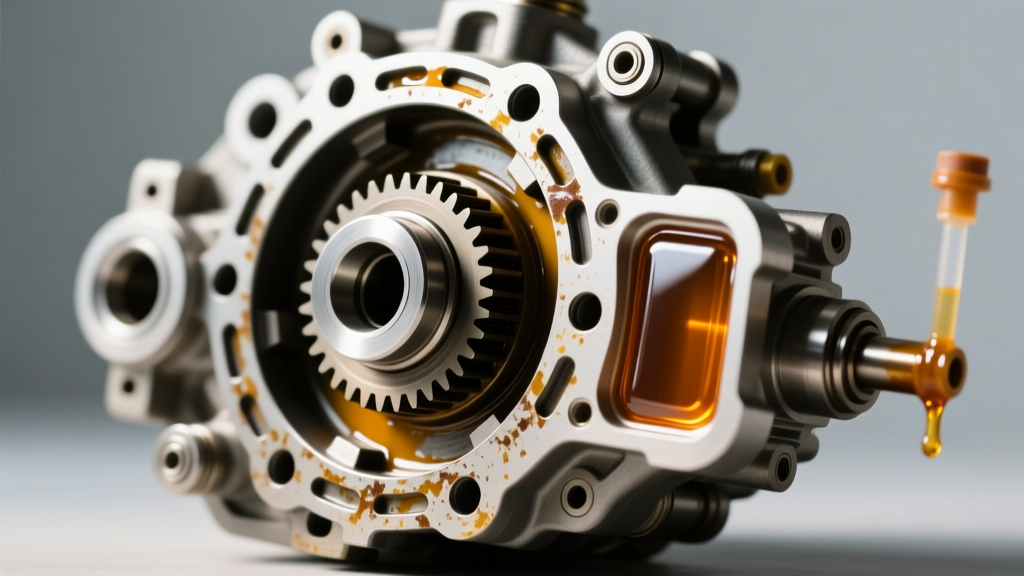
- Color & Smell: Burnt-smelling fluid or fluid with a dark, opaque black hue indicates severe clutch material wear. A milky appearance signifies water ingress through a compromised output shaft seal.
- Particulate Check: Pass the fluid through a 50-micron filter. Brass-colored flakes indicate planetary gear thrust washer wear. Ferrous metallic paste on the magnetic drain plug is normal in small amounts, but chunky steel shards point to bearing or cage failure.
Step 3: Haldex / Active Clutch Pump Verification
For active systems like Haldex Gen 5 (found in VW Golf R, Audi S3, Volvo XC90), the center diff relies on an electro-hydraulic pump. If the fluid is clean but chattering persists, the pump's internal filter screen is likely clogged with clutch debris. Pro Tip: The Gen 5 pump filter is not an official service part from the factory, but aftermarket filter kits are available. Drop the pump motor (secured by three 10mm bolts, torqued to 10 Nm), clean the screen, and replace the O-ring to restore hydraulic pressure.
The Rolling Circumference Mandate: The #1 Killer of Center Diffs
No diagnostic guide is complete without addressing the primary cause of premature center differential failure: mismatched tires. AWD systems are engineered to handle temporary speed differences (like cornering). They are not designed to handle continuous speed differentials caused by varying tire diameters.
Expert Rule of Thumb: The rolling circumference variance between the front and rear axles must not exceed 2/32 of an inch in tread depth difference. A single flat tire replaced with a brand-new tire on an opposite axle will force the center viscous coupling to slip continuously at highway speeds. This generates internal temperatures exceeding 250°F (121°C), boiling the silicone fluid and permanently fusing the coupling.
According to drivetrain dynamics research published by SAE International, continuous micro-slippage in the center differential reduces the lifespan of the friction linings by up to 80% within just 5,000 miles. If a customer presents with a locked center diff, always measure the tire circumferences with a stagger gauge before installing a replacement unit, or the new unit will suffer the exact same fate.
Repair Realities and 2026 Cost Benchmarks
When diagnosis confirms internal mechanical failure, understanding the repair economics is crucial for both technicians and vehicle owners.
- Haldex Pump & Filter Service: $150 - $250 (Parts and Labor). Resolves 70% of 'shudder' complaints in VW/Audi FWD-biased AWD systems.
- BMW xDrive Transfer Case Fluid Flush: $200 - $350. Requires a specialized pump to fill the ATC unit from the bottom up, ensuring no air pockets remain in the clutch pack galleries.
- Subaru Viscous Center Diff Replacement: $800 - $1,200. The unit is located inside the manual transmission extension housing or automatic transfer case. Labor involves dropping the crossmember and exhaust to extract the assembly.
- Complete Center Differential Rebuild (Torsen/Planetary): $1,800 - $2,800. Requires specialized press tools to remove output shaft bearings and set planetary gear backlash to exact OEM tolerances (typically 0.05mm - 0.10mm).
Final Thoughts on Driveline Longevity
Diagnosing an auto differential abnormal noise requires looking beyond the gearsets and focusing on the fluids and external variables that govern their operation. By adhering to strict fluid service intervals, utilizing only OEM-specified friction-modified lubricants, and enforcing strict tire-matching protocols, you can ensure the center differential operates silently and seamlessly for the life of the vehicle.