The Truth About Automatic Transmission Clutches
One of the most frequent questions we encounter at the shop is: does an automatic car have a clutch? The short answer is an emphatic yes. While modern automatic vehicles lack the traditional foot-operated dry friction disc found in manual transmissions, they rely heavily on a complex network of internal wet multi-disc clutch packs and a critical component known as the Torque Converter Clutch (TCC). As we navigate the 2026 automotive landscape, transmissions like the ZF 8HP, GM 10L80, and Ford 10R80 utilize upwards of six to eight individual clutch packs to manage gear ratios and lockup strategies.
When these internal clutches begin to fail, they rarely do so silently. Instead, they broadcast specific acoustic warnings—grinding, squealing, and chirping—that can help a trained technician pinpoint the exact failing component without immediately tearing down the unit. In this expert guide, we break down the diagnosis of automatic clutch noises, providing actionable data, scanner PID values, and teardown best practices.
Decoding Grinding Noises: TCC Delamination and Planetary Binding
A grinding noise emanating from the bellhousing area of an automatic transmission is a severe red flag. Unlike a manual transmission where a grinding noise often points to a failing throwout bearing or pilot bearing, automatic grinding usually originates from the torque converter or the front planetary gearset.
Torque Converter Clutch (TCC) Friction Delamination
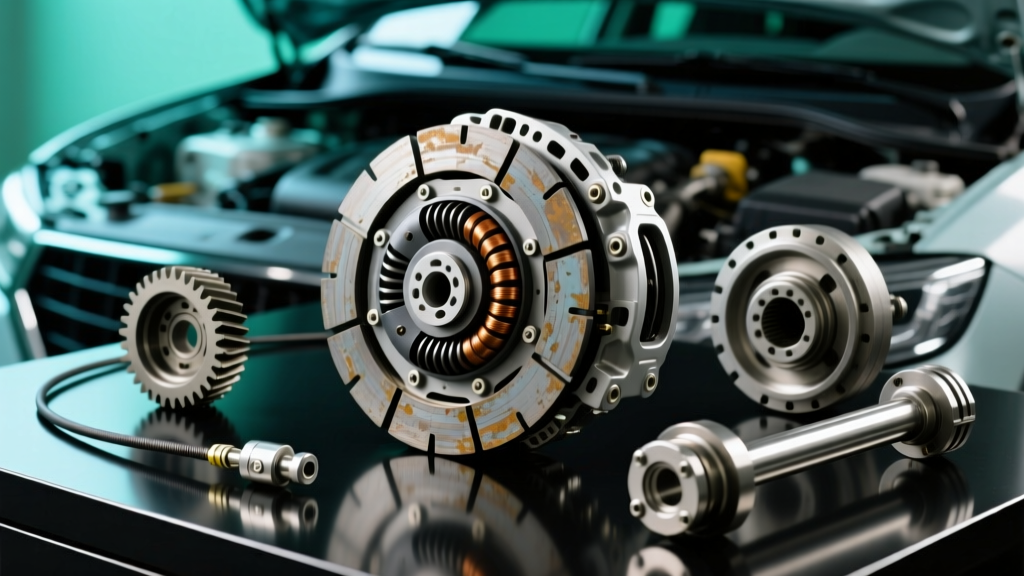
The TCC is essentially a large, internally mounted clutch disc lined with friction material (often Kevlar or specialized cellulose/synthetic weaves). Its job is to mechanically lock the engine to the transmission input shaft at cruising speeds to eliminate fluid slip and improve fuel economy. When the TCC lining degrades due to extreme heat or contaminated fluid, chunks of the friction material break off and become trapped between the converter cover and the turbine.
Diagnostic Step: If you hear a metallic grinding that correlates with TCC apply (usually between 35-55 mph in higher gears), command the TCC OFF using a bi-directional scan tool. If the grinding immediately ceases, the torque converter is internally destroyed. Cost to repair: $800–$1,400 for a remanufactured torque converter and fluid flush, assuming no debris has migrated into the transmission cooler lines.
Planetary Gearset Interference
If the grinding persists regardless of TCC state, you may be dealing with clutch pack failure leading to planetary binding. For instance, in the GM 6L80E, if the 3-5-R clutch pack burns up, the hub can gall and weld to the sun gear, causing catastrophic metal-on-metal grinding. Dropping the transmission pan is mandatory here; if you find silver glitter (indicating hard part wear) mixed with dark, burnt-smelling sludge, a full rebuild is required.
Squealing and Whining: Pump Cavitation vs. Valve Body Chatter
High-pitched squealing is frequently misdiagnosed as a failing engine accessory drive belt or water pump. However, when the squeal is isolated to the transmission bellhousing and changes pitch with engine RPM and line pressure, the internal fluid pump or TCC control valves are the culprits.
Fluid Pump Cavitation
Automatic transmissions use a gerotor or vane-style pump driven directly by the torque converter hub. If the transmission fluid level is low, or the internal filter is clogged with clutch debris, the pump will draw in air alongside the fluid. This cavitation creates a distinct, high-pitched whining or squealing noise that is loudest in Park or Neutral.
Expert Tip: Check the fluid level using the manufacturer's exact temperature specification. For example, the ZF 8HP requires the fluid to be between 30°C and 50°C (86°F–122°F) during the level check procedure. Using the wrong fluid viscosity (e.g., substituting a generic ATF for ZF LifeguardFluid 8) will alter pump clearances and induce cavitation squeal.
TCC Control Valve Bore Wear
In units like the Ford 6R80 and GM 6L80E, the aluminum valve body houses the TCC regulator valve. Over time, the constant oscillation of the valve wears out the aluminum bore. This allows pressurized fluid to leak past the valve, causing it to chatter rapidly in its bore. This hydraulic chatter translates into an audible squeal during TCC apply. According to technical bulletins from the Sonnax Transmission Company, reaming the bore and installing an oversized, anodized TCC regulator valve kit permanently resolves this squeal without requiring a full transmission replacement.
Chirping and Rattling: Wave Plate Fatigue and Solenoid Issues
Chirping is a rhythmic, metallic ticking or clicking sound that often occurs in specific gears or during gear transitions. It is one of the most highly documented clutch-related noises in modern automatics.
The Notorious GM 6L80/6L90 Wave Plate Failure
If you are diagnosing a GM vehicle with a 6L80 or 6L90 transmission and hear a chirping or rattling noise specifically in Reverse, 3rd, or 5th gear, you are likely dealing with a fractured 3-5-R clutch wave plate. The OEM wave plate is prone to fatigue and snapping. When it breaks, small metal fragments circulate through the clutch pack, causing a rhythmic chirp as the clutch piston applies and releases.
Teardown Best Practice: When rebuilding these units, experts referencing Automatic Transmission Rebuilders Association (ATRA) guidelines strongly recommend replacing the OEM wave plate with an upgraded, thicker aftermarket waved cushion plate to prevent recurrence. Furthermore, always inspect the 3-5-R clutch backing plate for scoring.
PWM Solenoid Chatter
Pulse Width Modulated (PWM) solenoids control the apply rate of the clutch packs. If a solenoid's internal filter screen becomes clogged with microscopic clutch material, the solenoid will rapidly pulse on and off to maintain target pressure, resulting in a faint electronic chirping or buzzing sound from the mechatronic unit (valve body). A simple solenoid resistance test (typically 3.0 to 5.0 ohms at 20°C) and a flow test on a solenoid test bench will confirm this diagnosis.
Automatic Clutch Noise Diagnosis Matrix
Use the following matrix as a quick-reference framework when road-testing a vehicle with suspected internal clutch noise.
| Acoustic Symptom | Primary Suspect | Diagnostic Action | Estimated Repair Cost (2026) |
|---|---|---|---|
| Metallic Grinding (Cruising) | TCC Friction Delamination | Command TCC OFF via scanner; noise stops = bad converter. | $800 - $1,400 |
| Heavy Grinding (In Gear) | Planetary/Clutch Hub Galling | Drop pan; inspect for heavy metal glitter and burnt fluid. | $3,000 - $4,800 (Rebuild) |
| High-Pitch Squeal (Park/Neutral) | Fluid Pump Cavitation | Check fluid level at spec temp; inspect filter restriction. | $150 - $400 (Service) |
| Squeal During TCC Apply | TCC Regulator Valve Bore Wear | Monitor TCC Slip RPM; inspect valve body for bore wear. | $600 - $1,100 (Valve Body) |
| Rhythmic Chirp (Rev/3rd/5th) | Fractured Clutch Wave Plate | Road test in specific gears; teardown inspection required. | $2,500 - $3,800 (Rebuild) |
| Electronic Buzzing/Chirp | Clogged PWM Solenoid Screen | Measure solenoid resistance; perform flow bench test. | $400 - $750 (Mechatronic) |
Expert Best Practices: Fluids, Torque Specs, and Reassembly
Diagnosing the noise is only half the battle; executing a flawless repair ensures the customer does not return with the same complaint. Adhering to strict reassembly protocols is non-negotiable.
Friction Modifiers and Fluid Selection
Modern wet clutches are engineered to operate with highly specific friction modifiers. Using the incorrect ATF will result in immediate TCC shudder, squealing, and premature clutch pack wear. For example, ZF Aftermarket strictly mandates the use of ZF LifeguardFluid 8 for 8HP units. The total dry fill capacity is roughly 8.5 to 9.5 liters, but a standard drain and fill only yields about 4 to 5 liters. Never attempt to 'flush' a ZF 8HP with generic universal ATF; the friction coefficients are entirely incompatible with the ZF mechatronic adaptation software.
Critical Torque Specifications
When removing the transmission to address bellhousing noises (such as replacing a torque converter or flexplate), precise torque application is vital to prevent misalignment, which can cause the new TCC to bind and chirp.
- Bellhousing to Engine Block (GM 6L80E M12 Bolts): 50 Nm (37 lb-ft).
- Torque Converter to Flexplate (GM M10x1.5 Bolts): 46 Nm (34 lb-ft) — Always apply a medium-strength threadlocker like Loctite 263.
- Valve Body to Case (ZF 8HP Torx Bolts): 8 Nm (71 lb-in) — Overtightening will warp the mechatronic casting and cause immediate hydraulic cross-leaks and solenoid chirping.
Final Thoughts on Automatic Clutch Diagnostics
So, does an automatic car have a clutch? Absolutely—and in many cases, it has half a dozen of them working in concert. By learning to differentiate between the metallic grinding of a delaminated TCC, the hydraulic squeal of a worn regulator valve, and the rhythmic chirp of a fatigued wave plate, you can accurately diagnose internal transmission failures before they result in total planetary destruction. Always rely on bi-directional scanner data, precise fluid temperature checks, and manufacturer-specific teardown guidelines to ensure your repairs stand the test of time.