When an automatic transmission begins slipping, throwing ratio codes, or losing gears, the immediate question for technicians and vehicle owners is whether to rebuild the existing unit or replace it entirely. Unlike manual transmissions where a single friction disc is swapped, an automatic transmission clutch replacement involves overhauling multiple internal clutch packs, steels, frictions, and hydraulic pistons. In 2026, with the prevalence of complex 8-speed and 10-speed units like the ZF 8HP and GM 10L90, the decision matrix requires precise diagnostic data. This step-by-step guide will walk you through the technical evaluation process, helping you accurately weigh the automatic transmission clutch replacement cost against a full remanufactured unit swap.
Step 1: Perform Definitive Clutch Pack Diagnostics
Before calculating costs, you must isolate the failure to a specific clutch pack or hydraulic circuit. Guessing leads to catastrophic financial mistakes. Begin with an OBD2 scan and fluid analysis.
- Scan for Slip Codes: Codes like P0730 (Incorrect Gear Ratio), P0734 (Gear 4 Incorrect Ratio), or P2714 (Pressure Control Solenoid 'D' Performance) directly point to clutch slip or hydraulic bleed-offs. For example, in the GM 6L80, a P0734 often indicates a failure in the 3-5-R clutch pack or a cracked wave plate.
- Stall Speed Testing: Perform a stall test in Drive and Reverse. If the stall RPM is significantly higher than the factory specification (e.g., exceeding 2,800 RPM on a 6L80), the forward or reverse clutch packs are mechanically slipping.
- Fluid Pan Teardown: Drop the transmission pan. The debris tells the story. Fine, dark gray silt indicates normal clutch wear. However, large flakes of friction material, brass bushing shavings, or metallic glitter indicate hard-part failure. If the aluminum clutch drum is scored, a simple clutch pack repair is no longer viable.
Expert Insight: Always cross-reference debris with the transmission's specific clutch apply chart. In the ZF 8HP, Clutch 'A' and 'E' failures are frequently misdiagnosed as mechanical wear when the root cause is a degraded mechatronic adapter sleeve causing a hydraulic pressure leak. Consult the Automatic Transmission Service Group (ATSG) apply charts before ordering parts.
Step 2: Evaluate the 'Repair' Route (Clutch Pack Overhaul)
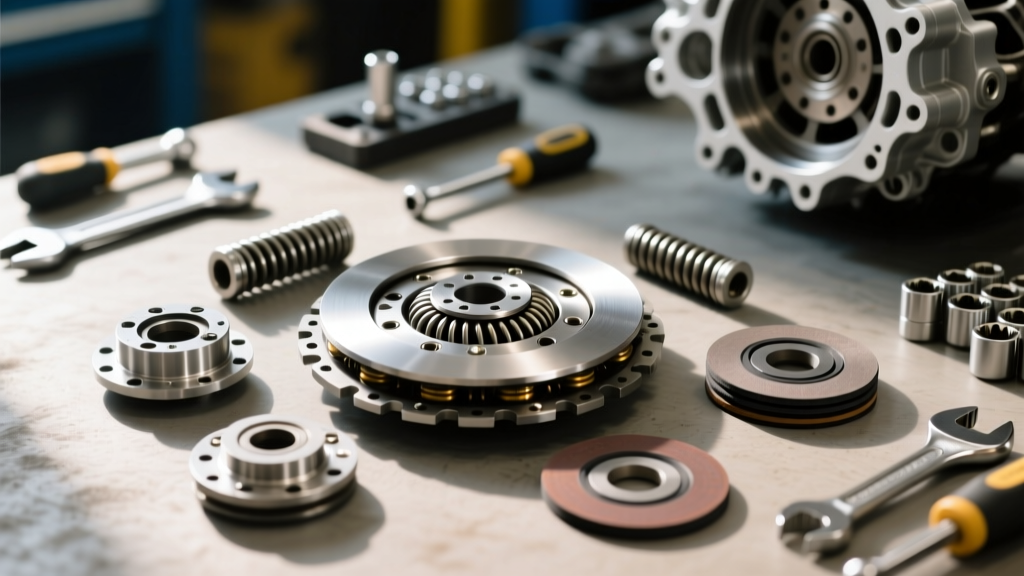
Repairing an automatic transmission means pulling the unit, tearing it down to the bench, and replacing the failed friction/steel packs, seals, and O-rings. This route is highly cost-effective if the hard parts (drums, planetary gears, valve body) are undamaged.
Sourcing High-Performance Friction Kits
Do not reuse OEM frictions if the vehicle is used for towing or performance. Upgrading to high-energy friction materials is a standard best practice. For the GM 6L80/6L90 family, the Raybestos Powertrain GPZ clutch pack kit offers superior heat dissipation and torque capacity over stock. Similarly, Alto Red Eagle frictions are the industry standard for high-load Ford 10R80 applications.
Addressing Known OEM Weak Points
A proper repair must address the engineering flaw that caused the failure. If you are rebuilding a GM 6L80, the OEM 3-5-R wave plate is notorious for fracturing and dropping debris into the clutch pack. You must install an upgraded billet wave plate or apply a Sonnax Smart-Tech heavy-duty drum kit to prevent a repeat failure. Ignoring these known weak points turns a cheap repair into a costly warranty claim.
Step 3: Evaluate the 'Replace' Route (Remanufactured Unit)
If the transmission case is cracked, the valve body is warped, or multiple clutch drums are scored beyond machining limits, the repair route is dead. You must pivot to replacing the entire unit with a remanufactured transmission.
Remanufactured units from suppliers like Jasper Engines or Powertrain Products are built on assembly lines with dyno-testing capabilities that independent shops cannot match. They include updated valve bodies, recalibrated mechatronic units (in the case of ZF transmissions), and upgraded clutch clearances. However, the upfront cost is substantially higher, and you must factor in the core charge, freight shipping, and the R&R (Remove and Replace) labor.
Step 4: Calculate the True Automatic Transmission Clutch Replacement Cost
Understanding the financial breakdown is critical for the repair vs. replace decision. The table below outlines the estimated 2026 market costs for a standard rear-wheel-drive V8 application (e.g., GM 6L80 or Ford 10R80).
| Service Option | Parts Cost (Avg) | Labor Cost (Avg) | Total Estimated Cost | Warranty Coverage |
|---|---|---|---|---|
| Clutch Pack Repair (In-House Rebuild) | $450 - $900 | $1,200 - $1,800 | $1,650 - $2,700 | Shop-dependent (usually 12 mo/12k) |
| Remanufactured Unit Replacement | $2,800 - $4,200 | $800 - $1,200 | $3,600 - $5,400 | 3 yr/100k miles (Nationwide) |
| Used/Junkyard Unit Swap | $800 - $1,500 | $800 - $1,200 | $1,600 - $2,700 | 30 to 90 days (High Risk) |
Note: Labor rates vary wildly by region. Dealerships in metropolitan areas may charge $180+/hour, pushing a full replacement well past $6,000, while independent transmission specialists operating at $110/hour can keep costs manageable.
Step 5: Execute the Teardown Decision Framework
Because internal damage is often hidden from external diagnostics, the final decision is usually made on the teardown bench. Follow this strict decision matrix once the transmission is disassembled:
- Inspect the Clutch Drums: Use a straight edge and feeler gauge to check the clutch drum splines and friction surfaces. If the aluminum drum is grooved deeper than 0.002 inches, the drum must be replaced. If the drum is obsolete or costs over $600 to replace, pivot to a full remanufactured unit replacement.
- Measure Piston Travel: Use a dial indicator to measure clutch pack clearance. For most GM and Ford applications, the ideal clearance is 0.040 to 0.060 inches. If the hydraulic piston seals are hardened, cracked, or the piston bore is scored, the hydraulic integrity is compromised, necessitating a more extensive rebuild or replacement.
- Check the Valve Body / Mechatronic Unit: In modern transmissions like the ZF 8HP, the valve body and TCM are integrated. If the solenoid bores are worn or the internal pressure regulators are scored by debris from a failed clutch pack, the mechatronic unit must be replaced or heavily refurbished, which drastically alters the automatic transmission clutch replacement cost.
Reassembly and Torque Specifications
If you proceed with the repair route, precision during reassembly is non-negotiable. When reinstalling the transmission to the engine block, always use new torque-to-yield (TTY) bellhousing bolts if specified. For the GM 6L80, the bellhousing-to-engine block bolts must be torqued to 37 lb-ft. The flexplate-to-crankshaft bolts require a two-step process: 15 lb-ft followed by an additional 62 lb-ft of rotation torque. Furthermore, fluid selection is critical. Do not mix fluid specifications. A 6L80 requires Dexron VI, whereas the newer 10L90 demands Dexron ULV (Ultra Low Viscosity). The ZF 8HP requires specific ZF Lifeguard 8 fluid. Using the incorrect fluid will alter clutch apply times, leading to immediate shudder and premature friction wear. Always verify the dry-fill and service-fill capacities; for instance, the 6L80 dry fill is 10.6 quarts, but a standard pan-drop service only takes 6.0 quarts.
Final Verdict: Which Path Should You Choose?
The decision between an automatic clutch pack repair and a full transmission replacement hinges on the extent of collateral damage. If your diagnostic steps and bench teardown confirm that the failure is isolated to a single friction pack, a burned wave plate, or a leaking piston seal, the repair route is the most financially sound choice, saving you thousands of dollars while restoring OEM performance. However, if the fluid pan reveals a 'glitter bomb' of planetary gear shavings, multiple scored drums, or a compromised valve body, the replacement route with a dyno-tested remanufactured unit is the only logical choice. It provides a predictable cost, a comprehensive nationwide warranty, and eliminates the risk of a secondary failure caused by hidden debris in the transmission cooler lines.