The Baseline: What Is the Color of Clean Automatic Transmission Fluid?
When enthusiasts, DIY mechanics, and daily drivers alike ask, "what is the color of clean automatic transmission fluid?", the standard industry answer is a vibrant, translucent red. However, as an automotive transmission specialist, I must immediately clarify that this is only true for traditional Dexron, Mercon, and ATF+4 formulations. In modern drivetrains, relying solely on the "red rule" can lead to catastrophic misdiagnoses and unnecessary teardowns.
Transmission fluid serves as a hydraulic medium, a friction modifier, and a thermal transfer agent. Its color is a direct visual indicator of its chemical stability, oxidation levels, and the physical wear of internal clutch packs. In this expert guide, we will decode the ATF color spectrum, explore manufacturer-specific fluid variations, and outline the precise diagnostic procedures required for modern sealed transmissions.
The ATF Color Degradation Spectrum
Before pulling a dipstick or cracking a leveling plug, you must understand the lifecycle of automatic transmission fluid (ATF). The dye added to ATF is not a functional lubricant; it is a diagnostic tracer. As the fluid is subjected to shear forces and thermal cycling, the base oil oxidizes and the friction modifiers deplete.
| Fluid Color | State / Condition | Friction Modifier Status | Expert Action Required |
|---|---|---|---|
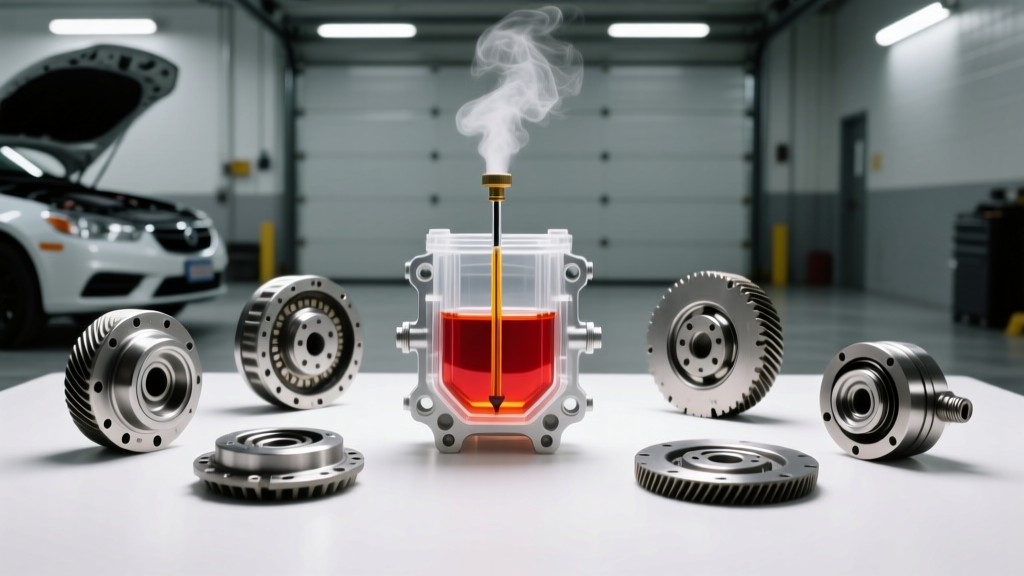
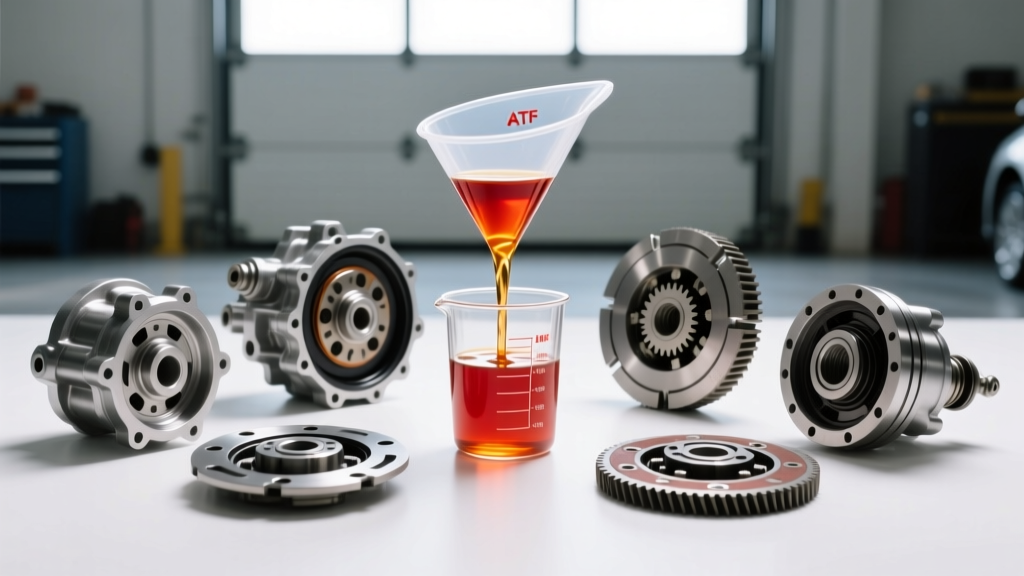
| Translucent Red | New / Factory Fill | 100% Active | No action. Baseline established. |
| Brick Red / Light Brown | Normal Wear (30k-60k mi) | 80% Active | Monitor. Schedule drain-and-fill. |
| Dark Brown / Opaque | Severe Oxidation | Depleted / Sludging | Immediate fluid exchange & filter service. |
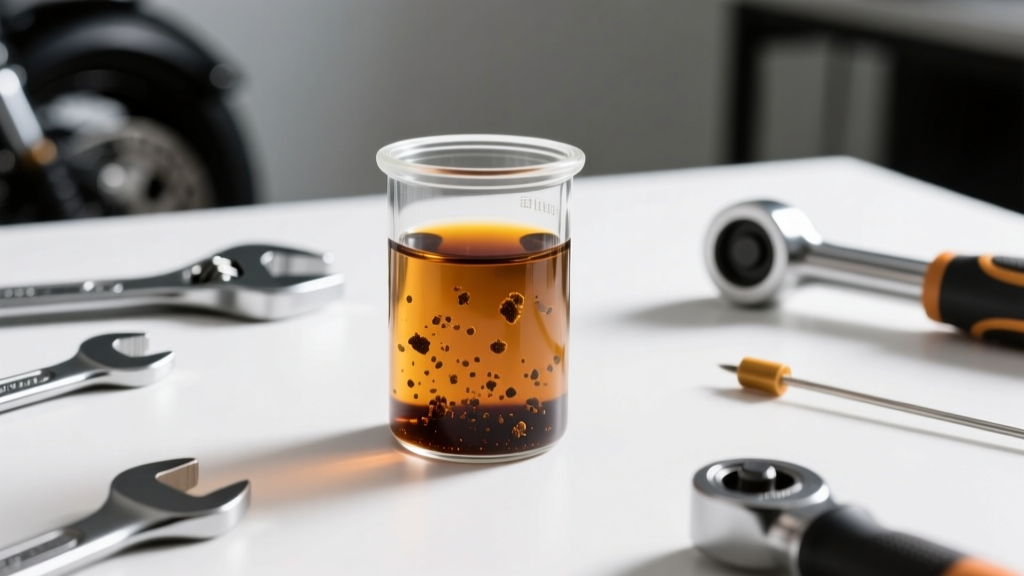
| Black + Burnt Odor | Thermal Breakdown | Failed. Clutch material shed. | Drop pan, inspect for debris. Rebuild likely. |
| Milky Pink / Frothy | Coolant Intrusion | Emulsified / Useless | Stop driving. Replace cooler, flush system. |
Translucent Red: The Factory Baseline
Fresh conventional ATF relies on highly refined petroleum base stocks or synthetic PAOs (Polyalphaolefins) mixed with ashless dispersants, anti-wear agents (like zinc dialkyldithiophosphate), and a red azo dye. When you wipe this on a white paper towel, it should be completely transparent with a bright cherry hue. According to Valvoline's ATF technical data, this translucency ensures the fluid can effectively suspend microscopic clutch particulates without clogging the valve body's delicate spool valves.
Brick Red to Light Brown: The Normal Service Window
Between 30,000 and 60,000 miles, the fluid will naturally darken to a brick red or light brownish-red. This is caused by the normal shedding of organic friction material from the clutch packs and the initial oxidation of the base oil. This is the optimal window for a preventative "drain and fill" service, which typically costs between $120 and $180 at an independent shop and restores the friction modifier package before the varnish begins to stick to the valve body.
Dark Brown and the "Burnt" Smell Test
If the fluid is opaque dark brown and emits an acrid, burnt-toast smell, the fluid has exceeded its thermal limits (typically above 260°F / 126°C at the sump). The organic friction modifiers have carbonized. At this stage, a high-pressure flush is strictly contraindicated, as the sudden introduction of high-detergent new fluid can dislodge carbon varnish that is currently providing the only friction holding worn clutch packs together. A gentle gravity drain-and-fill is the only safe intervention.
Critical Manufacturer Exceptions: When "Clean" Isn't Red
The most dangerous mistake a novice mechanic can make is assuming all clean ATF must be red. Modern OEMs have shifted toward proprietary, low-viscosity fluids designed for specific friction coefficients and fuel economy targets. Misidentifying these fluids as "contaminated" leads to thousands of dollars in unwarranted repairs.
ZF 8HP Series (LifeguardFluid 8)
The ubiquitous ZF 8-speed automatic (found in BMW, Audi, Jaguar, and the Ram 1500) utilizes ZF LifeguardFluid 8. When brand new, this fluid is yellowish-green, not red. As it ages, it darkens to a muddy olive or brownish-green. If you check the leveling plug on a ZF 8HP45 or 8HP70 and see yellow-green fluid, do not panic—the fluid is perfectly clean. As noted in the ZF Aftermarket Lubricants guide, using a red Dexron-equivalent in these units will cause immediate torque converter shudder and clutch pack failure due to incompatible friction modifiers.
CVT Fluids (Nissan NS-3 / Honda HCF-2)
Continuously Variable Transmissions require entirely different friction profiles to prevent the steel push-belt from slipping against the variable pulleys. Nissan's NS-3 CVT fluid is naturally green or blue-green when clean. Honda's HCF-2 is a clear, pale amber/red. Confusing Nissan NS-3 degradation (which turns dark green/brown) with standard ATF degradation can lead to misdiagnosing a healthy CVT system.
Expert Diagnostic Best Practices for Sealed Transmissions
Over 80% of modern vehicles, including the GM 6L80/8L90 and Ford 10R80, feature "sealed" transmissions without a traditional under-hood dipstick. Checking the color and level of these fluids requires a strict, temperature-dependent procedure.
- Connect an OBD2 Bi-Directional Scanner: You must monitor the Transmission Fluid Temperature (TFT) PID. The fluid expands significantly with heat; checking it cold will result in a false-low reading.
- Reach Operating Temperature: Cycle the transmission through all gears (P-R-N-D) with your foot on the brake to circulate fluid through the torque converter and cooler lines. Bring the TFT PID to the manufacturer's specified checking range (typically 30°C to 50°C / 86°F to 122°F for ZF units, or 85°C to 95°C for GM 8L90 units).
- Extract the Sample: With the vehicle perfectly level on a lift and the engine idling, remove the leveling plug. For the ZF 8HP plastic pan, this is an 8mm Allen plug. Expert Torque Spec: When reinstalling, this plastic plug must be torqued to exactly 10 Nm (88 lb-in). Overtightening will crack the plastic sump, requiring a $400+ pan replacement.
- The Paper Towel Wipe Test: Catch the initial drip in a clean, white, lint-free shop towel. Hold it up to a bright LED light source. Look for metallic glitter (indicative of planetary gear or bushing wear) or clutch material (dark, sooty streaks).
The "Strawberry Milkshake" Failure Mode
If your extracted fluid resembles a milky, pink strawberry milkshake, you are witnessing a catastrophic failure of the engine-to-transmission heat exchanger. Most automatic transmissions route hot ATF to a cooler integrated into the vehicle's radiator. When the internal solder joints or O-rings in this cooler fail, pressurized engine coolant mixes with the ATF.
Water destroys the friction material on the clutch plates almost instantly, causing them to delaminate from the steel cores. If you spot this milky emulsion, do not drive the vehicle. The transmission must be disassembled, the torque converter flushed or replaced, and the radiator swapped. Ignoring this will turn a $600 radiator and flush job into a $4,500 complete transmission rebuild. For deeper diagnostic flowcharts on cooler bypass failures, I highly recommend consulting the Sonnax Technical Resources library, which provides invaluable schematics on valve body and hydraulic circuit failures.
Summary: Trust the Data, Not Just the Dye
Understanding what the color of clean automatic transmission fluid should be requires moving beyond the simplistic "red is good, brown is bad" mentality. By accounting for OEM-specific fluid chemistries, utilizing OBD2 temperature data for sealed units, and performing tactile and olfactory inspections alongside visual ones, you can accurately assess the health of your drivetrain and intervene before a minor fluid degradation turns into a major mechanical failure.