Why the Allison Transmission Fluid Temperature Sensor Matters
If you own a GM Silverado or Sierra 2500HD/3500HD equipped with the legendary 6.6L Duramax diesel and the Allison 1000 transmission, you already know that maintenance is the key to longevity. However, one of the most common mistakes beginners make when performing transmission fluid maintenance is ignoring the Allison transmission fluid temperature sensor. Unlike older passenger vehicles where a quick dipstick check in the driveway is sufficient, heavy-duty trucks require precision. The fluid temperature dictates the exact volume of fluid in the pan, and guessing can lead to catastrophic mechanical failures.
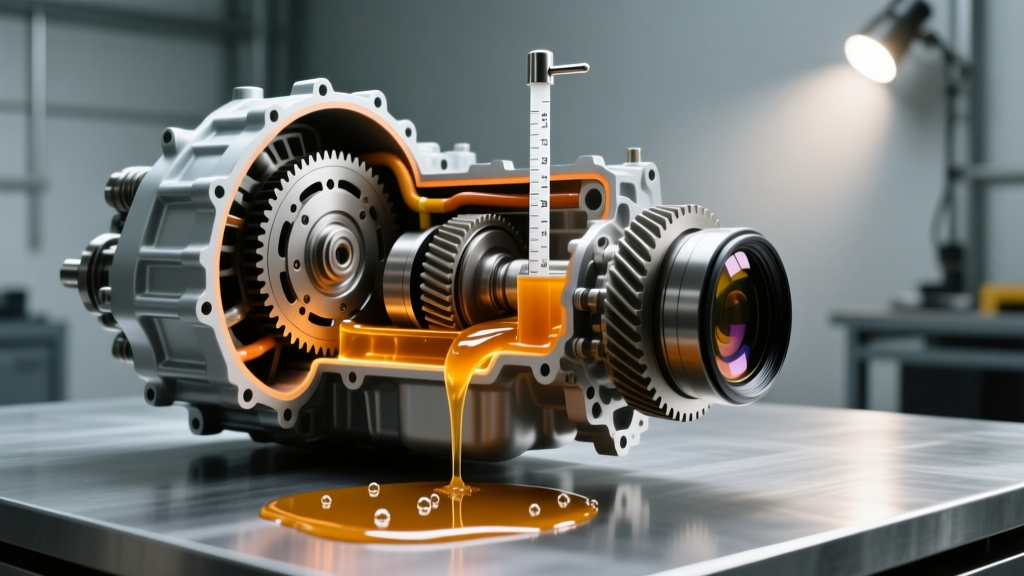
Automatic Transmission Fluid (ATF) expands significantly as it heats up. If you check the fluid level while the transmission is cold but use the 'HOT' band on the dipstick, you will inevitably overfill the system. Overfilling causes the rotating assembly to whip the fluid into a foam. Foamy ATF cannot transmit hydraulic pressure, leading to delayed shifts, slipping clutch packs, and eventual burnout. Conversely, checking a hot transmission using the 'COLD' band will result in underfilling, which starves the transmission oil pump, causes cavitation, and triggers immediate limp-mode protection.
Locating and Understanding the Sensor
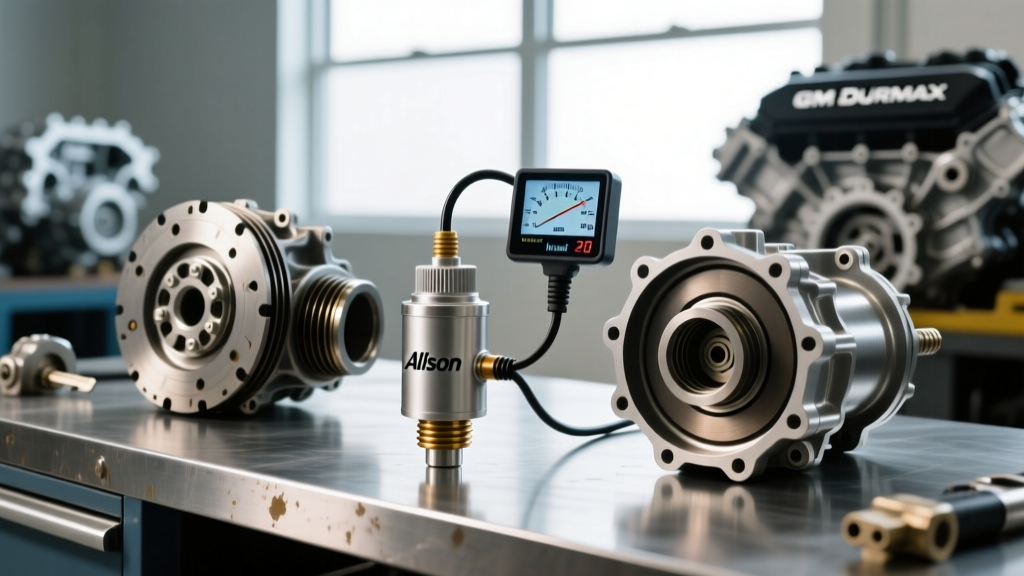
The Allison transmission fluid temperature sensor is technically a thermistor—a resistor whose electrical resistance changes predictably with temperature. The Transmission Control Module (TCM) reads this resistance to calculate the exact fluid temperature in real-time. This data is not only fed to your Driver Information Center (DIC) on the dashboard, but it is also used by the TCM to adjust shift pressures, dictate torque converter clutch (TCC) lockup schedules, and trigger thermal derating if the fluid exceeds safe limits.
On early generations of the Allison 1000 (5-speed and early 6-speed models), the thermistor was integrated into the internal wiring harness (Allison Part Number 29542814). On later 6-speed and the newer 10-speed variants, the sensor is often integrated directly into the Control Solenoid Body Assembly. This design change means that while the sensor itself is highly reliable, a failure on newer models requires replacing the entire solenoid body unit rather than just a standalone sensor.
Step-by-Step: Checking Fluid Using Sensor Data
To perform an accurate fluid level inspection, you must rely on the data provided by the Allison transmission fluid temperature sensor via your truck's DIC or an OBD2 scan tool. Here is the factory-recommended procedure for a heavy-duty GM truck:
- Park on a Level Surface: Even a slight incline will skew the dipstick reading. Leave the engine idling in Park.
- Cycle the Gears: With your foot firmly on the brake, shift the transmission through every gear (P-R-N-D), pausing for three seconds in each. This ensures the valve body passages, clutch apply pistons, and the torque converter are fully charged with fluid.
- Return to Park and Read the Temp: Navigate your DIC to the Transmission Fluid Temperature PID, or read it via a bi-directional scan tool.
- Match the Dipstick Band: Pull the dipstick, wipe it clean, reinsert it fully, and pull it again. Read the fluid level strictly according to the temperature band.
Temperature vs. Fluid Level Reference Chart
| Fluid Temperature Range | Dipstick Target Zone | Typical Scenario |
|---|---|---|
| 60°F to 100°F (16°C - 38°C) | COLD Band | First start in the morning; safe for initial fill verification. |
| 160°F to 200°F (71°C - 93°C) | HOT Band | Normal operating temp after 15+ miles of highway driving. |
| Above 250°F (121°C) | Do Not Check | Fluid is dangerously hot; risk of severe burns and inaccurate expansion readings. |
Source: DieselHub's Allison 1000 Maintenance Guide
Approved Fluids and Exact Capacities for the Allison 1000
Understanding the sensor is only half the battle; you must also fill the Allison 1000 with the correct fluid chemistry. For years, the gold standard was Allison TES-295 (commonly sold as Mobil Delvac 1 ATF). TES-295 is a premium synthetic fluid designed for extended drain intervals and extreme thermal stability under heavy towing loads.
However, GM and Allison have transitioned to the TES-668 specification for newer models (and it is backward compatible with older units). TES-668 is a lower-viscosity fluid engineered to improve cold-weather shift quality, reduce parasitic drag, and increase overall fuel economy without sacrificing shear stability. You can view the complete list of licensed manufacturers on the Official Allison Transmission TES-668 Approved Fluids List.
Allison 1000 Capacity Specifications
- Total System Capacity (Dry Fill): 12.7 Quarts (12.0 Liters)
- Service Capacity (Pan Drop & Filter Change): 7.4 Quarts (7.0 Liters)
- Transmission Pan Bolt Torque Spec: 18 lb-ft (24 Nm) in a crisscross pattern
- Filter Tube O-Ring: Must be lubricated with clean ATF before installation to prevent binding and tearing.
Troubleshooting Sensor and Fluid Issues
Because the TCM relies heavily on the Allison transmission fluid temperature sensor to command line pressure, a failing thermistor will cause immediate drivability issues. If the sensor reads artificially cold (e.g., -40°F), the TCM will command maximum line pressure, resulting in harsh, banging shifts. If it reads artificially hot, the TCM may trigger a thermal derate, locking the torque converter and limiting the truck to 3rd gear (Limp Mode) to protect the clutch packs.
Common Diagnostic Trouble Codes (DTCs)
- P0711: Transmission Fluid Temperature Sensor 'A' Circuit Range/Performance
- P0712: Transmission Fluid Temperature Sensor 'A' Circuit Low Input
- P0713: Transmission Fluid Temperature Sensor 'A' Circuit High Input
Replacement Costs and Considerations
If your OBD2 scanner confirms a hard sensor failure, the repair cost depends on your Allison 1000 generation. For older models where the sensor is part of the internal wiring harness, the part (Allison P/N 29542814) costs roughly $60 to $90. However, for newer models where the thermistor is embedded in the Control Solenoid Body Assembly, the replacement part can range from $450 to $650. Labor for dropping the transmission pan, removing the valve body/solenoid pack, and re-torquing everything to spec typically takes a professional shop 2.5 to 3.5 hours, adding $350 to $550 in labor costs depending on your local shop rate.
Always remember: whenever you drop the pan to address a sensor issue or perform routine maintenance, the fluid must be at a safe temperature. Use the DIC to verify the temp is below 120°F before breaking the pan seal to avoid severe burn hazards from hot, pressurized ATF.