The Drivetrain Divide: Open vs. Limited-Slip Differentials
When planning your Acura RDX rear differential fluid change, understanding the mechanical architecture of your specific drivetrain is not just a matter of curiosity—it dictates the exact fluids, capacities, and procedures required. As of the 2026 model year, the Acura RDX lineup features distinct rear differential configurations depending on the trim level and drivetrain package. While base front-wheel-drive models lack a rear differential entirely, the AWD models diverge into two primary camps: standard open/brake-actuated differentials and the highly advanced Super Handling All-Wheel Drive (SH-AWD) limited-slip systems.
Choosing the wrong fluid or ignoring the unique maintenance requirements of a limited-slip clutch pack can lead to catastrophic chatter, binding, and eventual failure of the ring and pinion or clutch packs. Below, we break down the mechanical differences, fluid chemistry, and exact service procedures for both setups.
The Open Differential Architecture
An open differential is the most basic and historically common design. It utilizes a simple spider gear set that allows the left and right wheels to rotate at different speeds during cornering. However, its fatal flaw is torque distribution: an open differential always sends power to the wheel with the least resistance. If your left rear wheel is on ice and the right is on dry asphalt, 100% of the torque routes to the slipping wheel, leaving you stranded.
To mitigate this, modern non-SH-AWD Acura RDX models rely on the vehicle’s stability control system to apply brake pressure to the slipping wheel, artificially creating resistance and forcing torque across the open differential. Mechanically, the differential itself remains a simple hypoid gear set, requiring only extreme pressure (EP) gear oil for lubrication and cooling.
The Limited-Slip and Torque-Vectoring Evolution
Unlike an open diff, a limited-slip differential (LSD) utilizes internal clutch packs or mechanical gears (like a Torsen unit) to limit the speed difference between the two wheels, ensuring torque is transferred to the wheel with traction. Acura’s SH-AWD system takes this concept exponentially further. According to Acura TechInfo documentation, the SH-AWD rear differential is essentially a torque-vectoring transaxle. It uses twin electromagnetic clutch packs to independently control torque delivery to each rear wheel, capable of over-driving the outside rear wheel by up to 5.7% during cornering to literally push the vehicle through a turn.
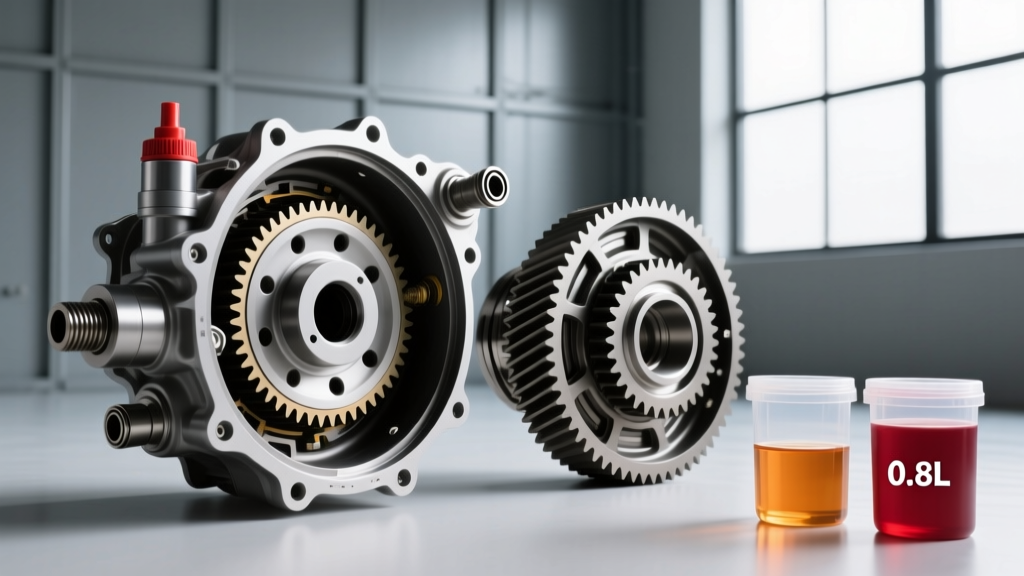
This mechanical complexity means the SH-AWD rear end is not a single fluid bath. It is a dual-chamber system requiring two entirely different chemical formulations to operate correctly.
Fluid Chemistry: Why You Cannot Mix Them
The most common mistake DIYers make during an Acura RDX rear differential fluid change is assuming a universal 75W-90 GL-5 gear oil is sufficient for all components. This is a critical error. Hypoid gears require high sulfur-phosphorus EP additives to prevent metal-on-metal scoring under extreme shearing forces. However, those exact same EP additives will degrade the friction modifiers on the SH-AWD clutch packs, causing violent shuddering and premature wear.
| Differential Type | Chamber / Component | OEM Fluid Specification | Capacity (Approx.) | OEM Part Number |
|---|---|---|---|---|
| Standard AWD (Open) | Main Hypoid Gear Case | 75W-90 GL-5 Gear Oil | 1.1 Quarts (1.0L) | N/A (Use reputable GL-5) |
| SH-AWD (LSD/Vectoring) | Hypoid Gear Case | 75W-90 GL-5 Gear Oil | 1.1 Quarts (1.0L) | N/A (Use reputable GL-5) |
| SH-AWD (LSD/Vectoring) | Clutch Pack Case | Acura All-Wheel Drive Fluid (DPSF-II) | 1.3 Quarts (1.2L) | 08200-9011 |
Executing the Acura RDX Rear Differential Fluid Change
Whether you are servicing a standard open differential or the dual-chamber SH-AWD unit, the physical drain and fill process requires precision. The Acura RDX utilizes a compact rear subframe, meaning clearance is tight. You will need a low-profile transmission jack or high-quality jack stands to safely elevate the rear of the vehicle.
Tools, Torque Specs, and OEM Part Numbers
Before getting under the vehicle, ensure you have the following hardware. Reusing crush washers is a primary cause of differential leaks and subsequent fluid starvation.
- Socket/Wrench: 18mm hex or socket (depending on exact year plug style)
- Torque Wrench: Capable of measuring 33 lb-ft (44 Nm)
- Crush Washers: 18mm Drain/Fill Plug Gaskets (OEM Part# 94109-18000) — Buy 4 if doing an SH-AWD dual drain.
- Fluid Pump: A manual transfer pump is mandatory, as there is no top-fill access tube on the RDX rear pumpkin.
The Dual-Chamber SH-AWD Procedure
If your RDX is equipped with SH-AWD, you will notice two distinct drain plugs and two distinct fill plugs on the rear differential housing. One set is located on the main gear housing (usually facing the rear or side), and the other is located on the clutch-pack housing extension.
- Level the Vehicle: The RDX must be perfectly level to ensure accurate fluid capacities. If using ramps, ensure the front and rear are at the exact same elevation.
- Open Fill Plugs First: Always break loose the 18mm fill plugs before the drain plugs. If a fill plug is seized and you have already drained the fluid, you are stranded.
- Drain the Hypoid Gear Case: Remove the lower gear case plug. Allow the 75W-90 GL-5 to drain completely. Inspect the magnetic plug for excessive metal shavings (fine metallic paste is normal; chunks indicate ring/pinion failure).
- Drain the Clutch Pack Case: Remove the clutch case drain plug. The Acura DPSF-II fluid may smell slightly burnt if the vehicle has been driven hard; this is normal due to clutch friction.
- Replace Washers and Torque: Install new 18mm crush washers on all drain plugs. Torque to exactly 33 lb-ft (44 Nm).
- Fill the Clutch Case First: Pump Acura DPSF-II (Part# 08200-9011) into the clutch fill hole until it reaches the bottom of the threads (approx. 1.3 quarts). Torque fill plug to 33 lb-ft.
- Fill the Gear Case: Pump 75W-90 GL-5 into the gear fill hole until it weeps out (approx. 1.1 quarts). Torque fill plug to 33 lb-ft.
Diagnostic Guide: Open vs. LSD Failure Modes
How do you know if your differential is failing before you pull the drain plug? The symptoms vary wildly based on the differential type.
- Open Differential Whine: A steady, high-pitched whine that changes pitch with vehicle speed (not engine RPM) usually indicates worn pinion bearings or improper ring-and-pinion backlash. This requires a full teardown and rebuild.
- LSD/SH-AWD Chatter: If you feel a rhythmic shuddering or binding sensation in the rear end during tight, low-speed parking lot turns, your clutch pack fluid is degraded. The friction modifiers in the DPSF-II have broken down, causing the clutches to grab and release violently. An immediate Acura RDX rear differential fluid change usually resolves this.
- SH-AWD Warning Light: If the SH-AWD warning light illuminates on the dash, the system has disabled torque vectoring. While this can be a sensor issue, it is frequently triggered by degraded clutch fluid causing the ECU to detect abnormal clutch slip ratios.
Buyer’s Guide: Rebuild vs. Replace in 2026
If your fluid analysis reveals chunky metal, or your SH-AWD clutch packs are physically worn beyond the fluid's ability to compensate, you face a decision: rebuild or replace.
As of 2026, rebuilding an SH-AWD rear differential is generally not recommended for independent shops or DIYers. The internal clutch pack clearances and electromagnetic calibration require specialized dealer-level tools. A complete OEM replacement rear differential assembly for an SH-AWD RDX typically ranges from $2,800 to $3,600 for the part alone, with dealership labor adding another $800 to $1,200.
Conversely, a standard open differential (if sourced from a salvage yard or aftermarket supplier) is vastly cheaper, often hovering around $600 to $900, and can be rebuilt by a competent drivetrain specialist using standard bearing and seal kits for under $400 in parts.
Expert Tip: Never attempt to 'flush' an SH-AWD differential by running the vehicle with the rear wheels elevated while the fluid is drained. The clutch packs will generate immense heat without the DPSF-II fluid to absorb and dissipate the thermal load, permanently glazing the friction material in a matter of minutes. Always perform a static drain and fill.
Ultimately, whether you are maintaining a base open differential or the sophisticated SH-AWD limited-slip system, adhering to the 30,000-mile severe service interval (or 60,000-mile normal interval) using exact OEM fluid specifications is the only way to protect your drivetrain investment. For further technical reading on torque-vectoring axles, consult Car and Driver's engineering breakdowns or your local dealer's service portal.