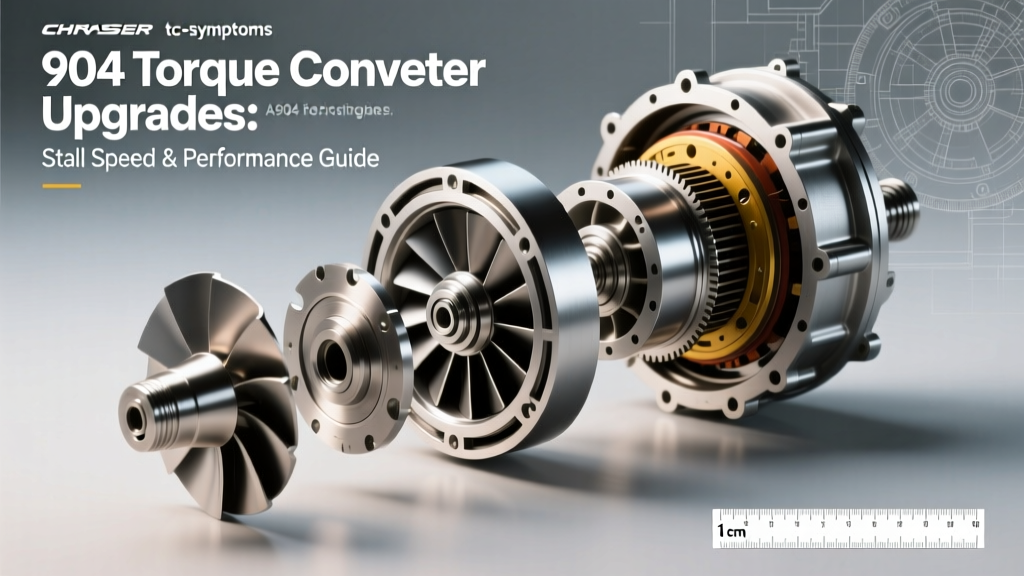
The A904 Legacy in Modern Performance Builds
The Chrysler TorqueFlite A904—also widely known by its later designations like the 30RH, A998, and A999—remains one of the most revered three-speed automatic transmissions in automotive history. Even in 2026, its lightweight compact architecture makes it a top-tier choice for AMC V8 swaps, classic Dodge drag cars, and Jeep rock-crawling rigs. However, the factory 904 torque converter is the ultimate bottleneck in any high-horsepower or high-torque application. Designed in the mid-20th century for mild street manners and fuel economy, the OEM stamped-steel converter simply cannot survive the extreme hydraulic pressures and centrifugal forces generated by modern performance camshafts, superchargers, or sticky drag radials.
Upgrading your 904 torque converter is not merely about achieving a higher stall speed; it is about managing torque multiplication, protecting the transmission's front pump, and ensuring efficient power transfer to the wheels. Whether you are building a 450-horsepower small-block bracket car or a low-geared trail rig, understanding the fluid dynamics and mechanical limits of the A904 converter is critical for a reliable build.
Decoding A904 Converter Architecture and Spline Counts
Before selecting a performance unit, you must verify your input shaft configuration. The A904 family primarily utilizes two distinct input shaft spline counts, which dictate converter compatibility:
- 23-Spline Input Shaft: The most common variant, found in Jeep applications (paired with the AMC 258 inline-six and 4.0L engines), early Dodge Slant-6 setups, and standard AMC V8s. Most aftermarket performance converters for the A904 default to this spline count.
- 26-Spline Input Shaft: Typically reserved for heavier-duty applications, certain high-torque Dodge V8 configurations, and aftermarket billet input shaft upgrades designed to handle 600+ lb-ft of torque.
OEM converters for the A904 generally measure either 11.75 inches or 10.5 inches in diameter. While the larger diameter provides excellent low-end torque multiplication for heavy vehicles, it carries a higher rotational mass and increased risk of centrifugal ballooning at high RPMs. For dedicated performance applications, builders almost universally step down to a 10-inch or 9-inch aftermarket converter to reduce rotating mass, lower parasitic drag, and safely increase engine RPM limits.
Stall Speed Dynamics: Flash vs. Foot-Brake
When shopping for a performance 904 torque converter, 'stall speed' is the most heavily marketed—and most frequently misunderstood—specification. To properly match a converter to your engine's powerband, you must distinguish between the two primary measurements of stall.
Foot-Brake Stall
Foot-brake stall is the maximum RPM the engine can achieve while the transmission is in gear, the brakes are fully locked, and the throttle is pushed to the floor. This number is heavily dependent on the engine's low-end torque output and the vehicle's braking capacity. If you install a 3,500 RPM converter in a lightweight drag car with weak brakes, you may never see the true stall speed on the tachometer before the tires break loose or the brakes fail.
Flash Stall
Flash stall is the true performance metric. It is the RPM at which the converter 'catches' and begins to multiply torque during a wide-open-throttle (WOT) launch from a roll or off the trans-brake. Flash stall is dictated by the stator fin angle and the internal turbine clearance. For a performance 904 torque converter, you want the flash stall to align precisely with the bottom edge of your camshaft's powerband. If your engine makes peak torque at 4,200 RPM, a converter that flashes at 3,800 to 4,000 RPM will allow the engine to instantly enter its optimal power window upon launch, shaving tenths of a second off your 60-foot times.
The Ballooning Effect: Why Stock Converters Explode
The most catastrophic failure mode of a factory A904 torque converter is 'ballooning.' The OEM converter cover is made of relatively thin stamped steel. When subjected to high line pressures (150+ PSI) and high rotational speeds (above 5,000 RPM), centrifugal force causes the steel cover to expand outward like a balloon.
This expansion has severe consequences:
- Front Pump Destruction: As the cover balloons forward, it pushes the entire converter assembly toward the engine block. This misaligns the converter hub inside the transmission, instantly destroying the front pump bushing and scoring the pump housing.
- Pressure Loss: The physical expansion increases the internal volume of the converter, causing a sudden drop in hydraulic line pressure, which leads to immediate clutch pack slip and burnt friction materials.
- Catastrophic Rupture: In extreme cases, the welded seams of the stamped steel cover will rupture under pressure, sending shrapnel through the transmission bell housing.
To combat this, modern performance 904 torque converters utilize anti-ballooning plates (internal steel rings that brace the cover) or fully billet steel covers machined from a single block of aircraft-grade alloy. Furthermore, the internal fins must be furnace-brazed rather than torch-brazed to withstand the extreme thermal cycling of WOT drag passes.
Performance 904 Torque Converter Application Matrix
Selecting the right converter requires matching the internal stator design to your specific use case. Below is a comparison matrix for common A904 performance builds in 2026:
| Application | Target Flash Stall | Cover Material | Stator Design | Est. Cost (USD) |
|---|---|---|---|---|
| Street/Strip (Mild Cam) | 2,400 - 2,800 RPM | Heavy-Duty Stamped w/ Anti-Balloon Plate | Standard Fin Angle (Tight) | $350 - $450 |
| Bracket Drag (Solid Roller) | 4,000 - 5,500 RPM | Billet Steel Cover | Aggressive Fin Angle (Loose) | $750 - $1,100 |
| Rock Crawling / Trail | 1,800 - 2,200 RPM | Reinforced Stamped | High-Torque Multiplication Stator | $400 - $600 |
Top Upgrade Paths and Builder Recommendations
When sourcing a performance 904 torque converter, relying on established manufacturers with rigorous dyno-testing protocols is essential. Here are three benchmark options depending on your build goals:
1. TCI Automotive Breakaway Series (Part #141100)
For dual-purpose street/strip AMC and Jeep builds, the TCI Automotive Breakaway series is a staple. Rated for a 2,400 RPM stall (in a standard 350ci V8 equivalent), it features furnace-brazed fins and a heavy-duty anti-ballooning plate. It provides excellent street manners while allowing a mild performance cam to breathe at the stoplight. Expect to pay around $380.
2. Hughes Performance Pro Street (Part #HP2418)
Hughes Performance offers the HP2418, specifically tailored for the AMC/Jeep 23-spline A904 applications. Hughes utilizes a proprietary stator design that maximizes torque multiplication off the line without generating excessive heat during highway cruising. This unit handles up to 450 horsepower reliably and is a favorite among AMC V8 swap enthusiasts.
3. PTC Custom 10-Inch Billet Race Converter
For dedicated drag cars running trans-brakes and 5,000+ RPM flash stalls, off-the-shelf units will not suffice. Performance Torque Converters (PTC) builds custom 10-inch billet units for the A904. These feature needle bearings between the turbine and cover (instead of standard thrust washers), multi-stage stators, and custom fin angles dialed in to your exact engine dyno sheet. Pricing starts at $950 and scales with options.
Critical Installation Specs and Clearances
Even the most expensive billet 904 torque converter will fail prematurely if installed incorrectly. Adhere strictly to these installation parameters:
Pilot Clearance: Once the transmission is bolted to the engine block, there MUST be a minimum of 0.125 inches (1/8') and a maximum of 0.250 inches (1/4') of clearance between the converter mounting pads and the flexplate. If the converter is pulled forward to meet the flexplate, you will destroy the front pump upon startup.
Fastener Hardware: Never use standard hardware store bolts to mate the converter to the flexplate. Use only Grade 8 (or Metric 10.9) 3/8'-24 UNF flange bolts. Apply a medium-strength threadlocker (such as Loctite 243) and torque them to 35-40 lb-ft in a star pattern.
Line Pressure Upgrades: Performance converters require higher hydraulic pressure to prevent internal clutch slip and converter drain-back. The stock A904 regulator spring provides roughly 120-145 PSI. For a high-stall performance converter, install an aftermarket pressure regulator spring to achieve 180-200 PSI in Drive. This ensures the converter remains fully charged during hard launches and prevents the stator from overrunning prematurely.
Final Thoughts on Fluid Selection
In 2026, fluid technology has advanced significantly. High-stall 904 torque converters generate immense internal heat due to fluid shearing. Do not use standard conventional ATF. Opt for a high-quality synthetic fluid with robust shear stability and high flash points, such as Red Line C+ or a dedicated synthetic racing ATF. Pair this with a high-capacity external transmission cooler and a deep-cast aluminum pan to increase fluid volume, ensuring your A904 drivetrain survives the brutal forces of modern performance driving.