The Reality of Automatic Transmission Clutch Failures
When drivers hear the word 'clutch,' they typically envision a manual pedal assembly, a throw-out bearing, and a single friction disc. However, modern automatic transmissions contain anywhere from four to eight individual wet friction clutch packs, along with a complex Torque Converter Clutch (TCC). Diagnosing automatic transmission clutch problems requires a fundamental understanding of hydraulic apply circuits, friction material degradation, and mechanical clearances. A single failing seal or fatigued wave plate can cascade into catastrophic lube circuit contamination.
In this comprehensive diagnostic guide, we will dissect the most prevalent automatic clutch failures in the ubiquitous GM 6L80/6L90 and ZF 8HP platforms. Furthermore, because the transmission teardown bench demands strict contamination control, we are including our highly requested 2026 Buyer's Guide for the best clutch gear mug and shop-safe drinkware to keep your bench pristine and your coffee hot during 10-hour rebuilds.
GM 6L80 / 6L90: The 3-5-R Wave Plate Epidemic
The GM 6L80 and 6L90 transmissions are engineering marvels that suffer from one glaring mechanical Achilles heel: the 3-5-R clutch wave plate. This stamped steel cushion plate (GM Part # 24254103) is designed to soften the apply stroke of the 3-5-R piston. Unfortunately, the metallurgy and stamping process leave it prone to fatigue fracturing, usually between 80,000 and 130,000 miles.
Symptoms and Teardown Evidence
Before you even drop the pan, the diagnostic clues are present. Vehicles will often exhibit a harsh 2-3 shift, a flaring 3-5 shift, or a complete loss of 3rd, 5th, and Reverse. When you drop the transmission pan, the presence of fine, glitter-like steel debris mixed with larger, curved metal shards is the hallmark of a fractured wave plate.
Once the transmission is on the bench, the debris from the shattered wave plate migrates through the lube circuit. You must inspect the following components for secondary damage:
- Valve Body Solenoids: Fine steel particles embed in the solenoid screens, causing restricted flow and erratic line pressure.
- Torque Converter: The TCC apply circuit becomes contaminated. A mandatory converter cut-and-clean or replacement is required; flushing is insufficient.
- Pump Stator Support: Check the stator support bushing for scoring. Debris caught between the bushing and the torque converter hub will destroy the front pump seal.
Air Testing and Clearance Specifications
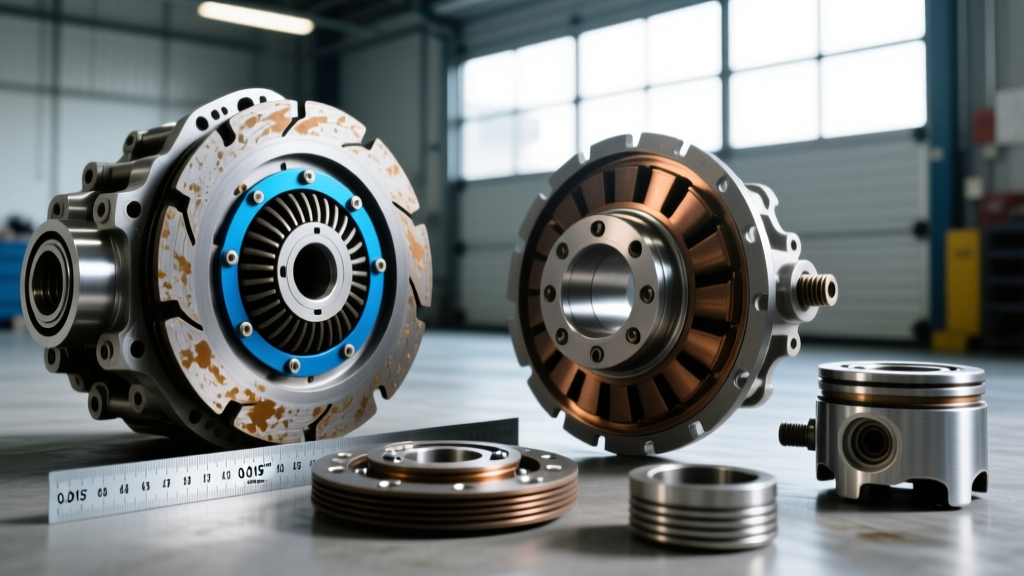
When rebuilding the 3-5-R drum, you must replace the wave plate with an updated flat steel apply plate or an aftermarket reinforced wave plate from suppliers like Sonnax. When air-testing the 3-5-R piston, apply 30 to 45 PSI of shop air to the case apply passage. The piston should stroke smoothly with a dull thud. If you hear a hissing sound, the EPDM piston seals have hardened and are bypassing hydraulic pressure. Target clutch pack clearance for the 3-5-R drum is strictly 0.040' to 0.065'. Always use a dial indicator and apply 50 lbs of downward pressure on the pressure plate to simulate hydraulic clamping force.
ZF 8HP Platform: Mechatronic Leaks and Module Degradation
The ZF 8HP (8HP45, 8HP70, 8HP90) is the gold standard of modern automatics, utilizing a Lepelletier gearset mated to a Ravigneaux planetary set. It relies on five friction clutch modules (A, B, C, D, E) and two brakes. Clutch problems in the ZF 8HP rarely stem from the friction materials themselves; instead, they originate from hydraulic leaks in the mechatronic unit and the transmission case.
The Adapter Sealing Sleeve Failure
A common complaint on 8HP units (especially in Chrysler, BMW, and Jaguar applications) is a delayed engagement into Drive or Reverse, accompanied by a 'Transmission Fault' message. This is frequently caused by the failure of the mechatronic adapter sealing sleeves. These plastic sleeves route fluid from the valve body to the clutch modules. Over time, heat cycling causes the plastic to crack, bleeding apply pressure directly into the pan.
According to data published by the Automatic Transmission Rebuilders Association (ATRA), replacing these sleeves requires dropping the mechatronic unit. The retaining torx bolts must be torqued precisely to 8 Nm (71 lb-in) during reinstallation to prevent warping the valve body casting. Never reuse the old plastic sleeves; always install updated ZF factory sealing kits.
Module A and B Clutch Drum Wear
Modules A and B are applied in almost every forward gear ratio, making them the highest-wear components. During teardown, inspect the inner splines of the aluminum clutch drums. The steel friction plates can gall the aluminum splines, preventing the clutch pack from releasing fully. This causes 'drag,' leading to severe overheating and burnt friction material. If spline wear exceeds 0.005' of lateral play, the entire drum assembly must be replaced.
Diagnostic Data: Clearances and Torque Specifications
Precision is non-negotiable in automatic transmission rebuilding. Below is a reference chart for critical clearances and torque specs when diagnosing and reassembling common automatic clutch packs.
| Transmission Model | Clutch Component | Target Clearance / Spec | Common Failure Mode |
|---|---|---|---|
| GM 6L80 / 6L90 | 3-5-R Clutch Pack | 0.040' - 0.065' | Wave plate fatigue / fracture |
| GM 6L80 / 6L90 | Valve Body to Case | 8 Nm (71 lb-in) | Warped casting causing cross-leaks |
| ZF 8HP45 / 8HP70 | Module A & B Packs | 0.035' - 0.055' | Aluminum drum spline galling |
| ZF 8HP45 / 8HP70 | Mechatronic Sleeve Torque | 4 Nm (35 lb-in) | Cracked plastic adapter seals |
| Ford 6R80 | Torque Converter Clutch (TCC) | 0.020' - 0.035' Lining | Lock-up shudder / P0741 Code |
Torque Converter Clutch (TCC) Diagnostics
No discussion of automatic clutch problems is complete without addressing the Torque Converter Clutch. The TCC is essentially a massive, single-plate wet clutch located inside the torque converter. When the Powertrain Control Module (PCM) commands TCC apply, it modulates the TCC PWM solenoid to slip the clutch slightly for smooth lock-up.
If a vehicle exhibits a high-frequency vibration (shudder) at highway speeds between 45-60 MPH, the TCC friction lining is likely degraded, or the TCC regulator valve in the valve body is bore-worn, causing erratic apply pressure. Before condemning the torque converter, monitor the TCC slip RPM via a bi-directional scan tool. Under steady-state cruise, TCC slip should be less than 20 RPM. If slip fluctuates wildly while the PWM solenoid duty cycle remains steady, you have a hydraulic control issue, not necessarily a mechanical clutch failure.
Shop Survival: 2026 Clutch Gear Mug Buyer's Guide
Let's talk shop environment. You have just spent four hours meticulously cleaning a ZF 8HP mechatronic valve body in an ultrasonic cleaner. Your hands are stained with ATF, and you are exhausted. You reach for your coffee. If you are using a standard, open-top ceramic clutch gear mug you bought at a swap meet, you are introducing a massive contamination risk to your rebuild.
Ceramic mugs chip. Microscopic ceramic dust and dried coffee residue can easily fall into open valve body bores or clutch apply passages, causing sticky valves and ruined friction plates. Furthermore, a spill on the teardown bench can compromise your precision measurements. As part of our commitment to total shop excellence, here is our 2026 comparison of shop-safe drinkware for the serious transmission diagnostician.
1. The Classic OEM Ceramic Clutch Gear Mug
- Pros: Inexpensive, features great vintage manual transmission graphics, microwave safe.
- Cons: Open top invites shop dust, chips easily, poor heat retention, spill hazard over expensive scan tools.
- Verdict: Keep it in the front office or breakroom. Never bring it to the clean teardown bench.
2. Vacuum-Insulated Stainless Steel Tumblers (e.g., Yeti, TruEarth)
- Pros: Unbreakable, exceptional heat retention (keeps coffee hot through a 6L90 teardown), sweat-proof exterior prevents moisture rings on service manuals.
- Cons: Higher upfront cost ($30-$45), cannot be microwaved if you forget it on the bench.
- Verdict: The baseline requirement for any modern transmission lab.
3. Magnetic Auto-Sealing Shop Mugs (e.g., Contigo Autoseal)
- Pros: 100% spill-proof, magnetic slider keeps airborne clutch dust and friction material out of your beverage, one-handed operation when holding a torque wrench.
- Cons: Complex lid mechanism requires thorough weekly disassembly to clean out trapped coffee oils.
- Verdict: The ultimate choice for the lead diagnostician working under vehicles or inside tight transmission bays.
Final Assembly and Verification
Diagnosing automatic transmission clutch problems requires moving beyond simple code reading. It demands an understanding of hydraulic circuits, metallurgy, and precise mechanical tolerances. Whether you are air-testing a GM 6L80 piston or replacing the mechatronic seals on a ZF 8HP, always rely on verified torque specifications and dial-indicator clearances rather than 'feel.'
Equip your bench with the right tools, reference the latest technical service bulletins from authorities like ZF Aftermarket and Sonnax, and maintain a contamination-free workspace—even if that means retiring your favorite open-top clutch gear mug to the office desk. Precision in diagnostics and assembly is the only way to ensure the transmission survives the next 150,000 miles.