The Great Truck Transmission Dilemma: Chrysler vs. GM
If you are diving into the world of late-model truck repairs, you have likely found yourself staring at the internals of either a Chrysler 65RFE or a GM 6L80/6L80E. Both are legendary heavy-duty and light-duty workhorses, but they represent entirely different engineering philosophies. For a first-time rebuilder, understanding the nuances between sourcing a 65RFE transmission rebuild kit and tackling a 6L80E overhaul is critical to your success—and your wallet.
As of 2026, the aftermarket support for both of these units is massive, but the failure points, required tools, and hidden costs vary wildly. This beginner-friendly explainer will break down exactly what you need to know before you order your master kit, drop the pan, and start unbolting bell housings.
What Exactly is Inside a Transmission Rebuild Kit?
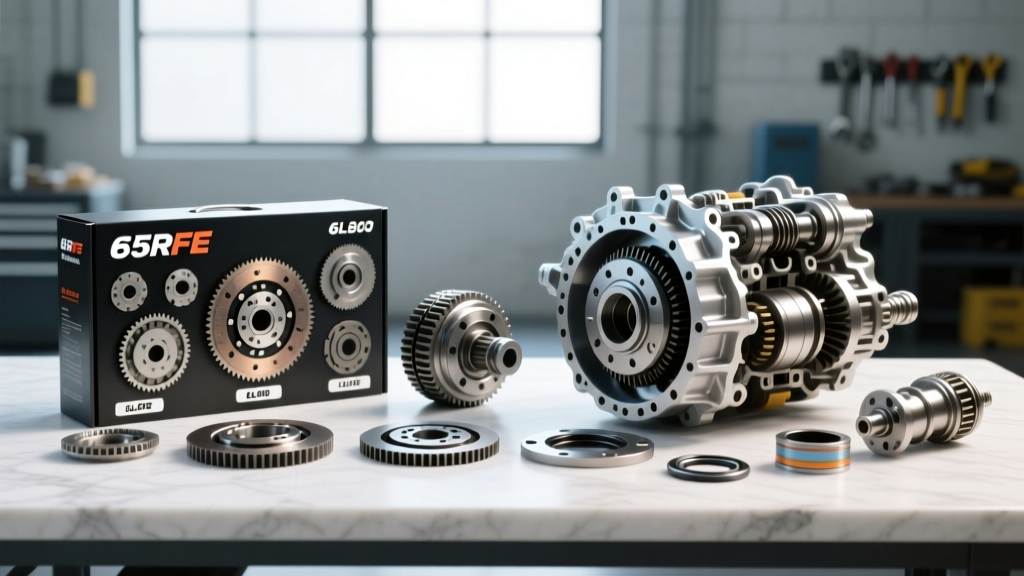
Before we compare the two specific models, beginners must understand what a 'rebuild kit' actually includes. When you order a Master Overhaul Kit from suppliers like Transtar Industries, you are primarily getting the wearable soft parts.
- Friction Clutches: The paper/cellulose-lined discs that engage the gears.
- Steel Plates: The smooth metal discs that sit between the frictions.
- Gaskets and Seals: Paper/rubber pan gaskets, valve body gaskets, and O-rings.
- Lip Seals and Piston Rings: Crucial for maintaining hydraulic pressure inside the clutch drums.
What is NOT included: Hard parts (planetary gears, clutch hubs, shafts), the torque converter, the valve body, and electronic solenoids. If your transmission suffered a catastrophic failure that scattered metal debris, a standard kit will not be enough; you will need to source individual hard parts.
Exploring the 65RFE Transmission Rebuild Kit
The Chrysler 65RFE (and its 6-speed flashed cousin, the 66RFE) is a staple in Dodge Ram 1500 and 2500 trucks. When you purchase a 65RFE transmission rebuild kit, you are dealing with a highly unique hydraulic design.
The Dual Input Clutch Design
Unlike most traditional automatics that use a single input clutch to connect the engine to the geartrain, the 65RFE uses a dual input clutch setup. This means there are two separate input clutches working in tandem to manage torque load. When rebuilding, you must pay meticulous attention to the sequence of the frictions and steels in this specific drum. Mixing up the thickness of the selective snap rings here will result in immediate slipping or binding upon first startup.
Common 65RFE Failure Points
According to technical bulletins from the Automatic Transmission Rebuilders Association (ATRA), the 65RFE is notorious for Underdrive Clutch Hub failure. The splines on the hub can strip, causing a total loss of forward movement. Furthermore, the integrated Solenoid/TRS (Transmission Range Sensor) block mounted on the valve body is a frequent culprit for erratic shifting and limp-mode codes. While your rebuild kit will include the gaskets to reseal the valve body, be prepared to spend an additional $150 to $250 on a replacement Mopar solenoid pack if yours tests out of spec.
The 6L80/6L80E Transmission Rebuild Guide
Switching gears to General Motors, the 6L80 and 6L80E (found in Silverados, Tahoes, and Camaros) present a completely different set of challenges. The 6L80E is a robust 6-speed, but its electronic integration makes it a steeper learning curve for beginners.
The TEHCM Factor
The most critical component in a 6L80E rebuild is the TEHCM (Transmission Electro-Hydraulic Control Module). Unlike older transmissions where the TCM was mounted externally under the hood or dash, the 6L80E houses the computer, the solenoids, and the pressure switches inside the transmission pan, bolted directly to the valve body.
Beginner Warning: If you are replacing a failed TEHCM, you cannot simply plug and play. The new module must be flashed with the vehicle's specific calibration data using a J2534 pass-through programming tool. Factor in the cost of a professional mobile tech to flash the module if you do not own advanced bi-directional scanning tools.
The 1-2-3-4 Clutch Wave Plate Issue
A massive pain point in the 6L80E is the failure of the 1-2-3-4 clutch wave plate. Over time, this thin steel disc fatigues and shatters, sending shrapnel through the clutch pack and destroying the apply piston. When ordering your 6L80E rebuild kit, it is highly recommended to upgrade to a reinforced aftermarket wave plate, such as those engineered by Sonnax Tech Resources, to prevent a repeat failure.
Cost & Specification Breakdown
Understanding the financial and technical differences between these two units will help you budget your weekend project accurately. Below is a direct comparison of the 65RFE and 6L80E based on 2026 aftermarket pricing and factory specifications.
| Feature / Spec | Chrysler 65RFE | GM 6L80 / 6L80E |
|---|---|---|
| Master Rebuild Kit Cost | $250 - $350 | $320 - $450 |
| Common Hard Part Failure | Underdrive Clutch Hub | 3-5-R Clutch Hub / Wave Plate |
| Control Module Location | External (TCM) | Internal (TEHCM in Pan) |
| Required Fluid Type | Mopar ATF+4 | Dexron VI |
| Dry Fill Capacity | ~12.5 Quarts | ~11.2 Quarts |
| Valve Body Torque Spec | 35 - 45 in-lbs | 80 in-lbs (TEHCM to VB) |
Hidden Costs and Essential Tools for Beginners
Whether you are installing a 65RFE transmission rebuild kit or piecing together a 6L80E, the kit itself is only about 30% of your total budget. Beginners frequently underestimate the 'hidden' costs of a proper rebuild.
The Torque Converter
Never reuse an old torque converter on a high-mileage truck. The internal clutch material degrades, and the stator bearings fail. A remanufactured heavy-duty torque converter will add $350 to $600 to your bill, but skipping this step is the fastest way to destroy your freshly rebuilt transmission within 5,000 miles.
Specialty Tools You Cannot Skip
You cannot rebuild a modern automatic transmission with just a socket set. To do the job correctly, you must invest in:
- Inch-Pound Torque Wrench: Valve body bolts and TEHCM fasteners require precise, low-torque settings. Overtightening a 6L80E valve body will warp the aluminum casting, causing immediate cross-leaks and pressure loss.
- Dial Indicator and Magnetic Base: You must measure clutch pack clearances. A general rule of thumb for both the 65RFE and 6L80E is to aim for 0.040' to 0.070' of total play in a clutch drum. If the clearance is too tight, the clutches will burn up; too loose, and the transmission will shift sluggishly.
- Clutch Spring Compressor: Both transmissions utilize heavy return springs in the clutch pistons. Attempting to compress these with C-clamps is dangerous and will likely result in the snap ring flying across your garage.
Final Verdict for the Weekend Wrench
If you are a beginner looking for a slightly more forgiving mechanical experience, the 65RFE transmission rebuild kit route offers a more traditional hydraulic layout, provided you respect the dual-input clutch sequencing and replace the solenoid block. However, if you are tackling the GM 6L80/6L80E, you must be prepared to deal with internal electronics, J2534 programming, and precise TEHCM torque specs.
Whichever truck is sitting on your lift, take your time, document your teardown with photos, and never force a component into place. Precision, cleanliness, and adherence to factory torque specs are the true secrets to a transmission that shifts like new for another 150,000 miles.