The CD6 Platform Shift: Why RWD Changes the NVH Game
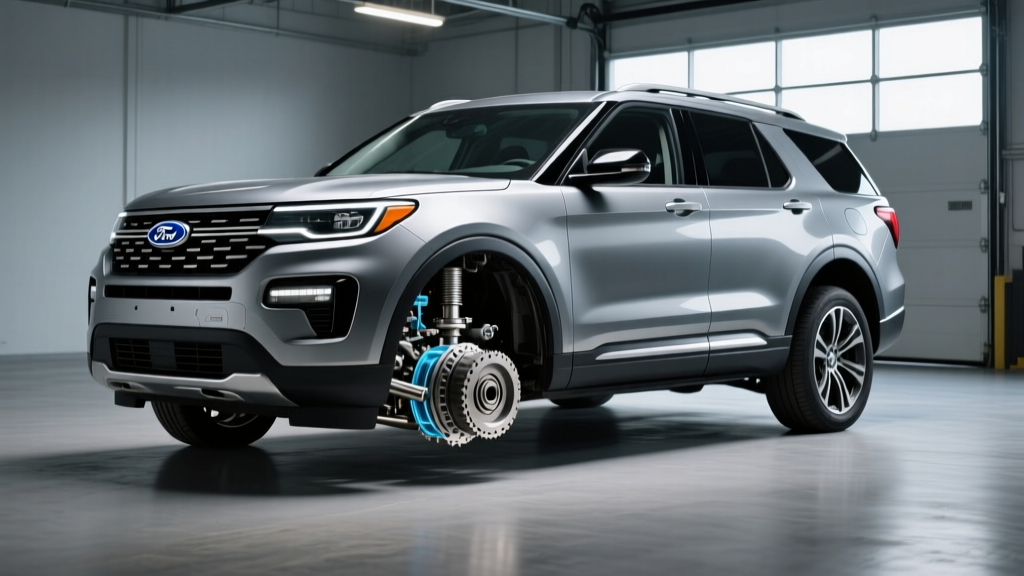
When researching 2025 Ford Explorer drivetrain options, RWD standard configurations utilize a longitudinal power flow that fundamentally alters the vehicle's Noise, Vibration, and Harshness (NVH) profile. Unlike the older D4-platform Explorers that relied on a transverse front-wheel-drive-biased architecture, the current CD6 platform routes power from the longitudinally mounted 10R60 (2.3L EcoBoost) or 10R80 (3.0L EcoBoost) 10-speed automatic transmission directly to the rear differential via a multi-piece driveshaft.
As we move through 2026, early CD6-platform Explorers are beginning to age out of their initial 5-year/60,000-mile powertrain warranties. Consequently, independent shops and DIY enthusiasts are seeing a surge in driveline NVH complaints. Diagnosing a vibrating driveshaft on a RWD-biased unibody SUV requires a completely different approach than older body-on-frame trucks, as the unibody floor pan acts as a massive sounding board for high-frequency harmonic resonances.
Deconstructing the Vibration: Frequencies and Failure Modes
Before throwing parts at a vibration, you must isolate the frequency. A common mistake is replacing a perfectly balanced driveshaft when the true culprit is a degraded rear differential pinion bearing or an out-of-phase U-joint. To diagnose this accurately, we use the Pico Technology NVH diagnostic framework, which correlates vehicle speed, tire diameter, and axle ratios to specific Hertz (Hz) frequencies.
The Math Behind the Shudder
Let us calculate the 1st-order driveshaft frequency for a 2025 Explorer RWD equipped with the 2.3L EcoBoost, a 3.58 rear axle ratio, and factory 255/55R20 tires.
Tire Revs per Mile: ~650 RPM
Vehicle Speed: 70 MPH (758 Tire RPM)
Driveshaft RPM: 758 x 3.58 (Axle Ratio) = 2,713 RPM
1st-Order Frequency: 2,713 / 60 = 45.2 Hz
If your accelerometer picks up a dominant vibration peak at exactly 45.2 Hz at 70 MPH, you have a 1st-order driveshaft imbalance or a failing Center Support Bearing (CSB). If the vibration peaks at 90.4 Hz (2nd order), you are likely dealing with excessive U-joint working angles, a bent pinion flange, or a transfer case output shaft runout issue.
OEM vs. Aftermarket Driveshafts: 2026 Buyer's Comparison
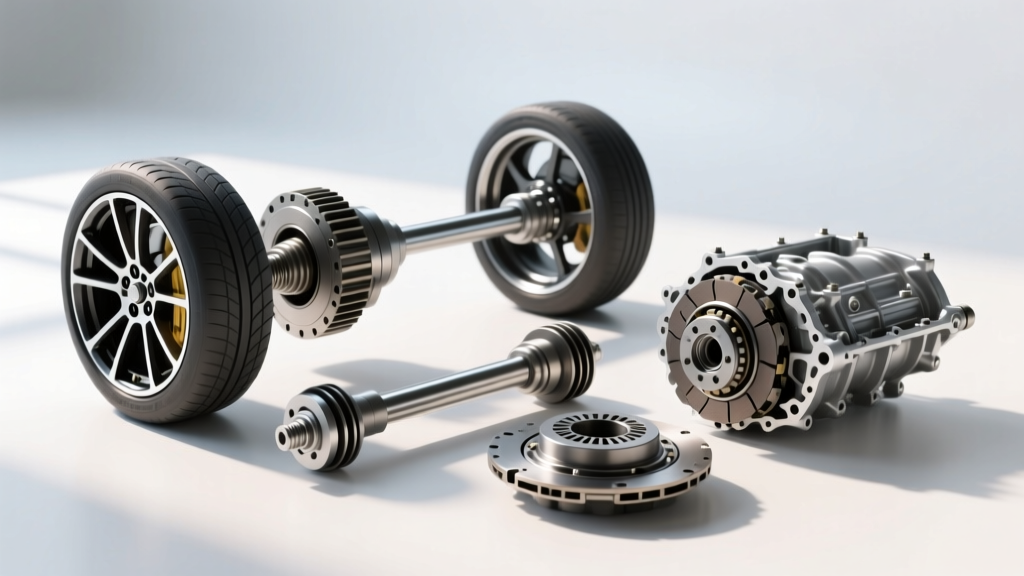
When the center support bearing fails or the aluminum shaft tubing suffers impact damage, buyers must choose between OEM Motorcraft assemblies and aftermarket alternatives. The Explorer's driveshaft is a complex, computer-balanced assembly featuring a slip yoke, a CV joint at the transmission output, and a vulcanized rubber CSB isolator.
| Feature | Motorcraft OEM Assembly | Dorman OE Solutions (Aftermarket) | Custom Spicer/Dana Built Shaft |
|---|---|---|---|
| Approx. Cost (2026) | $950 - $1,250 | $450 - $650 | $800 - $1,100 |
| CSB Isolator Quality | OE-spec vulcanized rubber | Standard rubber (prone to early NVH) | Heavy-duty polyurethane or OE rubber |
| Balancing Method | High-speed dynamic (Haweka) | Static or low-speed dynamic | High-speed dynamic (Pin-point accuracy) |
| Warranty | 2-Year Unlimited Mileage | Limited Lifetime | 1 to 3 Years depending on builder |
| Best For | Dealerships, Warranty Claims, NVH Purists | Budget Repairs, High-Mileage Fleet Vehicles | Lifted Explorers, Towing/Heavy Duty Use |
Expert Tip: If you opt for an aftermarket shaft, inspect the U-joint strap bolts and the slip yoke splines immediately upon unboxing. Aftermarket splines occasionally suffer from poor machining tolerances, leading to 'slip yoke clunk' when shifting from Park to Reverse.
Common Edge Cases: Phasing Errors and Slip Yoke Clunk
The 10R60 and 10R80 transmissions generate immense low-RPM torque. If the driveshaft was previously removed and reassembled without marking the yoke-to-tube relationship, the U-joints may be out of phase. An out-of-phase driveshaft cancels out the velocity fluctuations inherent to U-joint operation, resulting in a severe 2nd-order cyclic vibration that feels like a rhythmic 'wobble' in the seat pan.
Furthermore, 'slip yoke clunk'—a loud bang when engaging Drive or Reverse—is common on high-mileage CD6 Explorers. This occurs when the internal splines of the slip yoke dry out or develop micro-pitting. While Spicer/Dana recommends specialized spline greases (like Ford PTFE XL-3), severe pitting requires replacing the entire front shaft assembly, as the slip yoke is often welded to the front tube section on these specific OEM shafts.
Precision Torque Specs and Installation Protocol
Improper torque is the leading cause of post-installation driveshaft vibrations. The center support bearing must be pre-loaded correctly; if bolted down while under torsional stress, the rubber isolator will tear within 5,000 miles. Always follow this installation sequence:
1. Center Support Bearing (CSB) Pre-load
- Leave the CSB mounting bolts finger-tight.
- Install the rear differential pinion flange bolts and torque to spec.
- Install the transmission/transfer case output flange bolts.
- With the driveshaft fully seated and resting at its natural ride height, tighten the CSB bolts. This ensures the rubber isolator is centered and not twisted.
2. Critical Torque Specifications (CD6 Platform)
- Center Support Bearing to Crossmember: 35 Nm (26 lb-ft)
- Driveshaft to Rear Diff Pinion Flange (U-Joint Straps): 20 Nm (15 lb-ft) (Use new stretch bolts if equipped with torque-to-yield hardware)
- Front CV Joint to Transmission Output Flange: 45 Nm (33 lb-ft)
- Rear Axle Pinion Flange Nut: 285 Nm (210 lb-ft) (Prevailing torque nut; never reuse. If the flange is removed, the crush sleeve must be replaced and pre-load reset).
Sourcing the Right Parts: VIN is King
When sourcing replacement parts via Ford Parts Direct or local dealerships, never order a driveshaft by 'Year/Make/Model' alone. The 2025 Ford Explorer features multiple wheelbase and suspension configurations that alter the distance between the transmission output shaft and the rear differential pinion flange by millimeters. A shaft that is even 4mm too long will bottom out the slip yoke, destroying the transmission output seal and the transfer case bearing. Always provide your exact 17-digit VIN to the parts counter to ensure the correct spline count, shaft length, and CV joint configuration are supplied.
Final Diagnostic Verdict
Diagnosing driveline vibration on the RWD-standard 2025 Explorer requires moving beyond the old 'road test and guess' methodology. By utilizing NVH frequency analysis, understanding the mathematical relationship between axle ratios and driveshaft RPM, and adhering to strict CSB pre-load protocols, you can eliminate cabin resonance and restore the premium ride quality Ford engineered into the CD6 platform. Whether you choose an OEM Motorcraft assembly for guaranteed NVH compliance or a custom Dana/Spicer build for heavy-duty towing, precision installation remains the ultimate deciding factor in long-term drivetrain reliability.