The Hidden Costs of 4L60E Cooler Line Adapters
When budgeting for a complete 4l60e transmission cooler kit, most enthusiasts and fleet mechanics focus entirely on the heat exchanger itself. Whether you are installing a stacked-plate Derale Hyper-Cool or a heavy-duty Mishimoto auxiliary cooler, the primary hardware usually commands $80 to $150 of your budget. However, the most frequent point of failure—and the most common source of unexpected project expenses—lies in the transmission cooler line fittings and adapters. The General Motors 4L60E (and its earlier 700R4/4L60 counterparts) utilizes specific thread pitches, quick-connect mechanisms, and line diameters that rarely mate directly to aftermarket cooler hoses without the correct transitional hardware.
In 2026, the rising cost of raw brass and zinc-plated steel has pushed the price of high-quality fluid power adapters up by roughly 15% compared to early-2020s pricing. This comprehensive cost analysis breaks down the exact expenses, part numbers, and metallurgical considerations required to plumb a 4L60E cooling system without risking a catastrophic fluid leak or internal valve body contamination.
Why the 4L60E Cooling Circuit is Unique
The 4L60E routes fluid out of the transmission case, through the radiator's internal tank cooler (or an external factory loop), and back to the lube circuit. The standard line diameter for the 4L60E is 3/8-inch. While 1/2-inch lines are found on heavier 4L80E or Allison platforms, attempting to adapt a 4L60E to 1/2-inch cooler lines often results in a pressure drop that starves the torque converter and lube circuit. Therefore, your adapter budget must focus strictly on 3/8-inch hose barbs, 3/8-inch inverted flares, and 3/8-inch quick-connects. Furthermore, the radiator side of the equation typically utilizes a 1/4-18 NPSM (National Pipe Straight Mechanical) thread or a metric O-ring boss, depending on whether you are using an OEM GM radiator or an aftermarket aluminum replacement.
2026 Market Pricing: OEM vs. Aftermarket Adapters
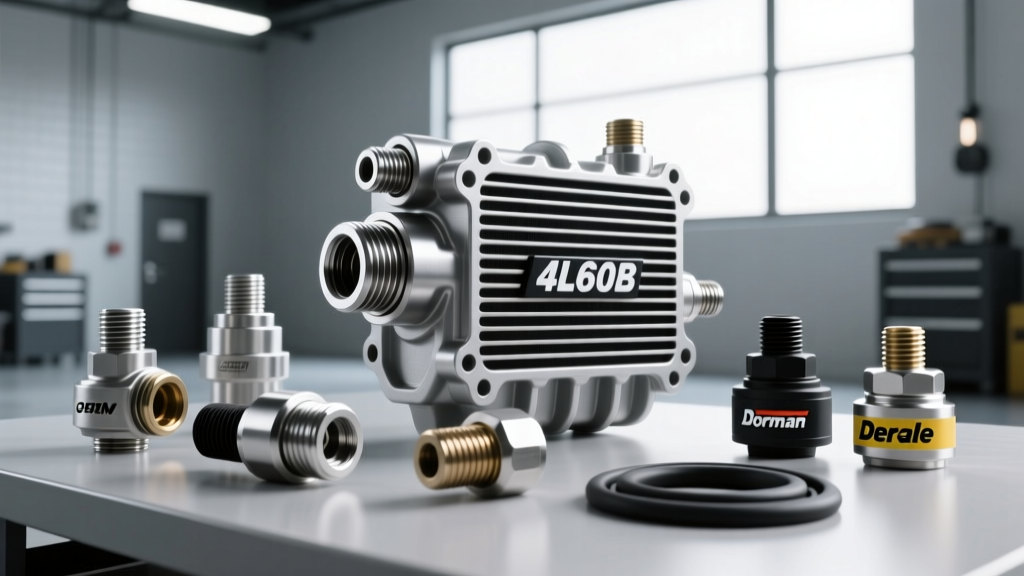
Sourcing the right adapters requires navigating a sea of cheap, poorly machined import fittings and premium domestic options. Below is a breakdown of the most common fittings required for a 4L60E cooler line swap, reflecting current 2026 market averages from major suppliers like Summit Racing and local auto parts networks.
| Part Number / Brand | Application / Thread Size | Material | Avg. Cost (2026) |
|---|---|---|---|
| Dorman 800-409 | 3/8' Quick Connect to 1/4' NPSM | Zinc-Plated Steel | $12.50 |
| Hayden 244 | 3/8' Tube to 1/4' NPSM Adapter | Forged Brass | $16.99 |
| Derale 32506 | 3/8' Inverted Flare to Hose Barb | Steel | $9.50 |
| GM Genuine 15593042 | OEM Radiator Fitting (NPSM) | Steel / Plastic Retainer | $22.00 |
| Dorman 800-410 | Assorted Quick-Connect Retaining Clips | Nylon / Spring Steel | $8.99 |
As the table illustrates, a basic set of brass and steel adapters will cost between $25 and $45. However, if your vehicle utilizes GM's push-in quick-connect lines at the radiator, you will also need specialized disconnect tools and replacement retaining clips, which we will detail below.
The NPT vs. NPSM Trap: Avoiding a $2,500 Mistake
The single most expensive mistake made during a 4L60E transmission cooler installation is confusing NPT (National Pipe Taper) with NPSM (National Pipe Straight Mechanical). Many budget cooler kits include cheap brass NPT adapters, assuming the user will simply wrap them in Teflon tape and force them into the radiator.
Never use an NPT fitting in an NPSM port. NPT fittings are tapered, meaning they wedge tighter as they are threaded in. The 4L60E's radiator cooler ports are NPSM, which are straight threads that rely on a rubber O-ring or a specialized nylon crush washer to create a seal. Forcing a tapered NPT fitting into a straight NPSM aluminum or plastic radiator tank will apply immense outward hydraulic pressure, inevitably cracking the tank. A cracked radiator tank leads to cross-contamination of coolant and ATF (the infamous 'strawberry milkshake'), which destroys the 4L60E's clutch packs and requires a complete transmission rebuild—a $2,500+ mistake born from a $10 fitting.
Expert Torque Spec: When installing a 1/4-18 NPSM adapter into an aluminum radiator tank, the maximum torque specification is 12 to 15 ft-lbs. Over-torquing will strip the soft aluminum threads or warp the tank weld. Always use a calibrated inch-pound or low-range foot-pound torque wrench.
Quick-Connect Fittings: Tools and Retaining Clips
By the late 1990s and early 2000s, GM transitioned the 4L60E to quick-connect cooler lines to speed up assembly line production. These lines feature a 3/8-inch metal tube with a machined groove that locks into a spring-loaded retainer clip inside the radiator or transmission fitting. If you are cutting these lines to install a traditional hose-barb auxiliary cooler, you must budget for the proper disconnection tools and new hardware.
- Lisle 39400 Quick Disconnect Tool Set ($24.99): Attempting to pry off a GM quick-connect line with screwdrivers will gouge the metal tube, ruining the O-ring sealing surface and guaranteeing a leak. The Lisle 39400 set includes the exact 3/8-inch and 1/2-inch collet tools required to safely compress the internal retaining spring and release the line.
- Replacement Retaining Clips ($8.99 - $12.00): The internal spring clips fatigue over time. According to Hayden Automotive's installation guidelines, reusing old, heat-cycled retaining clips is a primary cause of post-installation leaks. Always budget for a Dorman 800-410 assortment kit to ensure fresh, tensioned clips are used on every connection.
Sealants and the TCC Solenoid Threat
The consumables budget for a 4L60E cooler line job is small in dollars but massive in consequence. You must allocate $10 to $15 for high-quality liquid thread sealants and replacement O-rings. Specifically, you need a sealant like Loctite 592 or Permatex 56521 (PTFE-infused liquid thread sealants) for any NPT threads used on the transmission case side or aftermarket cooler ports.
The Teflon Tape Danger: Never use standard yellow or white plumbers Teflon tape on transmission cooler fittings. As the tape is threaded, microscopic shreds of PTFE shear off and enter the ATF stream. The 4L60E relies on a highly sensitive Torque Converter Clutch (TCC) PWM solenoid, which is protected by a very fine mesh screen. Teflon tape shreds are notorious for clogging this screen, resulting in P0741 diagnostic codes, TCC shudder, and eventual converter failure. Liquid sealants cure in the absence of air and will not shed debris into the hydraulic circuit.
Additionally, budget $5 for a pack of Viton O-rings. Standard Buna-N rubber O-rings degrade rapidly when exposed to the high heat and specific chemical makeup of modern Dexron VI or synthetic ATF blends. Viton withstands temperatures up to 400°F and resists ATF chemical breakdown.
Total Project Cost Estimator for 4L60E Fittings
To provide a realistic financial picture for your 2026 build, here is the finalized budget breakdown for the fittings, tools, and consumables required to properly adapt a 4L60E to an aftermarket stacked-plate cooler using a mix of quick-connects and hose barbs:
- Brass NPSM to 3/8' Barb Adapters (x2): $34.00
- Quick-Connect to NPSM Adapters (x2): $25.00
- Lisle Disconnect Tool Set: $24.99
- Dorman Retaining Clip Assortment: $8.99
- Loctite 592 Thread Sealant: $9.50
- Viton O-Ring Assortment: $6.50
- Total Fitting & Adapter Budget: $108.98
While adding $110 to your 4L60E transmission cooler kit budget might seem steep compared to the $15 bag of mystery fittings at the local hardware store, this investment guarantees proper thread engagement, prevents galvanic corrosion, and protects the internal hydraulic circuits of the transmission. For deeper insights into maintaining proper flow rates and avoiding pressure drops across your fittings, consult the technical resources at Sonnax, which provides extensive flow-testing data on 4L60E lube and cooler circuits. By investing in the correct adapters from the start, you ensure your transmission stays cool, pressurized, and reliable for hundreds of thousands of miles.