The 10R80 Thermal Bottleneck: Why the 2019 F-150 Needs Better Cooling
The 2019 Ford F-150 represented a high-water mark for the brand’s light-duty lineup, heavily featuring the jointly developed 10R80 10-speed automatic transmission. Whether paired with the 5.0L Coyote V8 or the 3.5L EcoBoost V6, the 10R80 delivers lightning-fast shifts and impressive towing capabilities. However, this dense gear ratio spread comes with a hidden cost: immense thermal generation. Every shift cycle involves clutch pack friction, and the aggressive torque converter lockup strategies generate significant heat in the fluid.
For stock daily drivers, the factory cooling system is barely adequate. But if you are tuning your EcoBoost, towing near the 13,200-pound maximum capacity, or running aggressive off-road trails, the factory setup falls short. Upgrading your 2019 F150 transmission cooler is not just a preventative measure; it is a mandatory performance modification to keep the 10R80 operating within its optimal thermal window of 180°F to 200°F (82°C to 93°C). Once transmission fluid temperatures exceed 220°F, the shear stability of the fluid breaks down rapidly, leading to clutch glazing, valve body wear, and eventual limp-mode activation.
Understanding the 10R80 Thermal Bypass Valve
Before selecting an aftermarket cooler, you must understand the 10R80’s thermal management system. Unlike older transmissions that flow fluid to the cooler constantly, the 10R80 utilizes a thermal bypass valve. This valve restricts fluid flow to the coolers until the fluid reaches approximately 180°F. This design ensures the transmission warms up quickly for optimal shift quality and emissions compliance.
If you install a massive aftermarket cooler in the wrong sequence, you risk trapping cold, highly viscous fluid in the auxiliary cooler during winter months, resulting in harsh shifts and delayed torque converter lockup. The correct performance routing for a 2019 F-150 is a series circuit:
- Transmission Out: Hot fluid exits the 10R80.
- Factory Radiator Cooler / Thermal Bypass: Fluid passes through the OEM heat exchanger and bypass valve to regulate minimum operating temperatures.
- Auxiliary Aftermarket Cooler: Fluid enters the high-capacity stacked-plate cooler mounted in the grille for maximum ambient air heat rejection.
- Transmission In: Cooled, density-stable fluid returns to the 10R80 lube and clutch circuits.
Choosing the Right Cooler: Stacked-Plate vs. Tube-and-Fin
When shopping for a 2019 F150 transmission cooler upgrade, you will encounter three primary designs. For performance applications, heavy towing, and tuned trucks, the stacked-plate design is the undisputed champion.
| Cooler Type | Thermal Efficiency | Pressure Drop | Best Application | Estimated Cost (2026) |
|---|---|---|---|---|
| Tube-and-Fin | Low | High | Light-duty, stock daily drivers | $45 - $70 |
| Plate-and-Fin | Medium | Medium | Standard towing (under 8,000 lbs) | $75 - $120 |
| Stacked-Plate | High | Low | Heavy towing, tuning, off-road performance | $130 - $220 |
A premium stacked-plate cooler, such as the Derale Performance Series 9000 or equivalent Mishimoto X-Treme models, utilizes internal turbulators that force the MERCON ULV fluid to constantly change direction. This boundary-layer disruption increases the heat transfer coefficient by up to 30% over standard plate-and-fin designs, all while maintaining a low pressure drop that protects the 10R80’s internal line pressure limits.
Step-by-Step Installation & Routing Guide
Installing an auxiliary cooler on the 2019 F-150 requires moderate mechanical aptitude and specific tools to avoid damaging the factory quick-disconnect fittings.
1. Front Fascia and Bumper Removal
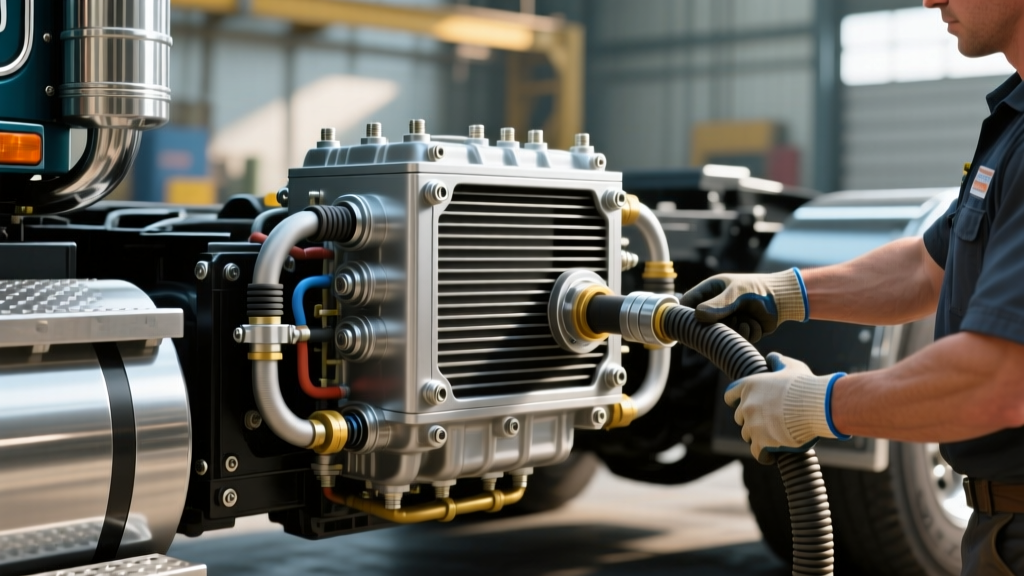
To mount the cooler directly in front of the A/C condenser and radiator stack, the front bumper cover must be removed. Start by popping the plastic push-pins along the top grille surround using a trim removal tool. Remove the 8mm and 10mm bolts securing the fender liners to the bumper cover. Carefully disconnect the ambient air temperature sensor and fog light harnesses (if equipped) before pulling the fascia forward.
2. Tapping the Cooler Lines
The 2019 F-150 utilizes 3/8-inch quick-connect fittings on the transmission cooler lines. Do not use pliers or screwdrivers to pry these apart. You must use a dedicated fuel line/transmission line scissor disconnect tool (such as the Lisle 39400 3/8" and 1/2" set). Slide the tool over the line, push it into the quick-connect collar to release the internal retaining clips, and pull the line straight apart.
Install the provided barb adapters or AN-fitting adapters into the factory lines. Use high-quality spring clamps or T-bolt clamps rated for 150+ PSI, as the 10R80 can see line pressure spikes exceeding 250 PSI during heavy throttle downshifts.
3. Mounting and Airflow Considerations
Use the provided zip-ties with rubber isolation pads to mount the cooler to the factory radiator support brackets. Avoid drilling directly into the A/C condenser fins. Ensure the cooler is positioned to receive direct, unobstructed airflow. If your F-150 is equipped with the factory active grille shutters, you may need to use a FORScan OBD2 module to disable the shutter motors, ensuring maximum airflow to your new stacked-plate cooler at all speeds.
Crucial Fluid Specs: MERCON ULV and the 10R80 Fill Procedure
The most common mistake made during a 2019 F150 transmission cooler installation is using the wrong fluid or improper fill procedures. The 10R80 requires MERCON® ULV (Ultra Low Viscosity) fluid. According to Motorcraft specifications, ULV is chemically distinct from the older MERCON LV. Using LV in a 10R80 will result in sluggish valve body operation, shuddering torque converters, and premature clutch failure due to incorrect friction modifiers.
Calculating Fluid Volume
The total dry-fill capacity of the 10R80 is approximately 13.1 quarts. However, adding a large stacked-plate cooler and 10 feet of additional 3/8" hose will increase the system volume by 1.5 to 2.5 quarts. Always purchase at least 4 extra quarts of Motorcraft MERCON ULV before starting the project.
The 185°F - 200°F Fill Rule
The 10R80 does not have a traditional dipstick. It uses an internal standpipe located inside the transmission pan. To check and set the fluid level accurately:
- Hook up an OBD2 scanner capable of reading Transmission Fluid Temperature (TFT).
- Start the truck and cycle through the gears to purge air from the new cooler lines.
- Drive the truck or let it idle until the TFT reads exactly between 185°F and 200°F (85°C - 93°C).
- With the engine idling in Park on a level surface, remove the 10mm fill plug on the side of the transmission case.
- Add ULV fluid until it begins to trickle out of the standpipe. Once the trickle slows to a drip, reinstall the fill plug and torque to 35 Nm (26 lb-ft).
For deeper technical insights into the 10R80 valve body and pressure regulation, transmission specialists like Sonnax offer extensive documentation on how thermal expansion affects the 10-speed's internal clearances and pressure regulator valves.
Performance Tuning and Thermal Management in 2026
As we look at the performance landscape in 2026, physical cooling upgrades must be paired with intelligent TCU (Transmission Control Unit) tuning. If you are using HP Tuners or similar software to modify your 2019 F-150, you can adjust the thermal management tables. By slightly lowering the threshold at which the ECU commands the torque converter to fully lock up in higher gears, you can drastically reduce slip-induced heat generation in the fluid.
However, software cannot overcome the laws of thermodynamics. A high-quality stacked-plate 2019 F150 transmission cooler remains the foundational hardware requirement for any truck pushing beyond 450 wheel-horsepower or towing 10,000+ pounds through mountain grades. By respecting the thermal bypass routing, utilizing the correct quick-disconnect tools, and strictly adhering to the MERCON ULV temperature-dependent fill procedure, you will ensure your 10R80 survives the most punishing environments while maintaining crisp, factory-calibrated shift quality.