The 2018 Chevrolet Silverado remains one of the most capable work trucks on the road, but when pushed to its limits in extreme environments, its drivetrain cooling architecture reveals critical vulnerabilities. If you are planning a 2018 Silverado transmission cooler upgrade to combat triple-digit ambient temperatures in states like Arizona, Texas, or Nevada, standard aftermarket advice will not suffice. As we navigate the increasingly severe heat waves of 2026, understanding the thermal dynamics of the GM 6L80 and 8L90 transmissions is mandatory for preventing catastrophic clutch pack failure.
The Thermal Reality: Fluid Degradation in Triple-Digit Heat
Modern automatic transmissions rely heavily on fluid not just for hydraulic pressure, but as the primary coolant for the torque converter and friction clutches. The 2018 Silverado 1500 (typically equipped with the 6L80) and the HD models or 6.2L V8 variants (equipped with the 8L90 or Allison 1000) use ACDelco Dexron VI synthetic blend fluid. While Dexron VI is highly stable, its lifespan is entirely dictated by temperature.
- 175°F (80°C): Optimal operating temperature. Fluid life exceeds 100,000 miles.
- 200°F (93°C): Normal heavy-load temperature. Fluid life drops to roughly 50,000 miles.
- 220°F (104°C): The danger threshold. Fluid oxidation accelerates, varnish begins to form on valve bodies, and friction material delamination risks spike.
- 240°F (115°C)+: Rapid seal hardening, clutch slippage, and imminent transmission failure.
In a 110°F desert environment, the baseline under-hood temperature can easily exceed 140°F before the transmission even begins generating its own parasitic heat. Upgrading your cooler is not an option; it is a critical reliability intervention.
The GM Thermal Bypass Valve Flaw
Before purchasing an auxiliary cooler, you must address the elephant in the room: the GM thermal bypass valve. On the 6L80 and 8L90 transmissions, GM installed a thermal bypass valve in the cooler lines or adapter block. Its intended purpose is to restrict fluid flow to the radiator cooler during cold starts, allowing the transmission to reach operating temperature faster for emissions and fuel economy compliance.
Why It Fails in Hot Climates
The bypass valve typically opens to route fluid through the radiator's internal transmission cooler once the fluid hits approximately 190°F. In a mild climate, this is fine. However, in a hot climate where ambient air is 105°F, your engine coolant is likely sitting at 215°F to 225°F. When the bypass valve opens, it sends 190°F transmission fluid into a radiator bathed in 220°F coolant. Instead of cooling the fluid, the radiator actively heats it. According to diagnostic procedures outlined by Sonnax transmission experts, this thermal feedback loop is a primary culprit behind summer towing failures.
The Fix: Bypass Deletion or Modification
For dedicated hot-climate or towing trucks, experts highly recommend installing a bypass valve delete kit or swapping to a modified valve with a lower opening threshold. By forcing 100% of the fluid to the auxiliary cooler at all times, you eliminate the radiator heat-soak variable. If you retain the radiator loop for winter driving, ensure your auxiliary cooler is oversized enough to compensate for the heat gained in the radiator.
Selecting the Right Stacked-Plate Cooler for Desert Driving
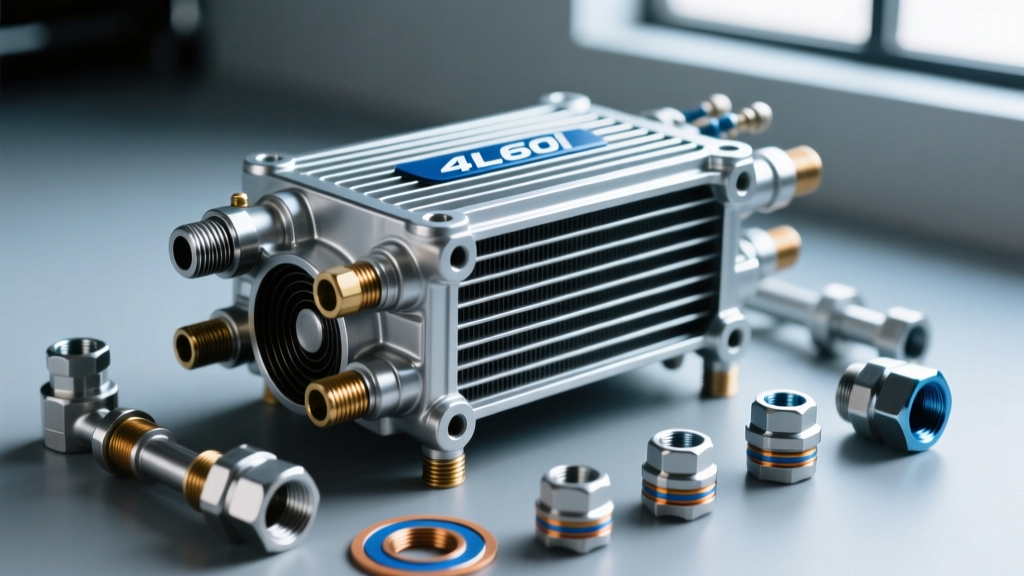
Not all transmission coolers are created equal. For extreme heat, you must abandon cheap tube-and-fin designs in favor of stacked-plate technology. Stacked-plate coolers utilize internal turbulators that force the fluid into a chaotic flow pattern, maximizing contact with the aluminum fins and drastically increasing the BTU/hr dissipation rate.
| Cooler Type | Heat Dissipation (BTU/hr) | Pressure Drop (PSI) | Hot Climate Verdict |
|---|---|---|---|
| Tube-and-Fin | Low (8,000 - 12,000) | Minimal | Avoid. Insufficient for 100°F+ towing. |
| Plate-and-Fin | Medium (15,000 - 20,000) | Moderate | Acceptable for light loads, not heavy towing. |
| Stacked-Plate | High (25,000 - 40,000+) | Low (Turbulent flow) | Mandatory. Best efficiency for desert heat. |
Brands like Mishimoto and Derale offer premium stacked-plate units. When selecting a unit, look for a Gross Vehicle Weight Rating (GVWR) of at least 24,000 lbs, even if your Silverado 1500 is rated for 7,000 lbs. Oversizing the cooler provides the necessary thermal mass to handle prolonged desert grades. For a comprehensive breakdown of core designs, refer to the Mishimoto transmission cooler buying guide.
Routing Strategy: In-Series vs. Standalone
The traditional routing method is in-series: Transmission -> Radiator Cooler -> Auxiliary Cooler -> Transmission. While this works in four-season climates, it is a liability in the deep desert. As established, the radiator will heat the fluid during peak summer afternoons.
The Expert Standalone Configuration
For trucks operating exclusively in hot climates, route the auxiliary stacked-plate cooler as a standalone unit. Bypass the radiator's internal cooler entirely (or cap the radiator cooler nipples and loop the trans lines directly to the aux cooler). To prevent overcooling during rare cold snaps or highway cruising, wire the auxiliary cooler's electric fan to a thermostatic switch set to activate at 185°F. This ensures the transmission reaches optimal operating temperature quickly without relying on the radiator's compromised cooling loop.
Installation Best Practices & Torque Specs
A proper installation prevents leaks, pressure drops, and line ruptures. The 2018 Silverado utilizes a mix of hard lines and rubber hose segments with quick-connect fittings.
- Fittings and Adapters: Do not use cheap brass barb fittings with hose clamps for high-pressure transmission lines. Use OEM-style push-lock quick-connect adapters (e.g., GM Part # 23282414 or equivalent 3/8" and 1/2" snap-lock fittings) to mate the hard lines to the cooler's AN or NPT ports.
- Torque Specifications: If your kit requires adapting to the hard line M14x1.5 flare nuts, torque them precisely to 18 lb-ft. Over-torquing will crush the aluminum flare seat on the transmission case or cooler, leading to slow weeping leaks that attract dirt and destroy seals.
- Line Routing: Keep all auxiliary hoses at least 4 inches away from exhaust manifolds and catalytic converters. Use stainless steel Adel clamps (P-clamps) with rubber cushions to secure lines to the frame. Never use nylon zip-ties near heat sources; they become brittle and snap under engine vibration and thermal cycling.
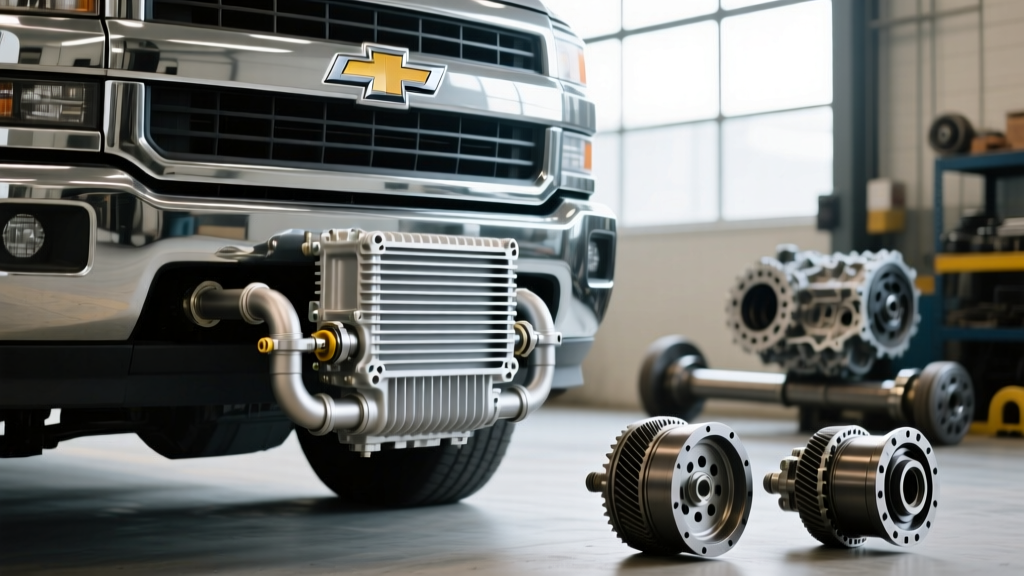
- Mounting Location: Mount the cooler in front of the A/C condenser but behind the grille mesh to protect the delicate stacked-plate fins from highway debris and rock strikes.
Fluid Selection and Fill Procedures for the 6L80 and 8L90
Adding an auxiliary cooler increases your total system fluid capacity. The 6L80 holds approximately 11.2 to 12.4 quarts (total system capacity), while the 8L90 holds slightly more. When performing this upgrade, drain the pan, replace the internal spin-on filter (if accessible on your specific pan setup), and refill with a premium synthetic fluid that meets or exceeds the Dexron VI specification, such as Mobil 1 Synthetic ATF or Red Line D6.
The DIC Temperature Calibration Rule
GM's 6L80 and 8L90 transmissions do not use a traditional dipstick for final level verification. They use a threaded level plug on the side or bottom of the transmission pan. To check the fluid level accurately, you must use an OBD2 scanner or the Driver Information Center (DIC) to monitor the Transmission Fluid Temperature (TFT). The fluid must be between 185°F and 200°F when the level plug is removed. If the fluid is too cold, it will overfill as it expands; if it is too hot, it will underfill, leading to pump cavitation and clutch burn-up.
Real-World Temperature Targets
After completing your 2018 Silverado transmission cooler upgrade, monitor your TFT via a pillar-mounted gauge or a Bluetooth OBD2 app. In 100°F+ ambient heat, your target unloaded cruising temperature should sit between 165°F and 180°F. When towing an 8,000 lb trailer up a 6% grade, the temperature should peak no higher than 205°F and drop rapidly once you crest the hill. By eliminating the thermal bypass flaw and maximizing stacked-plate surface area, you will secure your Silverado's drivetrain against the harshest desert conditions for hundreds of thousands of miles.