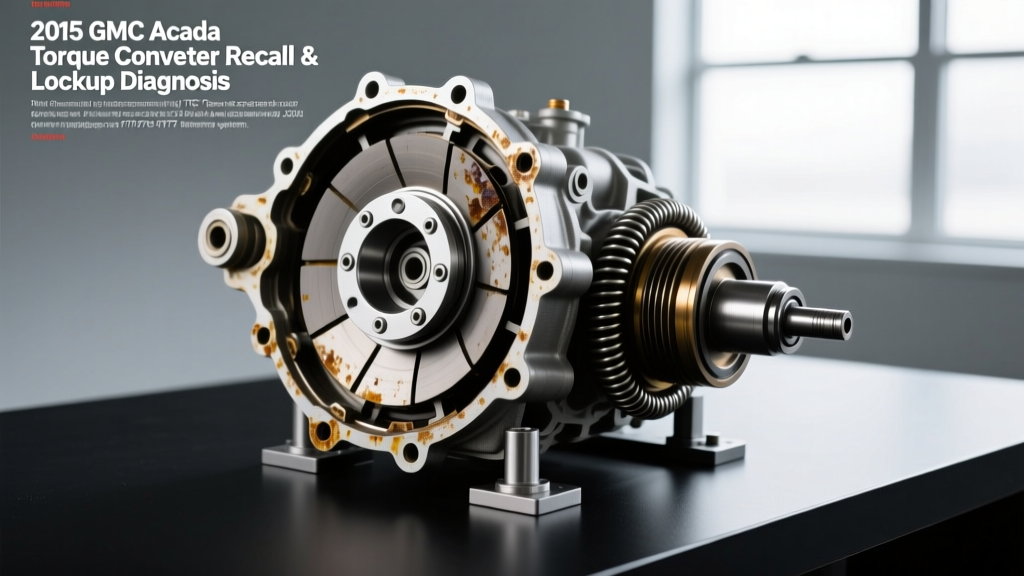
The Reality of the 2015 GMC Acadia Torque Converter Recall
Owners of the Lambda-platform SUVs frequently search for a 2015 GMC Acadia torque converter recall after experiencing a violent, rumble-strip-like vibration at highway speeds. As we navigate the diagnostic landscape in 2026, it is crucial to clarify a common misconception: while General Motors issued various Technical Service Bulletins (TSBs) and extended warranty coverages for the 6T70 and 6T75 transmissions, there was no blanket NHTSA safety recall specifically for the 2015 Acadia's torque converter. Instead, GM addressed these lockup failures through service campaigns targeting the Transmission Electro-Hydraulic Control Module (TEHCM) and TCC (Torque Converter Clutch) friction degradation.
Understanding the root cause of this shudder requires a deep dive into lockup torque converter operation, hydraulic circuit integrity, and precise scan tool diagnostics. Whether you are facing a failing torque converter clutch or a sticking PWM solenoid, this guide provides the exact framework needed to diagnose and resolve the issue.
How Lockup Torque Converter Operation Works in the 6T75
The 2015 GMC Acadia AWD is equipped with the GM 6T75 6-speed automatic transmission (FWD models use the 6T70). Unlike older transmissions that utilized a simple on/off solenoid for torque converter lockup, the 6T75 employs a highly sophisticated Pulse Width Modulated (PWM) TCC solenoid housed within the TEHCM.
The Mechanics of Controlled Slip
Modern lockup torque converter operation is designed to maximize fuel economy without transferring harsh engine harmonics to the drivetrain. When the PCM commands TCC apply, hydraulic fluid is routed through the turbine shaft to press the clutch piston against the converter cover. However, the PWM solenoid modulates fluid pressure to maintain a controlled slip—typically between 10 and 30 RPM—even during full lockup. This micro-slip dampens the 4-cylinder and V6 engine vibrations. When the friction material on the TCC piston wears down, or when hydraulic apply pressure leaks past degraded turbine shaft seals, the controlled slip turns into uncontrolled macro-slip, resulting in the notorious 30-45 Hz TCC shudder.
Symptom Diagnosis: TCC Shudder vs. Engine Misfire
Before tearing into the transmission, you must isolate the vibration. TCC shudder is frequently misdiagnosed as an engine misfire or a bad spark plug coil. Use this checklist to differentiate the two:
- Speed and Gear Dependency: TCC shudder almost exclusively occurs between 45 and 65 mph when the transmission is in 5th or 6th gear (overdrive) and the throttle is held steady at light load (15-25% TPS).
- The Brake-Tap Test: While the vehicle is shuddering at highway speed, lightly tap the brake pedal with your left foot. This signals the PCM to instantly release the TCC solenoid. If the shudder vanishes the millisecond you touch the brake, the issue is 100% isolated to the torque converter lockup circuit or hydraulic apply system.
- RPM Fluctuation: During a misfire, engine RPM will stumble and drop. During TCC shudder, you will often see the engine RPM fluctuate rapidly by 50-100 RPM as the clutch slips and grabs, while the vehicle speed remains relatively constant.
- Temperature Sensitivity: TCC shudder usually worsens as the transmission fluid temperature rises above 160°F (71°C) and the Dexron VI friction modifiers break down under heat.
Advanced Diagnostic Framework: Scan Tool Data
To properly diagnose lockup torque converter operation, a bi-directional scan tool capable of reading GM-specific Transmission PIDs (Parameter Identifiers) is mandatory. You must monitor the TCC slip speed while driving under the exact conditions that trigger the shudder.
| Scan Tool PID | Normal 6T75 Lockup Operation | Failing TCC / Hydraulic Leak |
|---|---|---|
| TCC Slip Speed | 10 - 25 RPM (Steady) | 40 - 150+ RPM (Fluctuating wildly) |
| TCC Solenoid Duty Cycle | 85% - 95% (Commanded) | Erratic, or maxed at 100% to compensate for slip |
| TFT (Fluid Temp) | > 140°F (60°C) for full apply | Shudder worsens as TFT exceeds 170°F |
| TCC Apply Pressure (Est.) | 110 - 130 PSI | Drops below 80 PSI due to circuit leaks |
According to Sonnax transmission specialists, if your scan tool shows the TCC Solenoid Duty Cycle maxing out at 95-100% while the TCC Slip Speed remains high, the TEHCM is desperately trying to apply the clutch, but hydraulic pressure is bleeding off. This points to worn stator support rings or degraded turbine shaft seals inside the transmission, rather than just a bad solenoid.
Technical Service Bulletins (TSBs) vs. Official Recalls
While the NHTSA Recall Database will not show a safety recall for the 2015 Acadia torque converter, GM did release critical service information regarding this exact failure. TSB PIT5264 and subsequent revisions address TCC shudder and harsh shifts. In many cases, GM dealerships were instructed to reprogram the TEHCM with updated calibration files that alter the TCC apply ramp rate, reducing the aggressive lockup that prematurely glazed the clutch friction material. If a software flash does not resolve the slip, physical replacement of the torque converter and TEHCM is required.
Repair Scenarios, Part Numbers, and Costs
Repairing a 6T75 lockup issue in 2026 requires careful consideration of the vehicle's mileage and overall health. If the transmission fluid is dark, smells burnt, or contains heavy metallic debris on the magnet, a simple TEHCM swap will not save the unit. The transmission must be removed to flush the cooler lines and replace the torque converter.
Component Breakdown and Pricing
- Torque Converter (Remanufactured): ACDelco Part # 24258482 (Verify with VIN). Cost: $350 - $550.
- TEHCM Assembly: The TCC PWM solenoid is integrated into the TEHCM and is not serviced separately by GM. ACDelco Part # 24253225 (Requires VIN programming). Cost: $450 - $700.
- Transmission Fluid: ACDelco Dexron VI (Part # 10-9395). You will need approximately 10 quarts for a dry fill and cooler line flush.
- Labor (R&R Transmission): 7.5 to 9.0 hours book time.
| Repair Level | Estimated Dealership Cost | Estimated Independent Shop Cost |
|---|---|---|
| TEHCM Replacement & Flash Only | $900 - $1,200 | $650 - $850 |
| Full Torque Converter & TEHCM R&R | $2,400 - $3,100 | $1,800 - $2,300 |
When sourcing parts, always verify fitment through the ACDelco Parts Catalog using your specific 17-digit VIN, as the 6T70 (FWD) and 6T75 (AWD) utilize different torque converter stall speeds and spline counts.
Expert Technician Note: Never perform a pressurized power flush on a 6T75 that is already exhibiting TCC shudder. The dislodged friction material from the failing torque converter clutch will migrate into the TEHCM's delicate 3-5-R and 4-5-6 clutch apply valves, causing catastrophic shift solenoid failures. Always perform a repeated drain-and-fill or a passive cooler-line flush using the transmission's own internal pump.
Post-Repair Maintenance and Fluid Specs
If you have successfully replaced the torque converter and restored proper lockup operation, maintaining the Dexron VI fluid is paramount. The 6T75 holds approximately 9.5 liters (10.0 quarts) for a complete dry fill, but a standard pan drop and filter change will only yield about 5.5 to 6.0 liters. GM does not specify a strict fluid change interval for 'normal' driving, but for vehicles that frequently tow or operate in mountainous terrain, dropping the pan and replacing the internal filter (ACDelco Part # 24236933) every 45,000 miles is the only way to preserve the friction modifiers required for smooth TCC apply and prevent a repeat of the shudder.