The 2005 Ram 1500 Drivetrain Context
The third-generation Dodge Ram 1500 (2002–2008) remains one of the most prevalent workhorses on the road today. Whether equipped with the 4.7L Magnum V8 or the legendary 5.7L HEMI, the rear axle is subjected to immense rotational stress, especially when towing or hauling. As we navigate the 2026 automotive maintenance landscape, understanding the exact 2005 Dodge Ram 1500 rear differential fluid capacity and associated service costs is critical for preserving your drivetrain's longevity and avoiding catastrophic ring-and-pinion failures.
Axle Identification: Chrysler 8.25 vs. AAM 9.25
Before purchasing gear oil, you must identify which axle housing sits under your truck. Dodge utilized two primary rear axles for the 2005 1500 series. Misidentifying your axle can lead to purchasing the wrong gasket or underestimating the fluid volume required.
| Axle Model | Ring Gear Size | Cover Bolts | Typical Engine Pairing |
|---|---|---|---|
| Chrysler 8.25 | 8.25 inches | 10-Bolt | 3.7L V6 / 4.7L V8 |
| AAM 9.25 (Chrysler 9.25) | 9.25 inches | 12-Bolt | 5.7L HEMI V8 |
2005 Dodge Ram 1500 Rear Differential Fluid Capacity
When determining the exact 2005 Dodge Ram 1500 rear differential fluid capacity, factory service manuals dictate the following baseline volumes:
- Chrysler 8.25 Axle: 2.15 quarts (approx. 2.0 liters)
- AAM 9.25 Axle: 2.50 quarts (approx. 2.4 liters)
Because both axles require slightly more than two quarts but less than three, you will need to purchase exactly three quarts of gear oil to complete the service. The remaining half-quart should be sealed and stored for future top-offs or steering box maintenance.
Gear Oil Specifications & The Trac-Lok Factor
The factory specification calls for SAE 75W-90 API GL-5 gear oil. In 2026, conventional mineral-based gear oils are largely considered obsolete for heavy-duty truck applications due to their rapid shear degradation under high thermal loads. We strongly recommend full synthetic formulations from brands like AMSOIL, Mobil 1, or Royal Purple.
Expert Note: Never use API GL-4 fluid in these hypoid gear sets. GL-5 contains the necessary extreme-pressure (EP) sulfur-phosphorus additives required to prevent the sliding friction of hypoid ring and pinion gears from welding together. Source: API Engine Oil Standards.
Limited Slip (Trac-Lok) Requirements
If your Ram 1500 is equipped with the Trac-Lok limited-slip differential, the base 75W-90 fluid is not enough. You must add a friction modifier to prevent clutch pack chatter during low-speed cornering. Mopar's original Friction Modifier (Part #04318060AD) is increasingly difficult to find at local dealerships, but aftermarket equivalents like Lubegard Limited Slip Supplement work flawlessly and cost significantly less.
Severe Duty vs. Normal Duty Maintenance Intervals
The factory service manual for the 2005 Ram 1500 categorizes maintenance schedules based on operational severity. If your truck is primarily a daily driver without heavy loads, the rear differential fluid is often labeled as 'filled for life' or scheduled for a 60,000-mile interval. However, automotive tribology experts universally reject the 'lifetime fluid' myth, especially for hypoid gear sets subjected to the extreme sliding friction of modern towing.
- Normal Duty (Commuting, Light Hauling): Replace fluid every 50,000 miles.
- Severe Duty (Towing >5,000 lbs, Off-Road, Snow Plowing): Replace fluid every 15,000 to 30,000 miles.
- Submersion Event: If the axle breather tube is compromised and water enters the housing during a river crossing or deep puddle, immediate replacement is mandatory. Water contamination turns GL-5 fluid into a milky emulsion that destroys pinion bearings within 500 miles.
2026 Cost Breakdown: DIY vs. Professional Service
Labor rates at independent drivetrain shops have climbed significantly, averaging $135 to $165 per hour in 2026. Here is a transparent cost analysis comparing a driveway DIY approach versus dealership or specialist servicing.
| Item / Service | DIY Cost (Est.) | Shop Cost (Est.) |
|---|---|---|
| Synthetic 75W-90 (3 Qts) | $36.00 - $54.00 | $60.00 - $85.00 (Markup) |
| Friction Modifier (If LSD) | $9.00 - $14.00 | $18.00 - $25.00 |
| RTV Silicone / Gasket | $8.00 (RTV Tube) | $12.00 (OEM Gasket) |
| Brake Cleaner & Shop Towels | $7.00 | $5.00 (Shop Supplies Fee) |
| Labor (0.8 - 1.2 Hours) | $0.00 (Your Time) | $110.00 - $180.00 |
| Total Estimated Cost | $60.00 - $82.00 | $205.00 - $307.00 |
By performing the service yourself, you save upwards of $200 while guaranteeing the use of premium synthetic fluids, as some quick-lube centers still default to cheaper conventional 80W-90 blends.
Diagnosing Differential Noise Before the Drain
Before committing to the cost of a fluid change, use the drain process as a diagnostic opportunity. When you pull the cover off the 9.25 or 8.25 axle, inspect the fluid and the housing interior closely:
- Fine Metallic Paste: A slight silvery sheen on the fluid is normal wear from the ring and pinion break-in process, even at 100,000 miles.
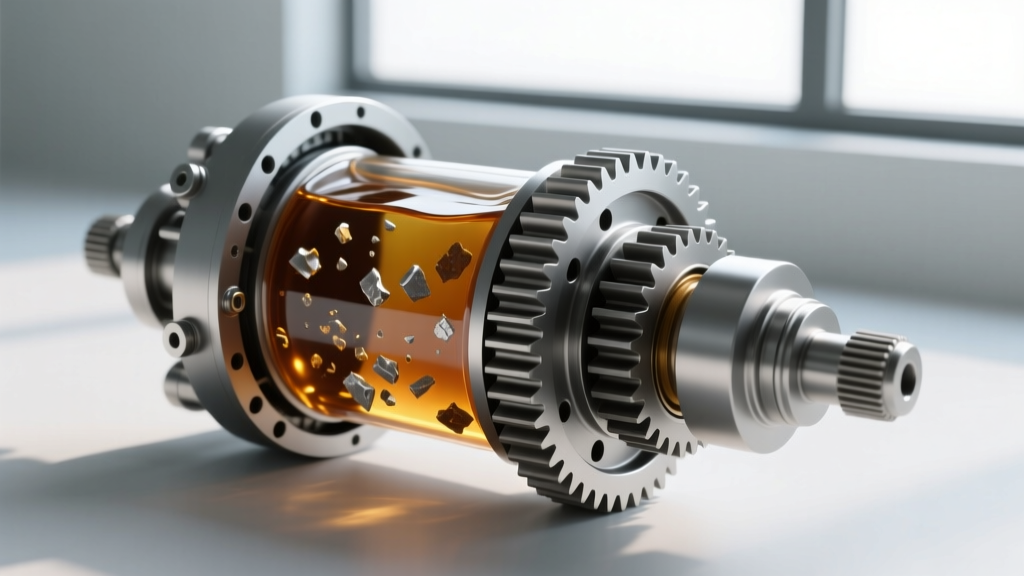
- Chunky Metal Flakes: If you find jagged metal shards clinging to the magnet (or the housing bottom if no magnet is present), your pinion or carrier bearings are actively failing. Fresh fluid will not fix this; a complete differential rebuild is required.
- Burnt Smell / Black Sludge: Indicates severe thermal breakdown. The gear oil has exceeded its 250°F+ operational threshold, likely due to low fluid levels from a leaking pinion seal or axle shaft seal.
Step-by-Step Service & Torque Specifications
Executing the fluid swap requires attention to sealing surfaces and hardware torque. The Chrysler axles do not feature a dedicated drain plug; the entire differential cover must be removed.
- Preparation: Safely raise the rear axle on jack stands. Ensure the truck is level so the fluid fills to the exact edge of the fill hole.
- Removal: Break loose the 10 or 12 cover bolts using a 3/8-inch drive ratchet. Leave the top two bolts loosely threaded to act as a hinge, then pry the bottom edge with a flathead screwdriver to drain the fluid into a catch pan.
- Cleaning: Spray the cover and housing mating surfaces with non-chlorinated brake cleaner. Scrape away all old RTV material. Do not let debris fall into the ring gear.
- Sealing: Apply a continuous 3mm bead of Permatex Ultra Black RTV to the cover. Permatex Ultra Black is highly resistant to synthetic gear oil and provides superior torque retention.
- Torque Specs: Reinstall the cover and tighten bolts in a crisscross pattern.
- Chrysler 8.25 Cover Bolts: 30 ft-lbs
- AAM 9.25 Cover Bolts: 35 ft-lbs
- Filling: Pump the 75W-90 fluid into the fill hole until it begins to weep out. If equipped with Trac-Lok, mix the friction modifier into the fluid bottle before pumping, or add it directly through the fill hole prior to the final quart.
Curing Time Warning: While RTV silicone is tack-free in 1 hour, it requires 24 hours to fully cure. If you must drive the truck immediately, torque the bolts to 15 ft-lbs, fill with fluid, and re-torque to the final specification after 500 miles of driving.
Final Thoughts on Axle Longevity
Understanding the 2005 Dodge Ram 1500 rear differential fluid capacity and adhering to strict API GL-5 synthetic specifications is the most cost-effective insurance policy for your truck's drivetrain. Whether you are rocking the 10-bolt 8.25 or the robust 12-bolt AAM 9.25, a $60 DIY service every 30,000 miles (or 15,000 miles under severe towing conditions) will easily push these axles past the 250,000-mile mark without bearing or gear failure. For more technical deep-dives into American Axle & Manufacturing specs, consult the AAM engineering archives.