The 2004 Ford Explorer Rear Differential: Understanding the IRS 8.8 Axle
As we navigate 2026, the fourth-generation Ford Explorer is well past its 20-year mark, and drivetrain complaints are increasingly common. When diagnosing 2004 Ford Explorer rear differential noise, the most critical piece of context is the axle architecture. Unlike the solid-axle setups found in older Rangers or F-150s, the 2004 Explorer utilizes a Ford 8.8-inch Independent Rear Suspension (IRS) differential. This unit is mounted directly to the rear subframe and utilizes inner and outer CV joints on the half-shafts.
This IRS configuration introduces unique noise variables. A clunk or whine that appears to originate from the rear differential might actually be a failing inner CV joint, a worn subframe bushing, or a degraded half-shaft stub spline. Accurate diagnosis requires isolating the differential pumpkin from the surrounding IRS components before tearing into the gear set. Below is our master diagnostic protocol for identifying and resolving rear axle noise on this specific platform.
Auditory Diagnostics: Decoding the Sound Profile
Gear and bearing noises change character based on load, deceleration, and cornering. Use this diagnostic matrix to narrow down the failure point inside the 8.8-inch IRS carrier before removing the differential cover.
| Noise Type | Driving Condition | Probable Failure Point | Severity & Action |
|---|---|---|---|
| High-Pitched Whine | Deceleration (coasting) | Pinion bearing wear or ring/pinion gear tooth wear on the coast side. | High. Requires pinion depth reset and bearing replacement. |
| Deep Howl | Acceleration under load | Low fluid level, severe gear wear, or incorrect pinion preload. | Critical. Immediate fluid inspection required to prevent seizure. |
| Chatter / Shudder | Low-speed tight turns | Limited-slip clutch pack wear or lack of friction modifier. | Moderate. Perform a fluid flush with Motorcraft XL-3 additive. |
| Metallic Clunk | Shifting from Reverse to Drive | Excessive ring gear backlash, worn cross-pin, or stripped stub shaft splines. | High. Check backlash with a dial indicator; inspect IRS stub shafts. |
| Grinding / Growling | Constant speed, straight line | Carrier bearing failure or damaged roller elements. | Critical. Do not drive; carrier cage may disintegrate and destroy the housing. |
Step-by-Step Troubleshooting Protocol
Before ordering a rebuild kit, you must verify the mechanical state of the differential. Follow these expert steps to isolate the root cause of the noise.
1. The Fluid Forensics Test
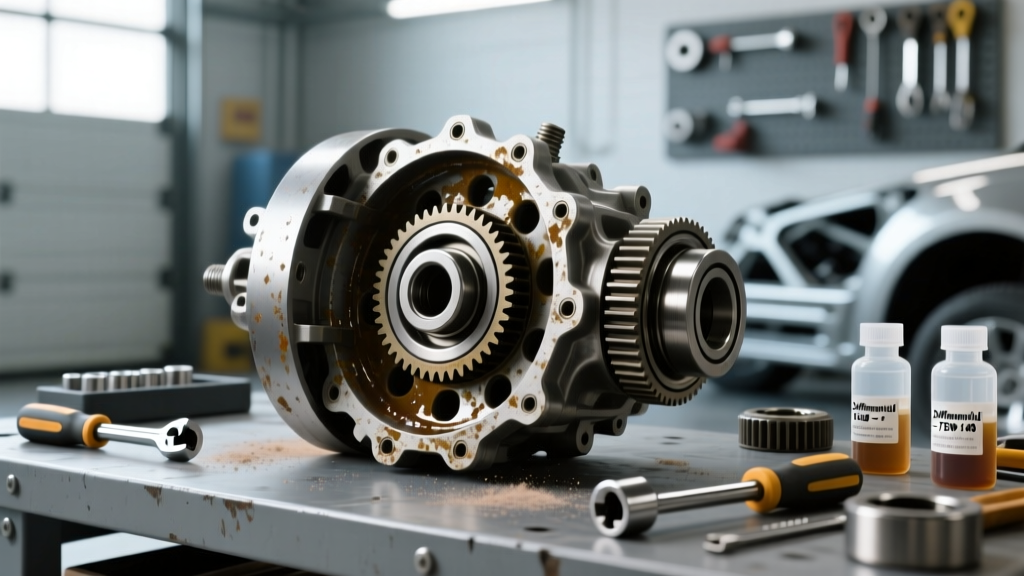
Remove the 10-bolt rear differential cover (use a 13mm socket, torque to 25-30 lb-ft on reassembly in a star pattern). The condition of the 75W-140 gear oil tells a definitive story:
- Gold/Amber with Fine Glitter: Normal wear for a 150,000+ mile unit. The fine metallic paste on the magnetic drain plug is standard clutch pack and gear lapping material.
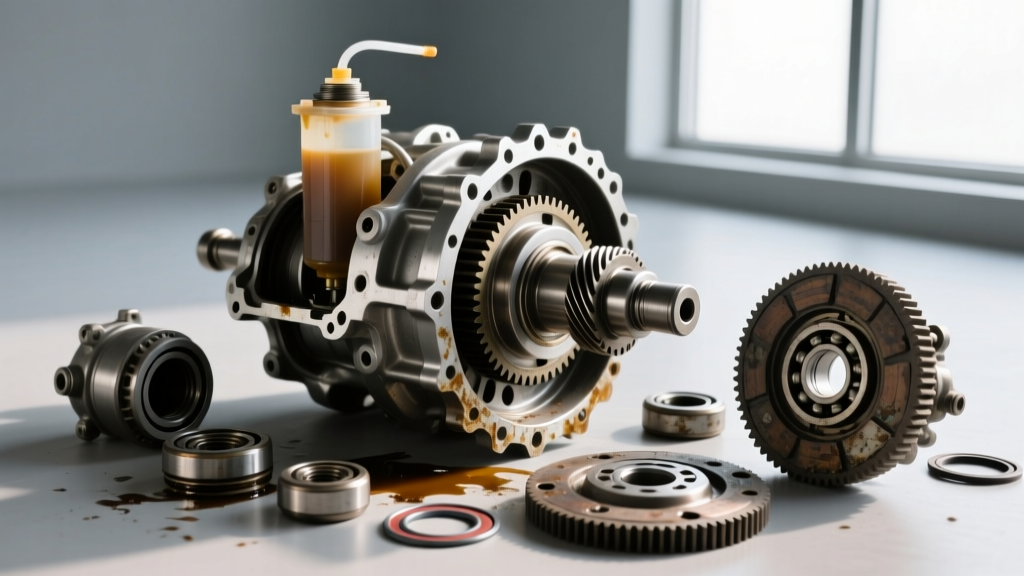
- Dark Brown with Burnt Smell: Overheating due to low fluid levels or aggressive towing. The limited-slip friction material has likely glazed or burned.
- Chunky Metal or Needle Bearings in Oil: Catastrophic pinion or carrier bearing failure. The differential requires a complete teardown and housing flush.
2. Measuring Ring Gear Backlash
Clunking noises are often blamed on the driveshaft or transmission, but excessive backlash inside the 8.8 IRS is a frequent culprit. Mount a magnetic dial indicator to the differential housing and position the probe against a ring gear tooth. Rotate the ring gear back and forth while holding the pinion flange stationary.
The factory specification for the Ford 8.8 rear end is 0.005 to 0.009 inches of backlash. If your reading exceeds 0.012 inches, the carrier shims have worn, or the ring gear bolts have stretched. (Always use Red Loctite 272 and torque ring gear bolts to 70-85 lb-ft).
3. Pinion Bearing Preload Verification
A whining noise on deceleration is the hallmark of a failing pinion bearing. To check this, you must remove the brake calipers and rotors to eliminate drag. Using an inch-pound torque wrench on the pinion nut, measure the rotating torque. For a used 8.8-inch differential with the driveshaft disconnected, the spec is typically 8 to 14 inch-pounds. If it spins freely with zero resistance, the crush sleeve has collapsed, or the pinion bearing is entirely worn out.
Expert Tip: The factory Ford 8.8 uses a one-time-use crush sleeve to set pinion preload. When rebuilding a 2004 Explorer IRS axle, discard the crush sleeve and install a solid pinion spacer kit (such as the Ratech elimination kit). This allows you to set preload precisely with shims and eliminates the risk of over-crushing the sleeve, which destroys new pinion bearings.
Fluid Specifications and the Friction Modifier Mandate
If your 2004 Explorer is equipped with a Traction-Lok (limited-slip) differential, fluid selection is not a suggestion; it is a mechanical requirement. The clutch packs inside the Ford 8.8 LSD require a specific friction modifier to prevent the 'chatter' noise during cornering.
Recommended Fill Procedure:
- Base Fluid: Motorcraft 75W-140 Synthetic Rear Axle Lubricant (or equivalent API GL-5 synthetic). The IRS 8.8 capacity is approximately 3.4 pints (1.7 quarts), but always fill until the fluid level is even with the bottom of the fill hole.
- Friction Modifier: Add exactly 4 oz of Motorcraft XL-3 Friction Modifier (Part # XL-3). Do not overfill the modifier, as excessive additive will cause the clutch packs to slip under heavy acceleration, leading to premature wear.
- The Break-In Drive: After filling, drive the vehicle in a large, empty parking lot. Perform 10 to 15 slow, tight figure-eights. This forces the clutch packs to engage and disengage, properly distributing the friction modifier into the porous sintered iron clutch material.
Rebuild vs. Replace: 2026 Cost Analysis
Given the age of the 2004 Explorer, owners must weigh the cost of a precision rebuild against installing a used or remanufactured unit. Because the IRS 8.8 requires specialized tools (bearing pullers, pinion depth setting tools, and a press), labor is the primary cost driver.
- Complete Rebuild (Parts & Labor): $900 - $1,400. This includes a master rebuild kit (Timken bearings, seals, shims), a new ring and pinion set (if gear wear is present), and 4-6 hours of specialized labor.
- Used IRS 8.8 Assembly: $450 - $800. Sourced from a salvage yard. Warning: You must verify the gear ratio (usually 3.55 or 3.73 for V8 models) and ensure the unit includes the inner stub shafts, which are often stripped out by junkyards.
- Remanufactured Unit: $1,200 - $1,800. The safest route for a daily driver, often including a 12-month warranty.
For comprehensive parts sourcing and cross-referencing OEM numbers, platforms like RockAuto provide excellent visual guides for the IRS 8.8 exploded views. When selecting gear sets, consult Spicer/Dana application guides to ensure you are ordering the correct reverse-cut or standard rotation ring gear for the IRS application. Finally, always verify chemical compatibilities for additives via the Motorcraft chemical specifications page to protect your drivetrain warranty.
Final Diagnostic Warning: The Subframe Illusion
Before spending thousands on a differential rebuild, inspect the rear IRS subframe bushings. The 2004 Explorer is notorious for subframe bushing degradation. When these rubber isolators tear, the entire rear differential assembly shifts under load, creating a massive metallic clunk that perfectly mimics internal gear backlash. A simple pry-bar test on the subframe mounts can save you from an unnecessary differential teardown.