The Short Answer: Is Rebuilding a Transmission Hard?
When weekend mechanics and automotive enthusiasts ask, 'is rebuilding a transmission hard?', the honest answer requires nuance. It is not necessarily 'hard' in terms of requiring a degree in mechanical engineering, but it is intensely unforgiving. Unlike a brake job or a water pump replacement, a transmission rebuild demands surgical cleanliness, precise measurement down to the thousandth of an inch, and strict adherence to torque specifications. A single misplaced check ball or a torn O-ring on an accumulator piston will result in immediate failure upon your first test drive.
However, with the right preparation, specialized tools, and realistic time expectations, rebuilding a transmission is a highly rewarding endeavor. The biggest hurdle for DIYers is not the mechanical complexity, but the severe underestimation of the time required. In this guide, we break down real-world transmission rebuild time estimates, hidden time sinks, and expert bench practices to help you decide if you should tackle the job yourself or hand it over to a professional.
Deconstructing the Timeline: Driveway vs. Professional Shop
Professional transmission shops operate with hydraulic lifts, transmission jacks, commercial-grade parts washers, and decades of muscle memory. Their 'book time' is vastly different from a DIY timeline. To understand the true scope of the project, you must divide the job into three distinct phases:
- Removal and Installation (R&R): Dropping the crossmember, supporting the engine, disconnecting driveshafts, cooler lines, and electrical harnesses. On a rusty 4WD truck, this alone can consume an entire Saturday.
- Teardown, Cleaning, and Inspection: Disassembling the unit, cataloging every thrust washer and snap ring, and cleaning the case, valve body, and cooler lines. This is the most time-consuming phase for a DIYer lacking a commercial parts washer.
- Bench Assembly: The actual rebuilding process, including measuring clutch pack clearances, setting endplay, and installing upgraded components.
Transmission Rebuild Time Estimates by Model
Not all transmissions are created equal. A classic rear-wheel-drive 4-speed is vastly simpler than a modern 10-speed with an integrated mechatronic unit. Below is a realistic time estimate chart for DIYers working in a home garage with standard hand tools and a basic engine hoist or transmission jack.
| Transmission Model | Common Vehicles | DIY R&R Time | DIY Bench Time | Difficulty Rating |
|---|---|---|---|---|
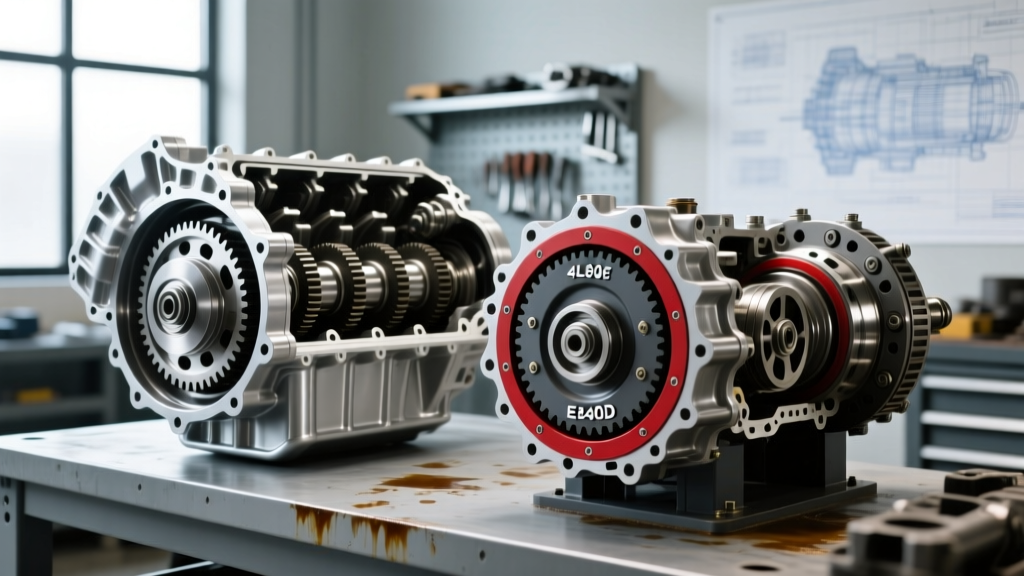
| GM 4L60E | Silverado, Camaro, Tahoe | 6 - 9 Hours | 8 - 12 Hours | Moderate |
| GM 6L80 | Silverado HD, Corvette C6 | 7 - 10 Hours | 12 - 16 Hours | High |
| Ford 10R80 | F-150, Mustang, Ranger | 8 - 11 Hours | 14 - 18 Hours | Very High |
| ZF 8HP70 | BMW F-Series, Ram 1500, Audi | 8 - 12 Hours | 16 - 22 Hours | Extreme |
As noted by the experts at the Automatic Transmission Rebuilders Association (ATRA), modern units like the ZF 8HP and Ford 10R80 require specialized proprietary software for mechatronic adaptation and valve body calibration, which can add days to your timeline if you are waiting on mobile programming services.
Hidden Time Sinks That Destroy Weekend Plans
If you are wondering why your rebuild is taking three times longer than a YouTube tutorial suggested, you have likely fallen victim to these common time sinks:
1. The TEHCM Programming Bottleneck (GM 6L80/6L90)
The 6L80 and 6L90 transmissions house the Transmission Electro-Hydraulic Control Module (TEHCM) directly inside the transmission pan. If your TEHCM is damaged or you are swapping in a remanufactured unit, it must be flashed with the correct VIN and calibration files. Without a GM MDI2 interface and a Techline Connect subscription, you will be waiting for a mobile tech to arrive and program the module, stalling your rebuild timeline by several days.
2. Commercial Cleaning vs. Brake Cleaner
A professional shop tosses valve bodies and clutch drums into an ultrasonic or high-pressure solvent washer. A DIYer is left with 15 cans of brake cleaner, a toothbrush, and a compressor. Properly cleaning a 4L60E valve body to ensure no microscopic debris is trapped in the spool valves can take 3 to 4 hours of meticulous manual labor. Skipping this step guarantees a burnt 3-4 clutch pack within 500 miles.
3. Rust and Seized Cooler Lines
Removing a transmission from a 15-year-old truck means dealing with rusted cooler line fittings. If you strip a fitting on the radiator or transmission case, your 6-hour R&R time instantly doubles as you fabricate new lines or replace radiators.
Expert Bench Practices to Accelerate Assembly
Speed on the bench comes from preparation and precision, not from rushing. According to Sonnax Tech Resources, the majority of post-rebuild failures stem from improper clearances and contaminated hydraulic circuits. Implement these best practices to do it right the first time:
- Master the Endplay Measurement: Before finalizing the assembly of a GM 4L60E, you must measure the output shaft endplay using a dial indicator. The specification is typically 0.010' to 0.025' (0.25mm - 0.64mm). If it is too tight, the unit will overheat and bind; if it is too loose, you will suffer from harsh shifts and premature thrust washer wear. Use selective thickness thrust washers or shims to dial this in perfectly.
- Clutch Pack Clearances: When rebuilding the notorious 3-4 clutch pack on a 4L60E, aim for a clearance of 0.040' to 0.060' (1.02mm - 1.52mm) using a feeler gauge. Always soak your new friction plates in the exact transmission fluid you plan to use (e.g., Dexron VI) for at least 30 minutes before assembly to prevent dry-start scorching.
- Valve Body Torque Specs: Valve body castings are soft aluminum and easily warped or cracked by overzealous impact drivers. Use a calibrated inch-pound torque wrench. For the 4L60E valve body to case bolts, the spec is 97 lb-in (11 Nm). For the 6L80 oil pump to case bolts, the spec is 106 lb-in (12 Nm).
- Upgrade Weak Points: While the unit is apart, do not reuse the factory 4L60E sunshell. Install a hardened 'Beast' sunshell to prevent the stripping of the splines, which causes a loss of reverse and 4th gear. Install a Corvette-style 2nd gear servo to increase line pressure and firm up the 1-2 shift.
The Financial Reality: DIY Time vs. Professional Cost
Understanding the time commitment is only half the equation; you must also weigh it against the financial realities of transmission repair costs. Let us look at the breakdown for a standard GM 4L60E rebuild.
DIY Rebuild Cost Breakdown
- Master Rebuild Kit (Frictions, steels, seals, gaskets): $250 - $350
- Hard Parts (Beast sunshell, Corvette servo, new pump rotor): $120 - $200
- Fluid (12 Quarts Dexron VI) & Filter: $80 - $110
- Specialty Tools (Snap ring pliers, dial indicator, torque wrench): $100 - $250
- Total DIY Cost: $550 - $910
Professional Shop Cost
A reputable shop will typically charge between $2,200 and $3,200 for a 4L60E rebuild, which includes a warranty (usually 12 months/12,000 miles) and the assumption of liability. If you value your time at $50 per hour, and the DIY route takes you 25 hours, your 'time cost' is $1,250. Add that to your $700 in parts, and you are at $1,950—dangerously close to the professional price, but with zero warranty and all the stress on your shoulders.
When to Throw in the Towel
If you are rebuilding a relatively simple, older unit like a TH350, 700R4, or 4L60E, the DIY route is highly viable and educational. However, if you are dealing with a ZF 8HP70 with a cracked mechatronic housing, or a Ford 10R80 with a failed torque converter and shattered planetary gearset, the cost of specialized tools, proprietary fluids (like ZF Lifeguard 8), and mandatory software adaptations makes the DIY route financially and practically illogical. In these cases, sourcing a remanufactured unit from a certified builder is the most time-efficient and reliable solution.
Final Verdict
So, is rebuilding a transmission hard? Mechanically, it is a test of patience, organization, and cleanliness rather than sheer brute strength. If you are methodical, respect the torque specs, and allocate a realistic 20 to 30 hours of workspace time, you can successfully rebuild a transmission in your home garage. However, if you are prone to rushing, lack a clean environment, or are dealing with a late-model mechatronic unit, the time and frustration involved make professional replacement the superior choice.