How Does a Transmission Cooler Work? The Core Physics
When diagnosing drivetrain thermal issues, the first question a technician must answer is: how does a transmission cooler work to shed heat? At its core, a transmission cooler is a heat exchanger. Hot automatic transmission fluid (ATF), typically exiting the torque converter at 210°F to 250°F, is routed through a network of tubes or plates. Ambient air passes over external fins, transferring the thermal energy from the fluid to the atmosphere.
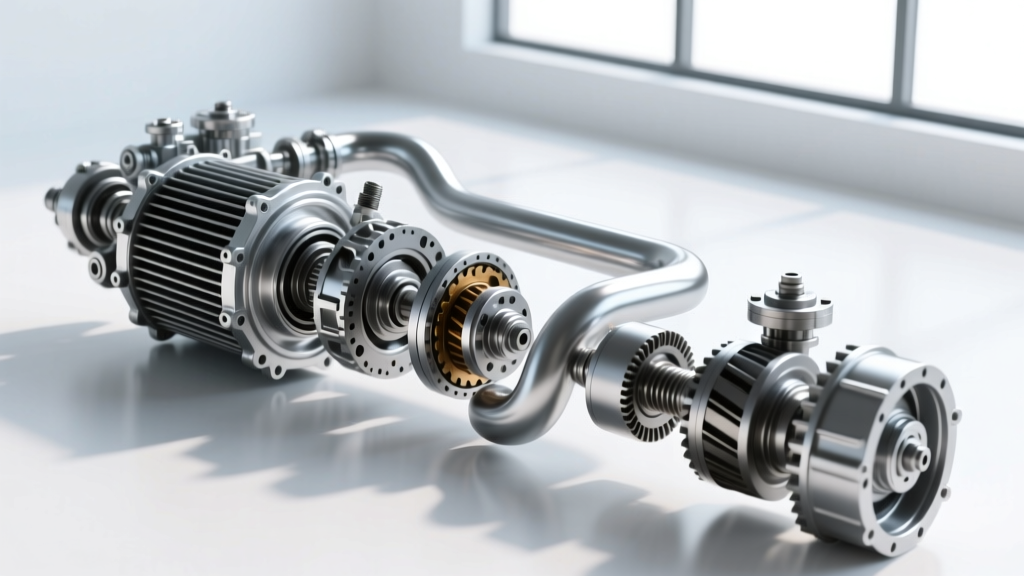
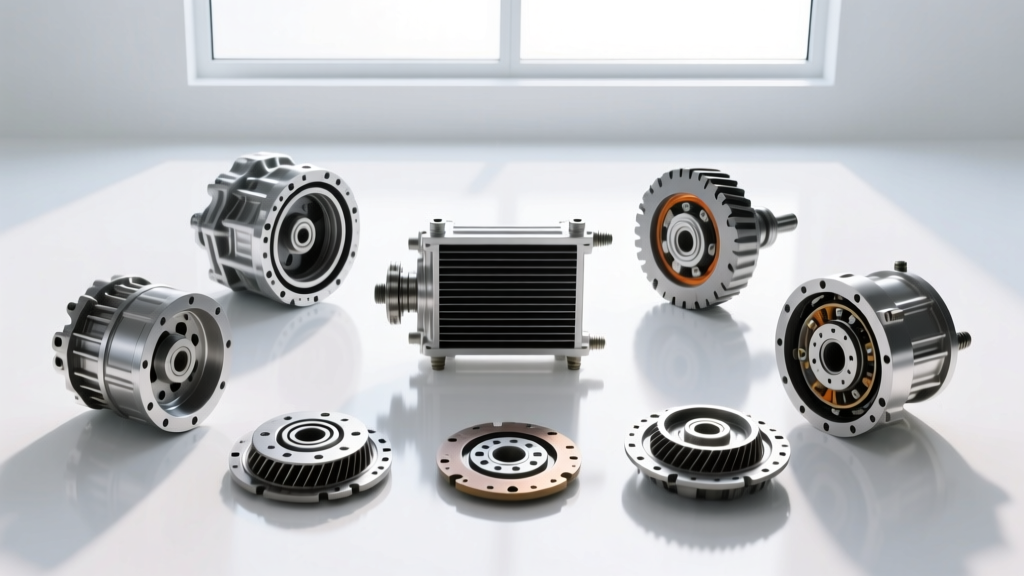
As of 2026, with modern 8-speed and 10-speed transmissions utilizing lower-viscosity fluids (like ZF 8-speed Lifeguard 8 or GM ULV), thermal management is more critical than ever. Fluid degradation begins at 220°F. By 240°F, the fluid varnishes, and the friction materials in the clutch packs begin to delaminate. Understanding the internal architecture of coolers—tube-and-fin, plate-and-fin, and stacked-plate—is essential for matching the right aftermarket brand to specific overheating symptoms.
Diagnosing Overheating: Matching Symptoms to Cooler Brands
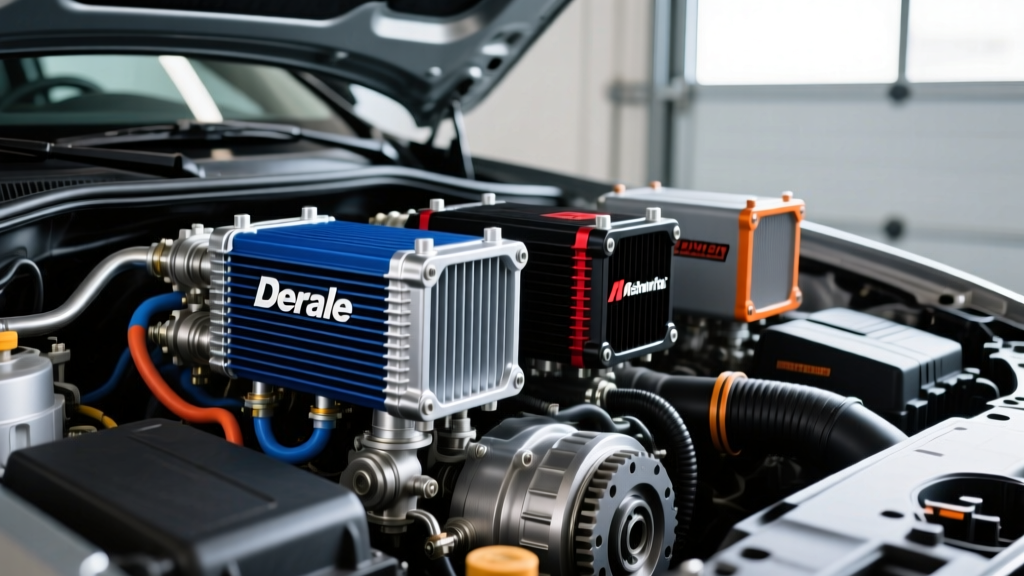
Not all coolers are created equal. A cooler designed for a daily-driven commuter will fail under the sustained load of a lifted truck towing 10,000 lbs. Below, we break down the big three aftermarket brands—Derale, Mishimoto, and Hayden—and map their engineering to specific transmission failure modes.
Derale Performance: Solving GM 6L80 Towing Overheating
The Symptom: You are towing a heavy trailer up a 6% grade. The GM 6L80 transmission fluid temperature gauge climbs past 235°F. You experience Torque Converter Clutch (TCC) shudder or the ECU commands a forced downshift to raise engine RPM and increase water pump flow.
The Diagnosis: The OEM radiator-integrated cooler lacks the thermal capacity for sustained high-GCWR (Gross Combined Weight Rating) towing. According to Sonnax Technical Resources, TCC shudder is heavily exacerbated by degraded fluid viscosity caused by localized boiling inside the torque converter.
The Solution: Derale Series 9000 (Part #13960)
Derale specializes in heavy-duty stacked-plate designs. The Series 9000 utilizes a turbulator plate design that agitates the ATF, preventing boundary layer stagnation and increasing the heat transfer coefficient.
- Core Dimensions: 11" x 11-3/8" x 1-1/4"
- GVW Rating: Up to 24,000 lbs.
- Fittings: 11/32" barb or optional -6 AN O-ring boss.
- Price Range: $90 - $130
Mishimoto: Managing ZF 8HP Track Heat Soak
The Symptom: During track days or repeated highway pulls in a Dodge Charger or BMW F-Series equipped with the ZF 8HP transmission, the vehicle enters "limp mode" or delays shifts after 15 minutes of hard driving.
The Diagnosis: Heat soak. The ZF 8HP relies on a complex Mechatronic unit and thermal management module. When the pan temperature exceeds 265°F, the TCM restricts torque to protect the clutch packs. Standard tube-and-fin coolers suffer from high pressure drop and poor thermal recovery during low-speed track sections.
The Solution: Mishimoto X-Trail or Universal Stacked-Plate Kits
Mishimoto’s engineering focuses on high-flow brazed aluminum cores. As detailed in Mishimoto's engineering tech papers, their internal fin geometry is optimized for high-velocity fluid movement, which is crucial for the ZF 8HP’s high-line-pressure demands (often exceeding 120 PSI under hard acceleration).
- Construction: Brazed aluminum, micro-extruded turbulators.
- Pressure Drop: Engineered to maintain < 4 PSI drop at 3 GPM, preventing TCC apply delays.
- Fittings: -10 AN or -8 AN for high-volume flow.
- Price Range: $180 - $320
Hayden Automotive: Bypassing Failing 4L60E OEM Coolers
The Symptom: A daily-driven truck with a 4L60E experiences gradual temperature creep in stop-and-go traffic. Upon checking the radiator, the coolant has a "strawberry milkshake" appearance.
The Diagnosis: The OEM transmission cooler, which is brazed inside the radiator’s coolant tank, has developed a pinhole leak. ATF and engine coolant have mixed. Even if the leak is caught early, the OEM cooler is now compromised and must be bypassed.
The Solution: Hayden Rapid-Cool (Part #678)
Hayden is the industry standard for OEM-replacement and light-duty auxiliary cooling. The Rapid-Cool series uses a highly efficient plate-and-fin design that offers a middle ground between the cheap tube-and-fin and the expensive stacked-plate.
- Core Dimensions: 10" x 15-3/4" x 3/4"
- GVW Rating: Up to 24,000 lbs (Gross Vehicle Weight).
- Installation: Includes standard 3/8" push-on fittings and OEM-style hose clamps.
- Price Range: $55 - $85
Brand Comparison & Diagnostic Matrix
| Brand / Model | Core Type | Best Diagnostic Application | Pressure Drop (Est.) | Avg. Cost |
|---|---|---|---|---|
| Derale Series 9000 | Stacked-Plate | 6L80/6L90 Towing, TCC Shudder from heat | 3 - 5 PSI | $110 |
| Mishimoto X-Trail | Brazed Aluminum | ZF 8HP Track use, Mechatronic heat soak | 2 - 4 PSI | $250 |
| Hayden Rapid-Cool | Plate-and-Fin | 4L60E/4L80E Radiator bypass, Daily driving | 5 - 8 PSI | $70 |
| OEM Tube-and-Fin | Tube-and-Fin | Basic commuter, light duty (Not recommended for towing) | 8 - 12 PSI | $40 |
Installation Torque Specs & Pressure Drop Testing
Understanding how does a transmission cooler work is only half the battle; proper installation dictates its survival. A common mistake in 2026 is over-tightening fittings or using the wrong hose clamps, leading to catastrophic fluid loss under pressure.
Crucial Torque and Plumbing Specs
- -6 AN Fittings: Torque to 12-15 ft-lbs. Over-torquing will crush the O-ring boss or strip the aluminum threads on stacked-plate coolers.
- -8 AN / -10 AN Fittings: Torque to 18-22 ft-lbs.
- Hose Clamps: Never use standard worm-gear clamps on ATF lines; the sharp edges will slice through the synthetic rubber under 150 PSI of line pressure. Use fuel-injection style constant-tension or smooth-band clamps, torqued to 25-30 in-lbs.
- Inline Thermostats: If operating in a climate where ambient temps drop below 40°F, install a 180°F inline bypass thermostat (e.g., Derale #13011). This prevents ATF from thickening and starving the transmission during cold starts.
Diagnosing Pressure Drop
If you install an auxiliary cooler and notice delayed shifts or TCC slip, the cooler may be too restrictive.
Pro-Tip: Install a 0-100 PSI liquid-filled gauge on the cooler return line. At idle, pressure should be 15-30 PSI. Under stall, it may spike to 150+ PSI. The pressure drop across the cooler (measured by testing the inlet vs. outlet) should never exceed 8 PSI. If it does, the cooler core is either too small, clogged with debris, or the internal turbulators are too restrictive for your transmission's pump volume.
Final Troubleshooting Verdict
When asking how does a transmission cooler work in the context of real-world diagnostics, the answer relies on matching thermal dynamics to your specific transmission's failure modes.
Choose Derale when you need brute-force BTU shedding for heavy towing with GM 6-speed and 10-speed trucks. Choose Mishimoto when packaging space is tight and you need high-flow, low-pressure-drop performance for ZF 8HP track applications. Choose Hayden for cost-effective, reliable OEM bypass solutions on older 4L60E and 4L80E platforms. By pairing the correct cooler architecture with precise installation torque specs and pressure testing, you can effectively eliminate overheating and extend your transmission's lifespan by hundreds of thousands of miles.