The Synergy of Cooling Upgrades and Telemetry
When your factory rubber lines begin to weep, crack, or swell, a transmission cooler hose replacement is no longer optional—it is critical to the survival of your drivetrain. However, simply swapping degraded SAE J1532 rubber hoses for modern PTFE-lined stainless steel braided lines only solves half the problem. You are upgrading your cooling capacity, but you are still flying blind regarding actual fluid thermodynamics. In 2026, with modern transmissions like the Ford 10R80 and GM 10L90 running aggressively high baseline temperatures to meet CAFE fuel economy standards, real-time telemetry is mandatory for anyone towing, off-roading, or hauling heavy payloads.
Performing a transmission cooler hose replacement is the single most opportune moment to integrate a dedicated transmission temperature monitoring system. Because you are already draining fluid, cutting lines, and accessing the cooler circuits, splicing in an inline temperature sender or swapping to a sensor-equipped deep pan adds negligible labor time while providing invaluable data. This guide compares the top monitoring solutions available, detailing exact fitments, torque specifications, and thermal thresholds for modern automatic transmissions.
2026 Buyer’s Matrix: Top Transmission Temperature Monitoring Kits
Choosing the right monitoring system depends heavily on your transmission model, your willingness to cut into hard lines, and your desire for analog versus digital telemetry. Below is a comparison of the most effective solutions on the market.
1. Autometer 2640 Z-Series Electronic Gauge (Best Overall Precision)
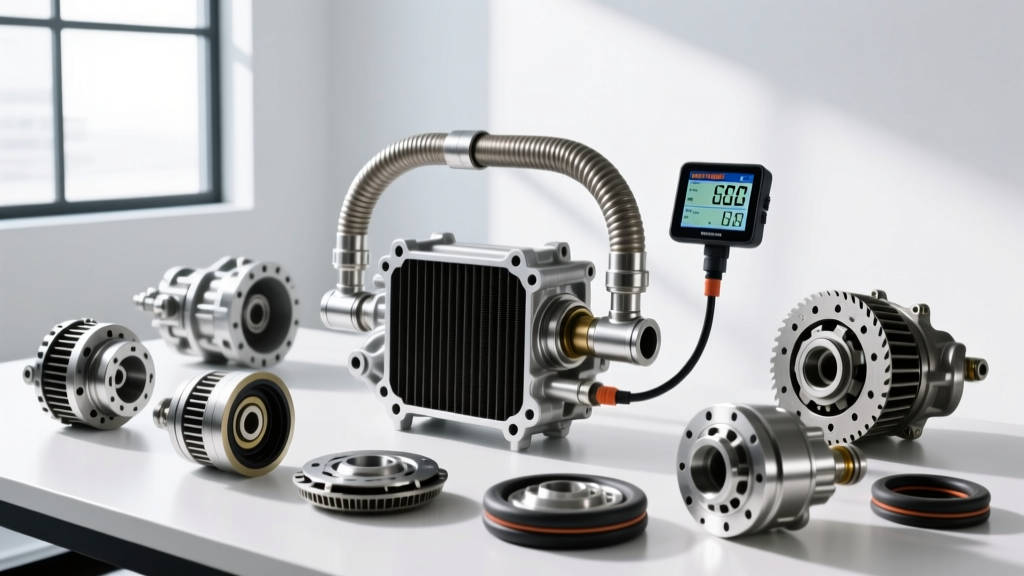
The Autometer 2640 utilizes a stepper-motor-driven electronic gauge paired with a 1/8-inch NPT thermistor sender. Unlike older mechanical capillary gauges, the electronic sender responds to temperature changes in milliseconds, providing real-time feedback when you hit a steep grade. The kit includes a 1/8-inch NPT to 3/8-inch hose barb T-fitting, making it ideal for splicing into the return line during your transmission cooler hose replacement. Autometer's technical installation guidelines recommend installing the sender in the pressure line (trans-to-cooler) to monitor peak internal temperatures, or the return line to monitor cooler efficiency. For towing, the pressure line is preferred.
2. Derale 13009 Inline Mechanical Gauge (Best Budget/Off-Road)
For budget-conscious builds or dedicated off-road rigs where electrical interference is a concern, the Derale 13009 mechanical gauge remains a staple. It uses a fluid-filled capillary tube to move the needle. While it lacks the instant snap of an electronic stepper motor, it is entirely self-contained and requires no wiring. The brass T-fitting included in the kit is designed for 3/8-inch or 1/2-inch cooler lines. When browsing Derale Performance's cooling system catalog, you will find this kit is highly favored by Jeep Wrangler and older GM 4L60E owners who prioritize simplicity over digital precision.
3. OBD2 Bluetooth CAN-Bus Scanners (Best Non-Invasive TFT Reading)
If your transmission cooler hose replacement is strictly a maintenance task and you refuse to cut into your new PTFE lines to install a T-fitting, an OBD2 CAN-Bus scanner is your best alternative. Modern transmissions (including the ZF 8HP and GM 8L90) feature internal Transmission Fluid Temperature (TFT) sensors. Using a high-quality Bluetooth adapter paired with an app like Torque Pro or Car Scanner, you can read the OEM TFT sensor PID. While this avoids plumbing modifications, be aware that OEM TFT sensors are often located in the valve body or pan, meaning they read sump temperature rather than the immediate post-torque-converter heat spike.
Hardware & Fitment Matrix
When integrating a sender during your hose replacement, matching the thread pitch and line diameter is critical to preventing cross-threading and high-pressure leaks. Use the table below to verify your hardware requirements.
| Component / Fitting | Thread / Size Spec | Torque Spec | Sealant Requirement |
|---|---|---|---|
| Standard Inline Sender | 1/8-inch NPT | 10 - 12 ft-lbs | PTFE Paste (e.g., Loctite 567) |
| Brass T-Fitting (3/8 Line) | 3/8-inch Hose Barb | Hand Tight + 1/4 Turn | None (Use double clamps) |
| Pan Adapter Plate | M10x1.0 or 1/8 BSPP | 15 - 18 ft-lbs | Copper Crush Washer |
| AN-6 to NPT Adapter | 9/16-18 UNF (AN-6) | 15 - 20 ft-lbs | None (O-ring or 37-deg flare) |
Warning: Never use standard white Teflon tape on NPT fittings in transmission cooling circuits. The tape can shred upon installation, travel through the cooler lines, and lodge inside the transmission's thermostat bypass valve or torque converter, causing catastrophic pressure drops.
Thermal Thresholds: What Your Gauge is Telling You
According to fluid tribology data published by Transmission Digest, Automatic Transmission Fluid (ATF) undergoes rapid chemical degradation once it exceeds specific thermal thresholds. Understanding these numbers is vital when interpreting your new gauge.
GM 6L80 / 6L90 (and 10L90)
The GM 6L and 10L families utilize an internal thermal bypass valve that prevents fluid from reaching the cooler until the ATF hits approximately 158°F to 176°F. This is done to reduce parasitic drag for EPA testing. Normal Operating Range: 175°F - 205°F. Danger Zone: Sustained temps above 220°F will rapidly oxidize Dexron VI or ULV fluids, leading to varnish buildup on the clutch plates and solenoid screens.
Ford 10R80
The Ford 10R80 is notorious for running hot by design, often idling in the 195°F - 210°F range in stock configuration. Ford's Mercon ULV fluid is engineered for these higher baselines. However, if your new gauge reads above 225°F while towing, you must upgrade to a high-capacity stacked-plate cooler and remove the factory thermal bypass valve entirely.
ZF 8HP (Chrysler/BMW/Ram)
The ZF 8HP is highly sensitive to fluid level checks, which must be performed with the fluid exactly between 30°C and 50°C (86°F - 122°F). Having an accurate inline or pan-mounted gauge is mandatory for DIYers performing fluid services on these units, as guessing the temperature will result in severe under-filling or over-filling.
Execution: Tapping the Line During Transmission Cooler Hose Replacement
To ensure a leak-free installation, follow this precise workflow when merging your hose replacement with a sensor install:
- Identify the Lines: Start the vehicle cold. Feel both cooler lines after 30 seconds. The line that rapidly gets hot is the pressure line (trans-to-cooler). The cooler line is the return line. Tap the pressure line for maximum heat warning capability.
- Cut and Deburr: Use a dedicated hose-cutting shear to ensure a perfectly square cut on your new PTFE or rubber hose. A jagged cut will allow the hose to slip off the barb under the 40-80 PSI of line pressure.
- Install the T-Fitting: Thread the 1/8-inch NPT sender into the brass or steel T-fitting before splicing it into the hose. This allows you to apply the correct torque on a bench vise without twisting the fragile cooler lines on the vehicle.
- Secure the Hose: Slide two stainless-steel T-bolt clamps over the hose. Push the hose onto the barb until it bottoms out. Position the clamps so the screws are offset by 180 degrees to balance the clamping force and prevent vibration-induced fatigue.
- Bleed the Air: After reassembly, idle the vehicle with the transmission in Park, then cycle through all gears. Check the T-fitting for weeping. Top off the dipstick or check-plug level accordingly.
Final Verdict
A transmission cooler hose replacement is a foundational repair, but adding temperature telemetry transforms your vehicle from a reactive machine into a proactive one. For heavy-duty towing and off-road applications, the Autometer 2640 Z-Series remains the undisputed champion due to its rapid stepper-motor response and robust T-fitting hardware. If you are maintaining a modern ZF 8HP or GM 10-speed and prefer to keep your plumbing intact, a high-quality OBD2 CAN-Bus scanner reading the internal TFT PID is the smartest, most cost-effective route. Regardless of your choice, monitoring your ATF temperatures is the cheapest insurance policy you can buy for a $3,000+ transmission rebuild.