The Fluid Dynamics: How a Torque Converter Works and Generates Heat
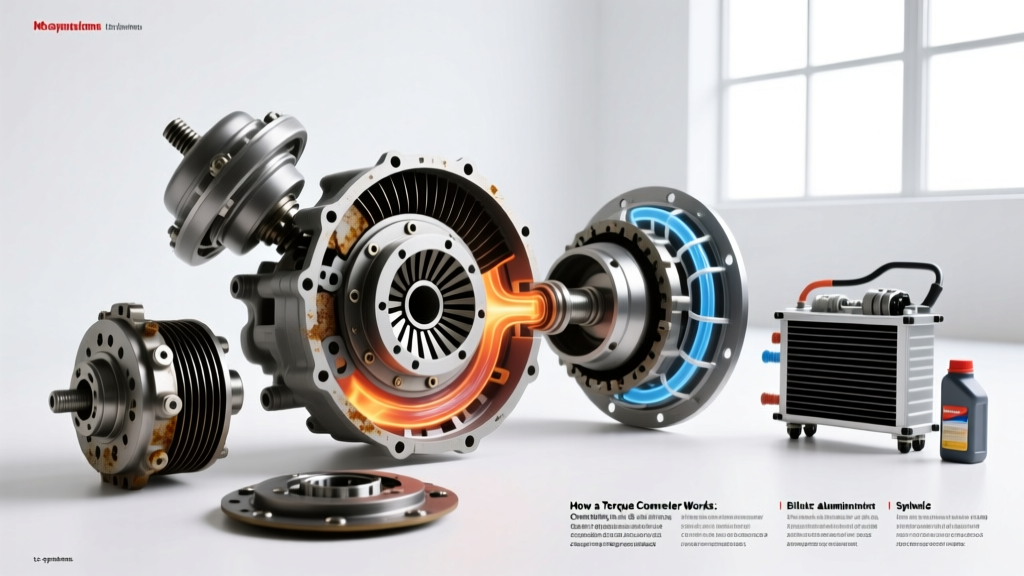
To effectively combat transmission failure, you must first understand how a torque converter works as a fluid coupling device. Inside the sealed housing, three primary components manage power transfer: the impeller (driven by the engine), the turbine (connected to the transmission input shaft), and the stator (which redirects fluid flow to multiply torque). When the engine spins the impeller, it hurls automatic transmission fluid (ATF) outward via centrifugal force. This fluid strikes the turbine blades, transferring kinetic energy and spinning the transmission.
However, this hydrodynamic transfer is never 100% efficient. The difference in speed between the impeller and the turbine is known as 'slip.' This slip creates immense internal fluid friction, converting kinetic energy into thermal energy. Under normal commuting conditions, a healthy torque converter operates between 160°F and 180°F. But when towing heavy loads, driving in stop-and-go traffic, or utilizing a high-stall aftermarket converter, fluid shearing can push temperatures past 220°F. According to Transmission Digest, for every 20°F increase in fluid temperature above 180°F, the lifespan of the ATF is effectively halved.
The TCC Slip Factor: Modern Overheating Culprits
Modern transmissions rely heavily on the Torque Converter Clutch (TCC) to eliminate slip and reduce heat. When the TCC locks, it creates a direct mechanical connection between the engine and transmission. However, modern tuning strategies—particularly in the GM 6L80, Ford 6R80, and ZF 8HP 8-speed transmissions—utilize Pulse Width Modulation (PWM) to keep the TCC in a state of 'controlled slip' during lower gears and light throttle application to improve NVH (Noise, Vibration, and Harshness) and fuel economy.
While this controlled slip (often 20 to 50 RPM) saves fuel, it generates continuous, localized heat at the clutch friction surface. If the converter's internal cooling flow is restricted, or if the ATF's viscosity breaks down, this localized heat warps the clutch piston, glazes the friction material, and ultimately leads to catastrophic TCC failure and debris contamination throughout the valve body. Experts at Sonnax frequently highlight that TCC apply pressure and hydraulic circuit integrity are paramount to preventing this micro-slip heat generation.
2026 Buyer’s Guide: Auxiliary Transmission Coolers Compared
If your factory radiator-integrated cooler is insufficient, adding an auxiliary transmission cooler is the most cost-effective defense against torque converter overheating. Below is a comparison of the top-tier plate-and-fin and tube-and-fin coolers for heavy-duty and towing applications.
| Cooler Model | Core Type | GVWR Rating | BTU/hr Dissipation | Approx. Cost (2026) |
|---|---|---|---|---|
| Hayden 679 Rapid-Cool | Plate-and-Fin | 24,000 lbs | ~14,500 | $65 - $80 |
| Derale 13504 Series 8000 | Plate-and-Fin w/ Turbulators | 26,000 lbs | ~16,200 | $75 - $95 |
| Tru-Cool 4544 LPD | Tube-and-Fin | 24,000 lbs | ~12,800 | $110 - $130 |
| Mishimoto MMTC-F2D | Stacked-Plate | 30,000 lbs | ~18,500 | $140 - $165 |
Buyer's Note: Plate-and-fin designs (like the Hayden and Derale) generally offer superior thermal transfer compared to traditional tube-and-fin models due to increased internal surface area and fluid turbulence. For vehicles equipped with a thermostat in the cooling lines (common in late-model Ram and Ford trucks), ensure you bypass the factory thermostat or install the auxiliary cooler after the thermostat to guarantee continuous flow.
Upgrading the Torque Converter: Billet Covers and Multi-Disc TCCs
For high-horsepower or severe-duty applications, simply cooling the fluid isn't enough; you must address the mechanical limitations of the torque converter itself. Factory stamped-steel converter covers are prone to flexing under high line pressure, which reduces TCC apply pressure and exacerbates slip-induced overheating.
Billet Steel Covers
Upgrading to a billet steel front cover (such as those offered by Circle D or Yank Performance for the GM 6L80/6L90) provides a rigid, zero-flex surface for the TCC piston. This ensures 100% of the hydraulic apply pressure is translated into clutch clamping force, eliminating micro-slip and the associated heat generation.
Multi-Disc vs. Single-Disc Friction
Factory converters typically use a single, large-diameter friction disc. Performance and heavy-duty rebuilders now utilize multi-disc TCC setups (often 3 to 5 discs, similar to the internal clutch packs of the ZF 8HP). By dividing the torque load across multiple friction surfaces, the clamping pressure required per disc is drastically reduced. This not only prevents glazing and overheating but also allows for aggressive lockup strategies at lower RPMs without stalling the engine or shattering the friction material.
Fluid Selection and Thermal Degradation Thresholds
The fluid is the lifeblood of the torque converter. Using the wrong ATF, or pushing a conventional fluid past its thermal limits, guarantees failure. Here is how modern ultra-low viscosity (ULV) fluids handle extreme heat:
- GM Dexron ULV / Ford Mercon ULV: Engineered for 8, 9, and 10-speed transmissions. These fluids have a base varnish threshold around 260°F, but their specialized friction modifiers begin to degrade rapidly if sustained above 225°F. Their lower viscosity reduces parasitic drag but requires precise temperature management to maintain hydrodynamic film strength.
- ZF LifeguardFluid 8: Specifically formulated for the ZF 8HP series. It features exceptional shear stability, but ZF explicitly warns that continuous sump temperatures above 130°C (266°F) will trigger permanent fluid breakdown and void warranty parameters.
- Amsoil Signature Series Multi-Vehicle: A premium synthetic alternative that pushes the thermal breakdown point well past 300°F, offering a massive safety margin for towing and off-road crawling where converter stall speeds remain high for extended durations.
According to fluid engineers at AMSOIL, synthetic base stocks maintain their hydrodynamic film strength significantly better than petroleum-based fluids when subjected to the extreme shearing forces inside a torque converter.
Installation Specs and Diagnostic Torque Values
When installing auxiliary coolers or replacing a torque converter due to heat damage, precision is mandatory. Improper line connections will lead to pressure drops, causing the TCC to slip and overheat immediately.
Crucial Torque Specifications
- GM 6L80/6L90 Cooler Line Quick-Connects: Do not overtighten. The retaining clips require a simple push-and-click. If using threaded adapters for aftermarket coolers, torque to 15-18 lb-ft.
- Ford 6R80 Cooler Line Fittings (Threaded): Torque to 18-22 lb-ft. Always use a backup wrench on the transmission case fitting to prevent twisting the internal transmission oil tubes.
- Torque Converter to Flexplate Bolts: Typically M8 or M10 depending on the application. Standard torque is 25-35 lb-ft, but always verify with the OEM service manual. Apply a medium-strength threadlocker (e.g., Loctite 243) to prevent backing out due to harmonic vibration.
Post-Installation Pressure Verification
After installing a new cooler or converter, hook up a transmission pressure gauge to the main line pressure tap. At idle in gear, you should see 45-60 PSI (depending on the transmission). When commanding TCC apply via a bi-directional scan tool, monitor the TCC slip RPM. It should drop to 0-10 RPM within 2 seconds. If slip remains above 50 RPM under light load, you have a hydraulic leak, a restricted cooler circuit, or a defective TCC solenoid.
Final Verdict: Protecting Your Drivetrain
Understanding how a torque converter works reveals that heat is the unavoidable byproduct of fluid coupling. While modern TCC strategies attempt to mitigate this, the laws of thermodynamics always win if cooling capacity is inadequate. For daily drivers and light towers, a $75 Hayden or Derale plate-and-fin cooler paired with a high-quality synthetic ULV fluid is the ultimate insurance policy. For heavy towing, off-roading, or modified powertrains, investing in a billet-covered, multi-disc torque converter is non-negotiable. Don't wait for the smell of burnt varnish to dictate your maintenance schedule—upgrade your cooling capacity today.