Understanding the Link Between OBD2 Codes and Failing Torque Converter Symptoms
When your vehicle begins to exhibit failing torque converter symptoms—such as a rhythmic shudder at highway speeds, erratic shifting, sudden stalling at stoplights, or a mysterious drop in fuel economy—the check engine light is often quick to follow. For beginners and seasoned DIYers alike, the illumination of the Malfunction Indicator Lamp (MIL) can feel overwhelming. However, the vehicle's Powertrain Control Module (PCM) is actually doing you a favor by storing Diagnostic Trouble Codes (DTCs) that point directly to the root cause.
The torque converter acts as a fluid coupling between your engine and transmission. Modern automatic transmissions utilize a Torque Converter Clutch (TCC) to mechanically lock the engine to the transmission input shaft at cruising speeds, eliminating parasitic fluid slip and improving fuel efficiency. When this lockup mechanism fails, the PCM detects the anomaly and logs a specific OBD2 code. In this beginner-friendly explainer, we will decode the most common torque converter DTCs, explore real-world diagnostic strategies, and break down the repair costs and torque specifications required to fix them.
How the PCM Monitors Torque Converter Clutch (TCC) Slip
Before diving into specific codes, it is crucial to understand how the computer monitors the health of your torque converter. The PCM continuously compares two critical data points:
- Engine Speed (RPM): Measured by the Crankshaft Position Sensor (CKP).
- Transmission Input Shaft Speed (ISS): Measured by the ISS sensor inside the transmission bellhousing.
When the TCC is commanded to lock (usually between 40–55 mph in higher gears), the PCM expects the Engine RPM and ISS RPM to match almost perfectly. If the PCM detects a rotational delta—meaning the engine is spinning significantly faster than the transmission input shaft—it calculates this as 'TCC slip'. If the slip exceeds the manufacturer's calibrated threshold (often greater than 100 RPM for a GM 6L80 or specific adaptive parameters in a ZF 8HP), the PCM will set a performance code and may trigger 'limp mode' to protect the transmission from catastrophic friction material failure.
Top 5 OBD2 Codes for Failing Torque Converter Symptoms
While dozens of transmission codes exist, the P0740–P0744 series is the universal language for torque converter clutch faults. Here is what they mean in plain English.
P0740: Torque Converter Clutch Circuit Malfunction
This is a broad electrical fault. The PCM has detected an open or short circuit in the TCC solenoid control circuit. It does not necessarily mean the torque converter itself is mechanically broken. The culprit is often a chafed wiring harness, a corroded transmission connector, or a failed internal solenoid coil. On Ford's 6R80 transmission, this can sometimes point to a failing molded lead frame inside the valve body.
P0741: Torque Converter Clutch System Performance or Stuck Off
This is the most common code associated with physical failing torque converter symptoms like highway shudder or slipping. The PCM is commanding the TCC to lock, but the actual slip remains too high. According to industry data from OBD-Codes P0741 Guide, this is frequently caused by worn TCC friction linings inside the converter, degraded transmission fluid losing its friction modifiers, or hydraulic leaks in the valve body. For example, in the ubiquitous ZF 8HP transmission found in BMW, Chrysler, and Ford vehicles, a worn mechatronic sealing sleeve often leaks apply pressure, resulting in a P0741 code.
P0742: Torque Converter Clutch Circuit Stuck On
If your vehicle shudders violently and stalls the engine when coming to a complete stop, P0742 is the likely culprit. This means the TCC is mechanically locked and refuses to release. The engine is directly coupled to the wheels at 0 MPH, causing a stall just like forgetting to press the clutch pedal in a manual car. This is usually caused by a stuck TCC apply valve in the valve body or severe debris clogging the solenoid exhaust port.
P0743: Torque Converter Clutch Electrical Circuit
Similar to P0740, but specifically indicating a severe electrical short to ground or voltage. The PCM's internal driver circuit may be compromised, or the TCC Pulse Width Modulation (PWM) solenoid has internally shorted out, blowing the PCM's transmission control fuse.
P0744: Torque Converter Clutch Circuit Intermittent
This code indicates erratic TCC behavior. The lockup engages and disengages unpredictably. This is a hallmark symptom of a failing Pressure Control Solenoid (PCS) or heavily contaminated fluid causing the TCC regulator valve to stick intermittently inside the valve body bore.
DTC Troubleshooting Matrix
Use the table below as a quick-reference framework to diagnose your specific OBD2 code and estimate the financial impact of the repair.
| OBD2 Code | Primary Meaning | Most Common Culprit | Estimated Repair Cost |
|---|---|---|---|
| P0740 | Circuit Malfunction | Wiring harness, connector, or solenoid coil | $200 – $600 |
| P0741 | Performance / Excessive Slip | Worn TC friction material, valve body leak, bad fluid | $400 – $1,800 |
| P0742 | Stuck On (Engine Stalls) | Stuck TCC apply valve, clogged solenoid screen | $350 – $900 |
| P0743 | Electrical Short / Open | Shorted PWM solenoid, blown PCM driver | $250 – $1,200 |
| P0744 | Intermittent Slip | Failing Pressure Control Solenoid, degraded fluid | $300 – $700 |
Real-World Diagnostics: Beyond the Code Reader
A cheap code reader will tell you what the code is, but professional diagnostics tell you why it happened. Before throwing expensive parts at the vehicle, follow these E-E-A-T approved diagnostic steps.
Step 1: Fluid Analysis and Inspection
Transmission fluid is the lifeblood of the torque converter. Pull the dipstick (if equipped) or crack the inspection plug.
- Color & Smell: Fluid should be bright red or light amber (depending on the specific OEM fluid like Dexron VI or Mercon LV). If it smells burnt or looks dark brown/black, the TCC friction material has likely disintegrated. A fluid flush will not fix this; the torque converter must be replaced and the cooler lines flushed.
- Level: Low fluid volume leads to low line pressure, preventing the TCC from fully applying, which triggers P0741 slip codes.
Step 2: Bi-Directional Scanner Testing
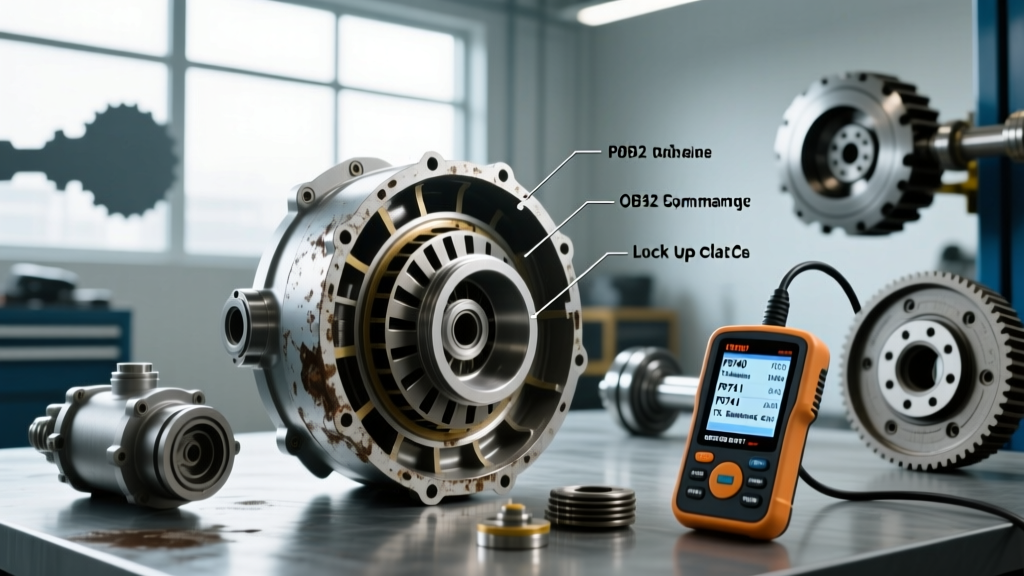
To accurately diagnose failing torque converter symptoms, you need a bi-directional scan tool capable of commanding transmission solenoids.
- Connect the scanner and monitor Engine RPM and ISS RPM live data.
- Drive the vehicle until the transmission reaches 3rd or 4th gear (above 45 mph).
- Use the scanner to manually command the TCC solenoid duty cycle to 100% (or 'Lock').
- Watch the RPMs. If the ISS RPM instantly matches the Engine RPM and holds steady, your electrical and hydraulic circuits are functioning, and the code may be an intermittent glitch. If the ISS RPM remains 200+ RPM lower than the Engine RPM, you have confirmed mechanical slip or a severe hydraulic leak.
Repair Costs, Part Numbers, and Torque Specs
When you have isolated the fault, precision during the repair is non-negotiable. Here are specific repair scenarios, part numbers, and vital torque specifications.
Scenario A: GM 6L80 TCC Shudder (P0741)
The GM 6L80 is notorious for TCC shudder. Often, the issue is a failing TCC PWM solenoid or degraded fluid.
- Part: ACDelco TCC PWM Solenoid (Part # 24236933).
- Fix: Drop the transmission pan, replace the solenoid body assembly, and perform a complete fluid exchange using Dexron VI or Dexron ULV (verify specific year application).
- Cost: $350 for parts and fluid.
Scenario B: ZF 8HP Mechatronic Sleeve Leak (P0741)
If your ZF 8HP transmission is slipping only when hot, the mechatronic adapter sleeve is likely worn, bleeding off TCC apply pressure.
- Part: Sonnax Mechatronic Sleeve Kit (Part # 95037-01K).
- Fix: This can be replaced by dropping the pan and mechatronic unit without removing the transmission from the vehicle.
- Cost: ~$150 for the part, plus $400 in labor and ZF Lifeguard 8 fluid.
Scenario C: Full Torque Converter Replacement
If the internal friction clutch is destroyed, the transmission must be removed. When reinstalling the transmission and torque converter, adhering to exact torque specifications is critical to prevent flexplate cracking or bellhousing warping.
- Flexplate to Torque Converter Bolts: Typically M10x1.5. Torque to 45–65 Nm (33–48 lb-ft) depending on the OEM. Always apply a medium-strength threadlocker (e.g., Loctite 243).
- Bellhousing to Engine Block Bolts: GM M10 bolts require 50 Nm (37 lb-ft). Ford and Chrysler specifications vary, but generally fall between 40–55 Nm.
- Cost: A remanufactured torque converter costs between $300 and $600. With labor and fluid, expect a total bill of $1,100 to $1,800.
Conclusion
Diagnosing failing torque converter symptoms doesn't have to be a shot in the dark. By understanding the relationship between OBD2 codes (P0740-P0744), TCC slip parameters, and hydraulic pressure, you can accurately pinpoint whether you need a simple $150 sealing sleeve, a new PWM solenoid, or a complete torque converter replacement. Always start with fluid analysis, verify slip with a bi-directional scanner, and respect the torque specs during reassembly to ensure your drivetrain operates flawlessly for miles to come.