The Acoustic Signature of Driveline Health
In the modern automotive landscape of 2026, automatic transmissions are engineering marvels. With 8, 9, and 10-speed units operating under extreme thermal loads and rapid shift cycles, preventive maintenance extends far beyond simple fluid exchanges. A critical, yet frequently overlooked aspect of transmission longevity is acoustic monitoring. Performing accurate torque converter noise diagnosis can save you from catastrophic driveline failure. While internal bearing wear or stator clutch degradation often dominate diagnostic conversations, one of the most common—and easily preventable—causes of severe driveline clunking is hardware-related: failing or improperly torqued torque converter bolts.
As a preventive maintenance guide, this article will dissect the acoustic signatures of torque converter failure, isolate the mechanical risks of loose mounting hardware, and provide a concrete diagnostic protocol for technicians and advanced DIYers.
Categorizing Torque Converter Noises
Before dropping the transmission pan or removing the bellhousing, you must accurately categorize the noise. The torque converter acts as a fluid coupling and a mechanical link between the engine’s crankshaft and the transmission’s input shaft. When it fails, or when its mounting hardware compromises, it produces distinct acoustic signatures.
- The Whine or Siren Sound: Typically indicates pump cavitation, low fluid levels, or a failing stator one-way clutch. This noise changes pitch directly with engine RPM, regardless of vehicle speed or gear selection.
- The Shudder or Vibration: Usually felt rather than heard, occurring between 30-50 mph under light throttle. This points to Torque Converter Clutch (TCC) apply issues, degraded friction material, or contaminated fluid lacking the necessary friction modifiers.
- The Rhythmic Clunk or Rattle: This is the danger zone. A metallic clunking that correlates with engine RPM and worsens during load transitions (e.g., shifting from Reverse to Drive, or letting off the throttle) often points to a cracked flexplate, broken turbine blades, or loose torque converter bolts.
The Hidden Threat: Torque Converter Bolt Failure
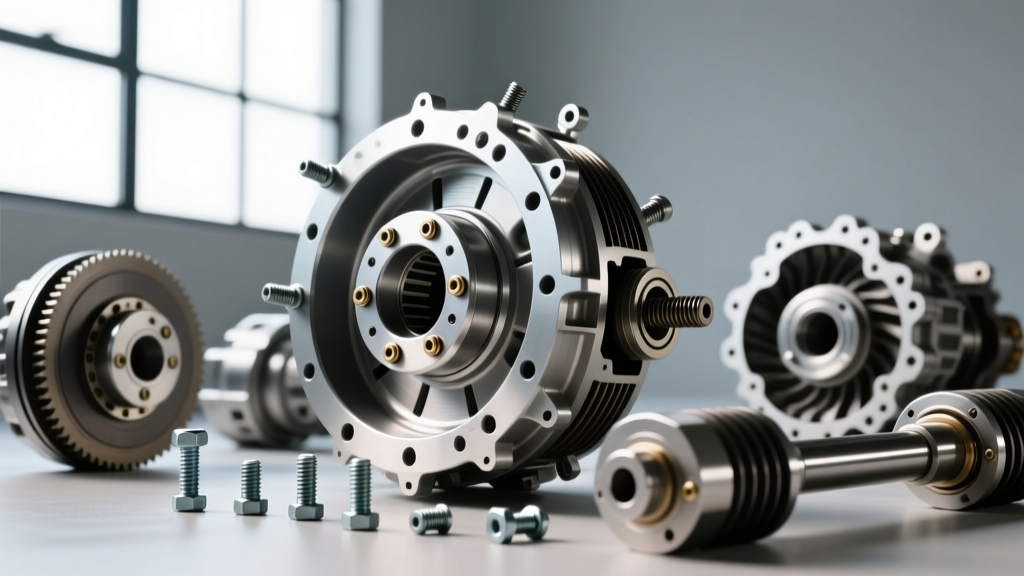
The torque converter is bolted directly to the engine’s flexplate (or drive plate). This joint must withstand immense rotational mass and the violent torque spikes of modern high-output engines. If the torque converter bolts are not torqued to exact OEM specifications, or if they are reused past their yield point, they will stretch and back out over time.
When these bolts loosen, the torque converter wobbles on the flexplate. This creates a rhythmic clunking noise that perfectly mimics internal transmission failure or a failing CV joint. Left unchecked, the elongated bolt holes will destroy the flexplate, and in severe cases, the converter can detach, tearing the transmission bellhousing apart from the inside. According to industry data from the Automatic Transmission Rebuilders Association (ATRA), misdiagnosing loose flexplate hardware as internal transmission failure leads to thousands of dollars in unnecessary teardowns annually.
OEM Torque Specifications & Preventive Hardware
Preventive maintenance requires verifying hardware integrity during any engine-out service, timing chain replacement, or transmission reseal. Below are the standard torque specifications for popular modern transmissions. Always verify with the specific OEM service manual for your exact model year, as bolt diameters (M8 vs. M10) and flexplate materials dictate the final spec.
| Transmission Model | Typical Application | Bolt Size | OEM Torque Spec | Preventive Upgrade Option |
|---|---|---|---|---|
| GM 6L80 / 8L90 | Silverado, Camaro, Corvette | M8 x 1.25 | 22 lb-ft (30 Nm) | ARP 134-2801 Chromoly |
| GM 10L80 / 10L90 | F-150, Mustang, CT5-V | M8 / M10 | 22 lb-ft (M8) / 35 lb-ft (M10) | OEM ACDelco 11547141 |
| Ford 10R80 | F-150, Bronco, Explorer | M8 x 1.25 | 26 lb-ft (35 Nm) | ARP Custom Flexplate Kit |
| ZF 8HP45 / 8HP70 | BMW, Dodge Charger, Audi | M8 | 30 lb-ft (40 Nm) + 90° | OE Yield Bolts (Mandatory) |
Note on ZF Transmissions: Many European applications utilize Torque-To-Yield (TTY) bolts for the torque converter-to-drive plate connection. These bolts stretch permanently during installation. Reusing TTY torque converter bolts during a preventive inspection or transmission R&R is a guaranteed path to failure. Always replace them with new OEM hardware.
Step-by-Step Noise Isolation Protocol
When a customer complains of a driveline clunk, follow this systematic diagnostic approach to isolate the torque converter bolts before condemning the transmission internals. Experts at Sonnax consistently emphasize that external mechanical linkages must be ruled out before internal hydraulic or friction element failures are assumed.
Step 1: The Electronic Stethoscope Test
Use an electronic stethoscope (such as the OTC 6260 ChassisEAR) with the vehicle on a lift. Place the sensors on the transmission bellhousing and the engine block near the rear main seal. Start the engine and cycle through Park, Reverse, Neutral, and Drive while holding the brake. If the clunking is loudest at the bellhousing mating surface and sounds like metal-on-metal slapping rather than a deep internal hydraulic thud, suspect flexplate or bolt issues.
Step 2: The Inspection Cover Verification
Most rear-wheel-drive and longitudinal setups feature an inspection cover at the bottom of the bellhousing. Remove this cover to expose the flexplate and torque converter bolts.
- Visual Inspection: Look for rust trails or metallic dust around the bolt heads. This is a primary indicator of bolt movement and fretting corrosion.
- Mechanical Check: Use a calibrated torque wrench to check the breakaway torque of the bolts. If a bolt turns before reaching the OEM breakaway spec, it has yielded or backed out.
- Flexplate Check: Inspect the flexplate for hairline cracks radiating from the crankshaft bolt circle or the torque converter bolt holes. Use a prybar gently to check for excessive axial runout.
Step 3: Stall Test (With Extreme Caution)
For older units like the 4L60E, a traditional stall test can highlight a slipping stator or internal failure. However, for modern 8 and 10-speed units (like the ZF 8HP or Ford 10R80), aggressive stall testing can cause immediate thermal damage to the TCC and clutch packs. Instead, perform a “neutral drop” simulation using bi-directional scan tool controls to command line pressure while monitoring input and output shaft speed sensors (ISS/OSS) for erratic slip ratios that indicate internal mechanical separation rather than bolt looseness.
Preventive Maintenance: Cost vs. Catastrophe
Integrating torque converter bolt inspection into your preventive maintenance schedule is a matter of financial logic. Consider the cost disparity between proactive hardware management and reactive failure repair:
- Proactive Hardware Replacement: A set of OEM flexplate bolts costs between $15 and $45. Upgrading to ARP chromoly hardware for high-stall or heavy-towing applications costs roughly $60 to $90. Labor to drop an inspection cover and re-torque is under 1 hour.
- Reactive Failure Repair: If loose torque converter bolts destroy the flexplate and score the transmission pump drive, you are facing a transmission removal. A new OEM flexplate ranges from $150 to $400. If the torque converter hub is damaged, a replacement converter costs $600 to $1,200. Total labor and parts for a catastrophic bellhousing failure easily exceed $2,500 to $4,000.
Final Thoughts on Driveline Longevity
Torque converter noise diagnosis requires a methodical, evidence-based approach. While internal failures like worn needle bearings or degraded TCC friction materials are common, the humble torque converter bolt remains a critical weak point if neglected. By adhering to strict OEM torque specifications, refusing to reuse yield-style hardware, and utilizing acoustic isolation tools, you can accurately diagnose driveline clunks and implement preventive measures that ensure the longevity of modern automatic transmissions.