The Magic of Fluid Coupling: A Beginner's Guide
If you have ever driven an automatic vehicle, you have relied on a marvel of hydraulic engineering sitting right between your engine and transmission: the torque converter. For beginners, understanding how this component works can seem daunting, but the fundamental principles are beautifully simple. Unlike a manual transmission that uses a mechanical friction disc to connect the engine to the gearbox, an automatic transmission uses a fluid coupling mechanism. This allows your car to come to a complete stop at a red light while the engine continues to idle, without stalling.
However, fluid coupling inherently creates 'slip,' which wastes fuel and generates excess heat. To solve this, modern automatics utilize a lockup mechanism commanded by the transmission torque converter clutch solenoid. In this comprehensive guide, we will break down exactly how torque converters operate, explore the critical role of the lockup solenoid, and provide real-world diagnostic data, part numbers, and torque specs for popular transmission platforms.
Inside the Housing: 4 Critical Components
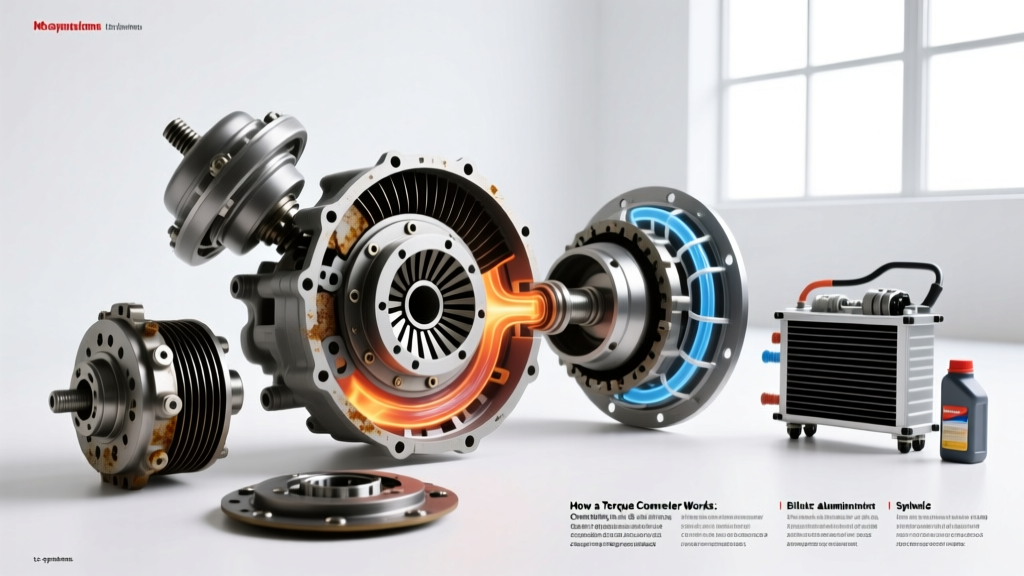
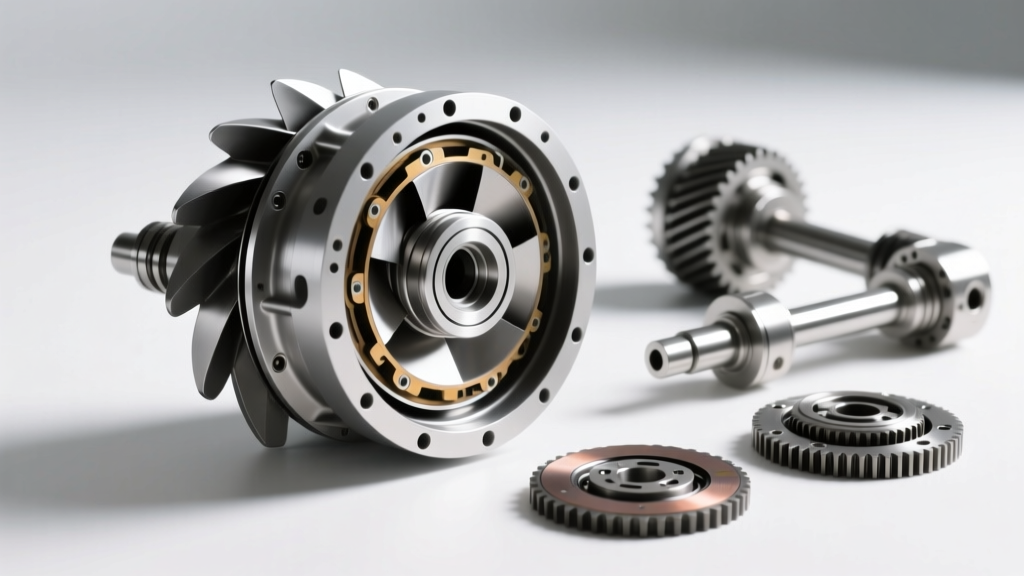
Before we can understand the electronic controls, we must look inside the welded steel housing of the torque converter. It is essentially a donut-shaped chamber filled with Automatic Transmission Fluid (ATF), such as Dexron VI or ZF Lifeguard 8. Inside, you will find four main components:
- The Impeller (Pump): Bolted directly to the converter housing, the impeller spins at the exact same speed as the engine's crankshaft. Its curved vanes fling ATF outward using centrifugal force.
- The Turbine: Sitting just millimeters away from the impeller, the turbine is splined to the transmission's input shaft. As the fluid thrown by the impeller strikes the turbine's vanes, it forces the turbine to spin, thereby transferring engine power to the transmission.
- The Stator: Located in the center between the impeller and turbine, the stator is mounted on a one-way clutch. Its job is to redirect the returning fluid back into the impeller, multiplying torque (often by a ratio of 1.8:1 to 2.2:1) during hard acceleration.
- The Torque Converter Clutch (TCC): A friction-lined piston located at the front of the converter. When engaged, it physically locks the turbine to the converter housing, eliminating fluid slip.
The Game Changer: The Transmission Torque Converter Clutch Solenoid
While fluid coupling is excellent for smooth launches and idle stability, it is terrible for highway fuel economy. At 65 mph, an unlocked torque converter can slip by 100 to 200 RPM, burning fuel and degrading the ATF. This is where the transmission torque converter clutch solenoid becomes the star of the show.
When the Powertrain Control Module (PCM) detects steady-state cruising conditions, it commands the TCC solenoid to open. This routes pressurized ATF (typically between 90 and 115 PSI) into the front of the converter, applying the friction clutch. The engine and transmission are now mechanically locked together, just like a manual clutch, yielding a 1:1 ratio and maximizing fuel efficiency.
Real-World Solenoid Specs & Part Numbers
Not all solenoids are created equal. The evolution of transmission technology has drastically changed how the transmission torque converter clutch solenoid operates. Let us look at three common platforms:
| Transmission Model | Solenoid Type | OEM Part Number | Typical Resistance / Spec |
|---|---|---|---|
| GM 4L60E | PWM (Pulse Width Modulated) | ACDelco 214-1892 | 10-12 Ohms @ 68°F (300 Hz) |
| Ford 6R80 (ZF 6HP26) | Integrated Mechatronic | ZF 1068.298.037 (Kit) | Integrated Linear Solenoid |
| Toyota Aisin U660F | Linear Apply Solenoid | Aisin SLU-Linear | 5.0 - 5.6 Ohms |
According to technical documentation from Sonnax Technical Resources, modern PWM and linear solenoids do not simply turn 'on' or 'off.' Instead, they pulse thousands of times per second to 'feather' the clutch apply, making the lockup transition completely imperceptible to the driver.
The 4 Phases of Torque Converter Operation
To truly grasp the system, you must understand the four distinct phases of operation your vehicle cycles through every time you drive to the grocery store.
| Phase | Driving Scenario | Stator State | TCC Solenoid State | Torque Multiplication |
|---|---|---|---|---|
| 1. Stall | Vehicle stopped, foot on brake, in gear. | Locked (redirecting fluid) | Exhausted (OFF) | Maximum (Up to 2.2:1) |
| 2. Acceleration | Pulling away from a stop light. | Locked (redirecting fluid) | Exhausted (OFF) | High (1.5:1 to 2.0:1) |
| 3. Coupling | Cruising at moderate speeds (e.g., 35 mph). | Freewheeling (overrunning clutch releases) | Exhausted (OFF) | None (1:1 Fluid coupling) |
| 4. Lockup | Highway cruising or light throttle deceleration. | Freewheeling | Applied (ON / PWM Modulated) | None (1:1 Mechanical Lock) |
When Things Go Wrong: Solenoid Failure Symptoms
Because the transmission torque converter clutch solenoid operates in a harsh environment submerged in hot ATF, it is a common failure point. When it fails, the PCM will typically illuminate the Check Engine Light and set a Diagnostic Trouble Code (DTC). Common codes include P0740 (TCC Circuit Malfunction), P0741 (TCC Performance/Stuck Off), and P0742 (TCC Stuck On).
Here is what you will actually feel in the driver's seat:
- Torque Converter Shudder: Often mistaken for an engine misfire, this feels like driving over a series of rumble strips. It typically occurs between 45 and 55 mph when the PCM commands a light, modulated apply of the clutch, but degraded ATF or a failing solenoid causes the friction material to grab and release rapidly.
- Engine Stalling at Stops: If the solenoid fails in the 'open' or 'stuck on' position, the mechanical lock remains engaged even as the vehicle comes to a halt. Because the engine is still physically locked to the transmission, it will stall out, much like stopping a manual car without pressing the clutch pedal.
- Poor Fuel Economy & Overheating: If the solenoid fails 'closed' or the circuit breaks, the converter will never lock. You will lose 2-4 MPG on the highway, and the constant fluid shear will cause ATF temperatures to spike past 230°F, rapidly destroying the transmission's internal clutches.
For deeper diagnostic flowcharts and rebuilding standards, the Automatic Transmission Rebuilders Association (ATRA) provides excellent technical bulletins regarding TCC apply pressure testing using a manifold gauge block.
Diagnostic & Repair Cost Breakdown
Repairing a faulty TCC solenoid varies wildly depending on the transmission architecture. Here is what you can expect to pay at a reputable independent shop in 2026:
Drop-Pan Solenoid Replacements (e.g., GM 4L60E, Ford 4R70W)
On older or simpler transmissions, the solenoid is located in the valve body, accessible simply by dropping the transmission oil pan.
Parts: $25 - $60 (e.g., ACDelco or BorgWarner OEM replacement).
Labor: 1.5 to 2.5 hours.
Fluid & Filter: $60 - $120.
Total Estimated Cost: $250 - $450.
Pro-Tip: When reinstalling the torque converter after any major service, ensure you torque the flexplate-to-converter nuts to exact specifications. For the GM 4L60E, the M8 nuts require exactly 15 lb-ft (20 Nm). Over-torquing can warp the converter hub and destroy the front transmission pump seal.
Integrated Mechatronic Replacements (e.g., ZF 8HP, Ford 6R80)
On modern 6, 8, and 10-speed automatics, the TCC solenoid is permanently integrated into the plastic mechatronic valve body assembly. You cannot buy just the solenoid from the OEM; you must replace the entire valve body and recalibrate the Transmission Control Module (TCM).
Parts: $900 - $1,800 for the OEM Mechatronic unit (e.g., ZF Lifeguard kit).
Labor: 4.0 to 6.0 hours (requires dropping the transmission pan, valve body, and performing software adaptation).
Fluid: $150 - $250 (requires specific OEM fluid like ZF Lifeguard 8).
Total Estimated Cost: $1,800 - $3,200.
Final Thoughts on Maintenance
The health of your transmission torque converter clutch solenoid is directly tied to the quality of your ATF. The microscopic friction material that wears off the TCC piston circulates through the transmission and can easily clog the tiny mesh screens protecting the solenoid. To prevent premature failure, avoid 'lifetime fluid' myths. Perform a drain-and-fill service every 40,000 to 60,000 miles using only the exact OEM-specified fluid. By understanding how your torque converter operates and respecting the hydraulic limits of the system, you can easily push your automatic transmission well past the 200,000-mile mark.
For more in-depth guides on specific transmission models and torque converter stall speed tuning, explore our complete Torque Converter Systems archive.