The EV Paradigm Shift: Redefining the Driveshaft
When buyers enter the used market in 2026, comparing a high-mileage internal combustion engine (ICE) truck to a used Model 3 or Model Y requires a fundamental shift in mechanical understanding. If you are researching a drivetrain Tesla versus an ICE equivalent, the first technical hurdle is terminology. Traditional rear-wheel-drive (RWD) and four-wheel-drive (4WD) vehicles utilize a longitudinal tubular driveshaft equipped with universal joints (U-joints) and center support bearings (CSBs) to transfer torque from the transmission to the differential.
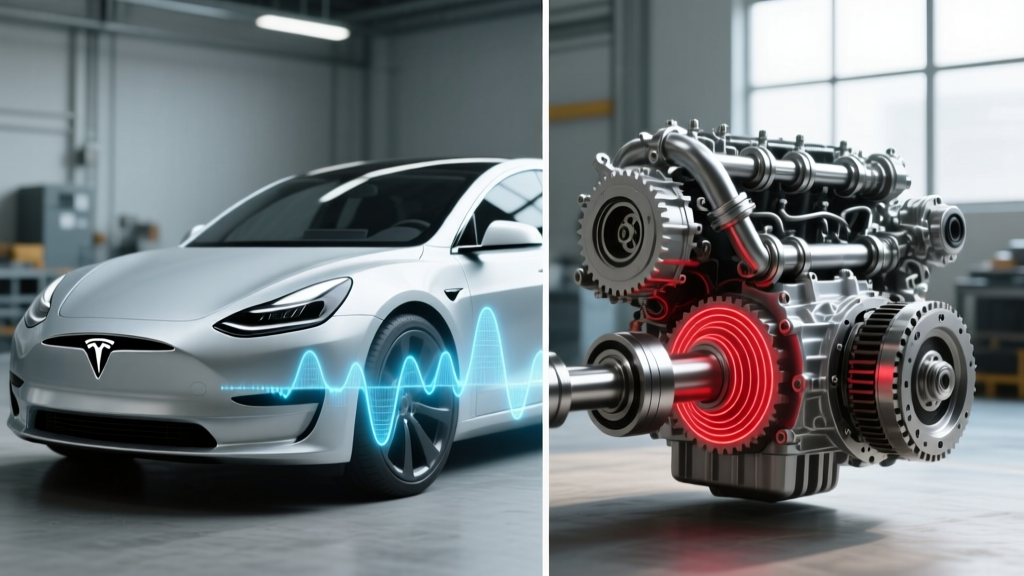
Tesla vehicles, however, do not use traditional longitudinal driveshafts. Instead, the Tesla electric drivetrain relies on a reduction gearbolted directly to the electric motor, which then distributes power to the wheels via half-shafts (CV axles). Therefore, 'driveshaft vibration diagnosis' in a Tesla actually translates to half-shaft, spline lash, and reduction gear bearing diagnostics. Understanding this architectural divergence is critical for accurate troubleshooting and estimating repair costs.
Diagnosing Drivetrain Tesla Vibrations: The EV Buyer’s Checklist
As the 2018–2021 Tesla Model 3 and Model Y fleet ages past the 100,000-mile mark, drivetrain wear patterns have become highly documented. Unlike ICE vehicles where vibrations are often speed-dependent, Tesla drivetrain vibrations are predominantly load-dependent.
1. Inner CV Joint and Tripod Housing Wear
The most common source of vibration under acceleration in a Tesla is wear within the inner constant velocity (CV) joint. The inner joint uses a tripod design that slides in and out of a housing filled with specialized grease. When the grease degrades or the tripod rollers develop flat spots, you will feel a distinct lateral shudder or vibration through the chassis specifically when applying regenerative braking or accelerating from 30 to 50 mph.
2. Spline Lash and the Notorious 'Clunk'
While not a continuous vibration, excessive spline lash between the half-shaft and the rear drive unit (DU) differential causes a jarring clunk during load reversals (transitioning from acceleration to regen braking). In severe cases, this looseness manifests as a low-frequency drivetrain shudder at low speeds. Tesla has issued multiple revisions of the rear half-shaft assembly (e.g., updating from early part numbers to later revisions like 1344847-00-D) to tighten spline tolerances and apply specialized anti-backlash grease at the factory.
3. Reduction Gear Bearing Degradation
If the vibration is strictly speed-dependent (e.g., appearing exactly at 72 mph regardless of throttle position), the culprit is rarely the half-shafts. Instead, suspect the internal bearings of the single-speed reduction gear. High-frequency whining accompanied by a physical buzz in the floorpan indicates bearing pitting or cage wear inside the DU.
Traditional ICE Driveshaft Vibration: The U-Joint & Balance Factor
Contrast the Tesla experience with a traditional ICE vehicle equipped with a 6L80, 8L90, or ZF 8HP transmission. Here, the tubular driveshaft spins at high RPMs, making it highly sensitive to physical imbalance and angular misalignment.
Speed-Dependent Harmonics
ICE driveshaft vibrations typically peak between 45 and 65 mph. This is a harmonic resonance issue. If the driveshaft is out of balance, or if a U-joint (such as a Spicer 1310 or 1350 series) has seized due to lack of lubrication, the shaft orbits rather than spinning true. According to Spicer Parts engineering guidelines, even a few ounces of imbalance at 3,000 RPM generates massive centrifugal force, shaking the entire chassis.
Center Support Bearing (CSB) Failure
Two-piece driveshafts rely on a rubber-isolated CSB. When the rubber degrades or the internal bearing fails, the driveshaft drops out of its optimal pinion angle. This creates a binding effect in the U-joints, resulting in a cyclic vibration that feels like a rhythmic 'thump-thump-thump' that correlates directly with driveshaft rotation speed, not wheel speed.
Comparison Chart: Tesla EV Half-Shaft vs. ICE Driveshaft Diagnostics
| Diagnostic Factor | Tesla EV Drivetrain (Half-Shafts / DU) | ICE Drivetrain (Tubular Driveshaft) |
|---|---|---|
| Primary Vibration Trigger | Load-dependent (Throttle / Regen) | Speed-dependent (45–65 mph) |
| Common Failure Points | Inner CV tripod, DU spline lash, DU bearings | U-joints, CSB, Pinion angle, Shaft imbalance |
| Test Drive Method | Coast-down vs. Power-on load reversal test | Neutral coast-down test (isolates engine from driveline) |
| Noise Profile | Clunking on reversal, high-freq DU whine | Cyclic clunking, squeaking at low speeds, harmonic hum |
| Typical Repair Cost (2026) | $800 – $1,400 per half-shaft assembly | $350 – $700 for U-joints / CSB rebuild |
Buyer’s Guide: Inspecting Used Vehicles for Drivetrain Wear
Whether you are evaluating a used Model Y or a Silverado with a 4L60E, a proper test drive is your best diagnostic tool. Here is how to isolate the vibration source.
The Tesla Load-Reversal Test
- Accelerate steadily to 55 mph on a smooth, flat road.
- Abruptly lift off the accelerator to engage maximum regenerative braking.
- Listen and feel for a metallic 'clunk' from the rear axle. A single, solid clunk is often normal spline take-up, but a rattling, multi-stage clunk accompanied by a lateral shudder indicates worn inner CV joints or excessive DU differential backlash.
- If the vibration persists while coasting in Neutral (disengaging regen), the issue is likely wheel balance or DU output bearings, not the half-shafts.
The ICE Neutral Coast-Down Test
- Drive the vehicle to the speed where the vibration peaks (e.g., 60 mph).
- Shift the transmission into Neutral and let the engine idle.
- If the vibration disappears, the issue is engine-related (harmonic balancer, misfire) or transmission torque converter shudder.
- If the vibration remains, it is isolated to the driveshaft, U-joints, or rear differential pinion bearing. As noted by SKF Automotive bearing specialists, a failing pinion bearing will often emit a howling noise that changes pitch precisely with vehicle speed, regardless of engine load.
Critical Torque Specs and Repair Realities
For the DIY buyer or the independent mechanic evaluating repair quotes, adhering to precise torque specifications is non-negotiable for drivetrain longevity.
- Tesla Model 3/Y Rear Axle Nut: The M14 axle nut securing the half-shaft to the wheel hub requires a massive 250 Nm (184 lb-ft) plus an additional 90-degree turn. Reusing the old stretch nut is a guaranteed path to hub bearing failure and severe vibration.
- ICE U-Joint Strap Bolts: Standard 1310/1350 U-joint strap bolts (often 5/16" or M8) should be torqued to exactly 15 to 20 lb-ft. Over-torquing distorts the U-joint cap, binding the needle bearings and causing immediate low-speed vibrations.
- ICE Pinion Nut: If replacing the differential pinion seal to fix a leak, the pinion nut on a standard GM 8.8 or 10-bolt axle requires 200 to 250 lb-ft to maintain the correct bearing crush sleeve preload. Guessing this torque will destroy the differential bearings within 500 miles.
Final Verdict for the 2026 Used Market
When comparing a drivetrain Tesla to an ICE equivalent, the EV offers fewer moving parts but demands higher precision in its CV joints and reduction gears. ICE driveshafts are rugged and cheap to rebuild—a standard Spicer U-joint swap costs under $100 in parts—but they require constant vigilance regarding pinion angles and balance. Tesla half-shafts are largely sealed, maintenance-free units; when they fail, you are replacing the entire $1,000 assembly. Armed with these diagnostic frameworks, buyers can confidently identify whether that chassis shudder is a minor U-joint fix or a major drive unit overhaul.
For further community-driven diagnostic data and owner experiences, the Tesla Motors Club forums remain an invaluable resource for tracking specific build-date drivetrain revisions and aftermarket half-shaft solutions.