Decoding the TCC Slip PID: What Your Scanner is Telling You
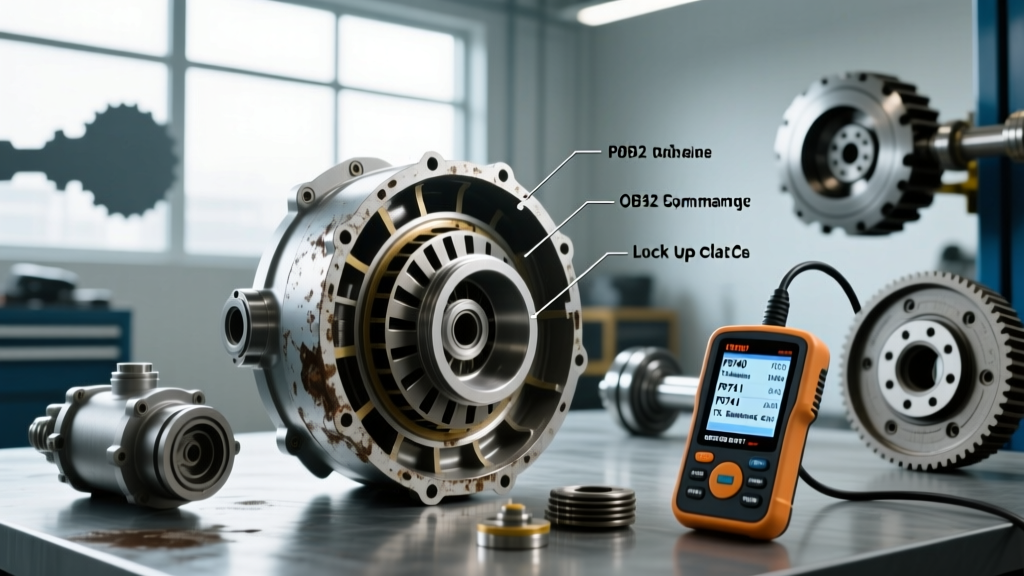
When connecting a bi-directional OBD-II scan tool to a modern automatic transmission, few data PIDs (Parameter Identifiers) cause as much diagnostic anxiety as torque converter slip actual vs desired. If your scanner shows the Torque Converter Clutch (TCC) commanded to lock (Desired = 0 RPM slip), but the turbine shaft speed sensor reports a 50 to 200 RPM variance (Actual = high slip), the Transmission Control Module (TCM) is detecting a severe efficiency loss. This discrepancy usually triggers codes like P0741 (TCC Stuck Off), P0744 (TCC Circuit Intermittent), or manufacturer-specific codes like GM's P2763.
Understanding this data stream is critical before authorizing a teardown. The 'Desired' slip value is calculated by the TCM based on throttle position, transmission fluid temperature (TFT), and current gear ratio. The 'Actual' slip is the real-time mathematical difference between Engine RPM (via the crankshaft position sensor) and Transmission Input Shaft Speed (TISS). When the actual slip exceeds the desired threshold by more than 20-30 RPM consistently under steady-state cruising, the friction material inside the torque converter is either delaminating, or the hydraulic apply circuit is failing to seal.
Below is our comprehensive, model-specific 2026 replacement cost and repair guide for the most common transmissions plagued by TCC slip issues, including the GM 6L80, Ford 6R80, and ZF 8HP platforms.
Model-Specific Failure Profiles & 2026 Replacement Costs
GM 6L80 / 6L90 (Silverado, Sierra, Tahoe, Camaro)
The 6-speed 6L80 and 6L90 transmissions are notorious for TCC friction material failure, particularly in trucks used for towing. The OEM friction lining often breaks apart, contaminating the TEHCM (Transmission Electro-Hydraulic Control Module) and clogging the TCC PWM solenoid screen. According to Transmission Digest teardown reports, replacing the torque converter without flushing the cooler lines and replacing the TEHCM solenoids will result in immediate repeat failure.
- OEM Part Number: ACDelco 24279278 (6L80) / 24280850 (6L90)
- Parts Cost (2026): $450 - $680 (OEM); $280 - $350 (Aftermarket Billet/Rebuilt)
- Fluid Capacity & Type: 11.5 Quarts Dexron ULV (Ultra Low Viscosity)
- Book Labor Time: 5.8 - 7.2 Hours (R&R Transmission & Flexplate)
- Total Estimated Cost: $1,350 - $2,100 (Independent Shop)
Ford 6R80 (F-150, Mustang, Expedition)
The ZF-sourced 6R80 features a highly complex hydraulic valve body. Before condemning the torque converter for 'actual vs desired' slip errors on a 6R80, technicians must inspect the TCC regulator valve in the valve body. Bore wear in the cast aluminum valve body allows apply fluid to bypass, preventing the TCC from fully engaging. If the scanner shows erratic, bouncing slip data rather than a steady high-slip number, the valve body is the culprit, not the converter.
- OEM Part Number: Motorcraft 9L7Z-7902-A
- Parts Cost (2026): $520 - $750 (OEM); $300 - $400 (Aftermarket)
- Fluid Capacity & Type: 13.1 Quarts Mercon LV
- Book Labor Time: 6.0 Hours
- Total Estimated Cost: $1,400 - $2,250 (Includes Valve Body Inspection)
ZF 8HP (Ram 1500, Chrysler, BMW, Audi)
The 8-speed ZF 8HP utilizes an aggressive TCC lockup strategy, often engaging the clutch as early as 2nd gear to improve fuel economy. This constant micro-slipping generates immense heat, leading to premature damper spring fatigue and friction wear. When the internal damper fails, it creates a low-frequency shudder that the TCM interprets as slip variance. Replacing the TC on an 8HP requires specialized ZF Lifeguard 8 fluid and a mandatory TCM adaptation reset via OEM software (like wiTECH or ISTA).
- OEM Part Number: ZF 0501 216 245 (Varies by specific vehicle application)
- Parts Cost (2026): $850 - $1,400 (OEM ZF)
- Fluid Capacity & Type: 8.5 - 9.5 Quarts ZF Lifeguard 8 ($35-$45 per quart)
- Book Labor Time: 6.5 - 8.0 Hours
- Total Estimated Cost: $1,900 - $3,200 (Dealership/Specialist)
2026 Torque Converter Replacement Cost Matrix
| Transmission Model | OEM TC Part # | Avg. OEM TC Cost | Avg. Labor Hours | Total Est. Cost (2026) |
|---|---|---|---|---|
| GM 6L80 | 24279278 | $565 | 6.5 | $1,540 - $1,850 |
| Ford 6R80 | 9L7Z-7902-A | $635 | 6.0 | $1,535 - $1,900 |
| ZF 8HP70 | 0501 216 245 | $1,125 | 7.2 | $2,200 - $3,200 |
*Note: Costs reflect 2026 national averages for independent transmission specialists. Dealership labor rates and OEM fluid markups will push these estimates 20-30% higher.
Diagnostic Protocol: Ruling Out False Slip Readings
Before pulling the transmission based solely on a torque converter slip actual vs desired PID, follow this strict diagnostic hierarchy to avoid misdiagnosis. As highlighted by Sonnax technical resources, hydraulic leaks and sensor faults frequently mimic internal mechanical failure.
- Verify the TISS Sensor: A failing Transmission Input Shaft Speed sensor will send erratic RPM data to the TCM, creating a false 'actual slip' reading. Compare the TISS data against the Engine RPM at idle in gear. They should correlate smoothly without dropouts.
- Check TCC Apply Pressure: Install a transmission pressure gauge on the TCC apply port. Command the TCC on via your scan tool. If line pressure does not spike to match the TCC apply pressure (usually 80-120 PSI depending on the model), you have a hydraulic leak in the stator shaft, pump rings, or valve body.
- Inspect Fluid for Debris: Drop the pan. If you find thick, dark, fibrous material or heavy brass glitter, the torque converter friction material has physically failed, and a full transmission flush and cooler line replacement are mandatory.
- TCM Software Calibration: On modern vehicles (2018+), a simple TCM reflash can alter the TCC apply ramp rate, curing minor shudder and slip codes without hardware replacement. Always check for TSBs (Technical Service Bulletins) before authorizing mechanical repairs.
Critical Installation Specs & Torque Sequences
When installing the new torque converter, adhering to exact clearances and torque specifications is non-negotiable to prevent catastrophic pump failure or flexplate cracking.
The Pull-Back Measurement
Before bolting the transmission to the engine block, you must verify the torque converter is fully seated into the transmission oil pump. Measure the distance from the engine block mating surface to the torque converter flexplate mounting pad. Compare this to the distance from the transmission bellhousing mating surface to the flexplate pad on the converter. You must have a minimum clearance of 1/8-inch to 3/16-inch (3mm - 5mm). If the converter is flush or protruding, it is not fully engaged with the pump gear. Forcing it with the bellhousing bolts will instantly shatter the oil pump upon engine startup.
Fastener Torque Specifications
- Torque Converter to Flexplate Bolts: These are typically M10x1.25 or M12x1.25 Grade 10.9 fasteners. Torque to 33 - 48 lb-ft (45 - 65 Nm) depending on the manufacturer. Always apply a medium-strength threadlocker (e.g., Loctite 242) to these bolts, as they are subject to immense rotational shear.
- Flexplate to Crankshaft Flange: If removed, torque to 74 - 85 lb-ft (100 - 115 Nm) in a star pattern. Use new OEM stretch bolts if mandated by the manufacturer.
- Transmission Bellhousing to Engine Block: Torque M12 bolts to 37 - 50 lb-ft (50 - 68 Nm). Ensure all alignment dowels are present and undamaged; missing dowels will cause converter runout, leading to premature TCC failure and transmission case vibration.
Summary: Data-Driven Repairs Save Money
Interpreting the torque converter slip actual vs desired data stream is the first line of defense against unnecessary transmission removals. By combining live data analysis with hydraulic pressure testing and model-specific failure knowledge, technicians and informed DIYers can accurately pinpoint whether the fault lies in a $50 solenoid, a $300 valve body bore, or a $1,200 torque converter. Always prioritize OEM fluids, strict torque sequences, and post-installation TCM adaptations to ensure the longevity of your drivetrain repair.
For further reading on OBD-II diagnostic trouble codes related to transmission slip, refer to the OBD-Codes P0741 Database for community-driven diagnostic case studies and scanner screenshots.