The Evolution of Tacoma Rear Differential Fluid Specifications
When maintaining the drivetrain of a mid-size truck, understanding the nuances of gear oil is paramount to longevity and performance. For 2026 owners, the conversation surrounding tacoma rear differential fluid has become increasingly complex due to shifting manufacturer specifications, varying axle housings, and the distinct mechanical requirements of TRD locking differentials. Whether you are driving a 3rd-generation workhorse or the latest 4th-generation model equipped with the robust 8.75-inch ring gear, the fluid you choose directly impacts parasitic loss, thermal management, and gear wear.
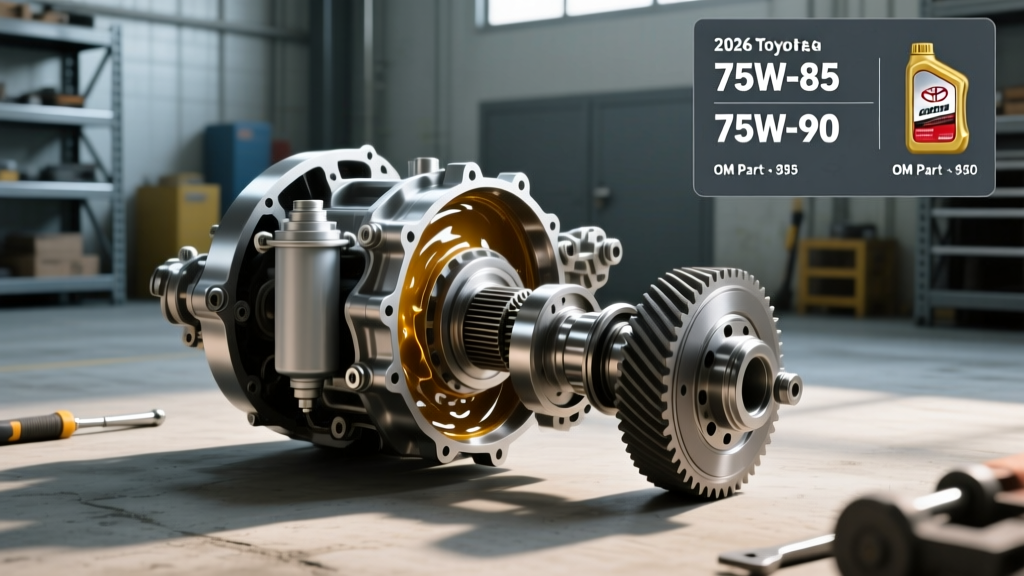
Historically, Toyota recommended 75W-90 API GL-5 gear oil for its solid rear axles. However, in an effort to meet stringent CAFE (Corporate Average Fuel Economy) standards, Toyota transitioned to a lower-viscosity 75W-85 GL-5 synthetic fluid for many of its late-model trucks. This 75W-85 specification reduces churning losses and mechanical drag within the differential housing, yielding marginal but measurable improvements in highway fuel economy. But does this factory specification hold up under the extreme thermal loads of towing, off-roading, or heavy payload hauling? This guide breaks down the exact specifications, real-world costs, and mechanical edge cases you need to know before draining your axle.
75W-85 vs. 75W-90: Viscosity, Shear Stability, and API Standards
The API GL-5 standard dictates that gear oils must contain extreme pressure (EP) additives, typically sulfur-phosphorus compounds, to protect hypoid gear sets like the ring and pinion found in the Tacoma's rear axle. The primary debate for Tacoma owners centers on the viscosity grade: stick with the factory 75W-85, or step up to the traditional 75W-90?
- 75W-85 (OEM Spec): Optimized for cold-weather flow and fuel efficiency. It reaches critical bearing surfaces faster during sub-freezing startups but operates with a slightly thinner protective film at extreme sustained temperatures (e.g., towing a 5,000 lb trailer up a 6% grade in the Mojave desert).
- 75W-90 (Enthusiast/Towing Spec): Offers a higher high-temperature high-shear (HTHS) viscosity. While it may cost you 0.1 to 0.2 MPG in everyday driving, the thicker fluid film provides superior shock-load protection for the pinion bearing and ring gear teeth during aggressive off-road articulation and heavy towing.
For daily drivers and light commuters, the OEM 75W-85 is perfectly adequate. For those utilizing their Tacoma for overlanding, rock crawling, or max-capacity towing, stepping up to a high-quality synthetic 75W-90 remains the gold standard for drivetrain preservation.
The TRD Locker E-E-A-T Factor: Friction Modifiers Explained
One of the most common and costly mistakes made by amateur mechanics is dumping 'Limited Slip' (LS) gear oil into a Tacoma equipped with the TRD Off-Road electronic locking differential. It is critical to understand the mechanical distinction between clutch-pack limited-slip differentials (LSDs) and dog-clutch lockers.
Clutch-pack LSDs require specialized friction modifiers to prevent the clutches from chattering and binding during cornering. The TRD electronic locker, however, utilizes a mechanical dog-clutch mechanism that physically locks the left and right axle shafts together via a shift fork and actuator motor. It does not contain friction clutches. Therefore, it does not require LS friction modifiers. While using an LS fluid won't instantly destroy the locker, the unnecessary friction modifiers can cause foaming under heavy articulation and high temperatures. This foaming can lead to fluid starvation at the pinion bearing and potentially interfere with the actuator motor's engagement speed. Purists and off-road experts universally recommend a standard GL-5 fluid without LS additives for the TRD locker housing.
2026 Cost Analysis: DIY vs. Dealership Service
Dealership labor rates have continued to climb, with major metropolitan Toyota service centers averaging $160 to $195 per hour in 2026, while rural and independent shops hover around $110 to $140. Because a differential fluid service is generally billed at 0.5 hours of labor, the markup is significant. Below is a detailed cost breakdown comparing your service options.
| Service Route | Fluid Cost | Parts/Hardware | Labor | Total Est. (2026) |
|---|---|---|---|---|
| DIY (OEM 75W-85) | $45.00 | $6.00 (Washers) | $0.00 | $51.00 |
| DIY (Aftermarket 75W-90) | $36.00 | $6.00 (Washers) | $0.00 | $42.00 |
| Independent Shop | $55.00 | $10.00 | $65.00 | $130.00 |
| Toyota Dealership | $75.00 | $15.00 | $95.00 | $185.00 |
As the data illustrates, performing the service in your own driveway yields a 70% to 75% cost savings compared to a dealership visit, while allowing you to control the exact quality and specification of the gear oil going into your axle.
OEM vs. Aftermarket: Part Numbers and Pricing
Sourcing the correct fluid and hardware is the next step in the cost analysis. Dealership parts counters often apply a 30% to 40% markup over online OEM wholesalers. Here are the exact part numbers you need to cross-reference:
- Toyota Genuine 75W-85 GL-5 (1 Quart): Part # 08885-02506. Expect to pay $12-$15 per quart at the dealer, or $9-$11 via online wholesale catalogs.
- Aftermarket 75W-90 Synthetic: Mobil 1 Synthetic Gear Lube LS 75W-90 (Part # 104361) or AMSOIL Severe Gear 75W-90. These typically retail for $10-$13 per quart at major auto parts stores.
- Crush Washers (Qty 4): Part # 90430-18008 (18mm ID). You need two for the rear differential (drain and fill). Never reuse aluminum crush washers; they work-harden and will leak. Cost is roughly $1.50 to $3.00 each at the dealer, or $5 for a 10-pack online.
Crucial Service Specifications: Capacity, Tools, and Torque
Executing the service requires precision to avoid damaging the axle housing or causing premature bearing failure due to under-filling. According to Toyota Owner's Resources and factory service manuals, the specifications for the 8.0-inch and 8.75-inch rear axles are as follows:
- Fluid Capacity: Approximately 3.0 Liters (3.17 Quarts). Always purchase 4 quarts to account for spillage and pump priming.
- Tooling: The rear differential drain and fill plugs typically require a 24mm socket. However, if a previous owner or shop replaced the OEM bolts with aftermarket 'easy-drain' plugs, you may need a 10mm hex (Allen) bit or a 3/8-inch square drive.
- Torque Specification: Both the drain and fill plugs must be torqued to exactly 29 ft-lbs (39 Nm). Over-torquing can crack the cast aluminum or stamped steel differential housing, leading to a catastrophic and expensive axle replacement.
- The Golden Rule of Drivetrains: ALWAYS remove the FILL plug before removing the DRAIN plug. If the fill plug is seized, rusted, or stripped, you do not want to be left with an empty differential and no way to refill it.
Hidden Costs and Edge Cases in Axle Maintenance
While the baseline cost of a fluid swap is low, aging Tacomas (especially 2016-2023 models exposed to road salt) present several hidden cost variables. The most common edge case is the seized fill plug. Factory steel plugs galvanically corrode when mated to the aluminum differential housing or steel axle tubes. If the plug rounds off, you may face the cost of a replacement plug ($15-$25) or, in severe cases, the labor to drill and extract the bolt, which can push a $40 DIY job into a $300 shop repair.
Additionally, for TRD Off-Road models, the electronic locker actuator is mounted directly to the rear housing. If you overfill the differential, or if the internal breather tube is clogged with mud and water, fluid can be forced up into the actuator motor housing. Replacing a failed OEM locker actuator motor costs upwards of $600 in parts alone. To mitigate this, ensure the axle breather hose is routed high into the frame rail and is free of debris before performing any fluid service. By understanding these specifications, torque limits, and mechanical nuances, you can confidently maintain your Tacoma's rear axle while avoiding the inflated costs and technical pitfalls of dealership servicing.