How Many Differentials Does a Car Have? The AWD Breakdown
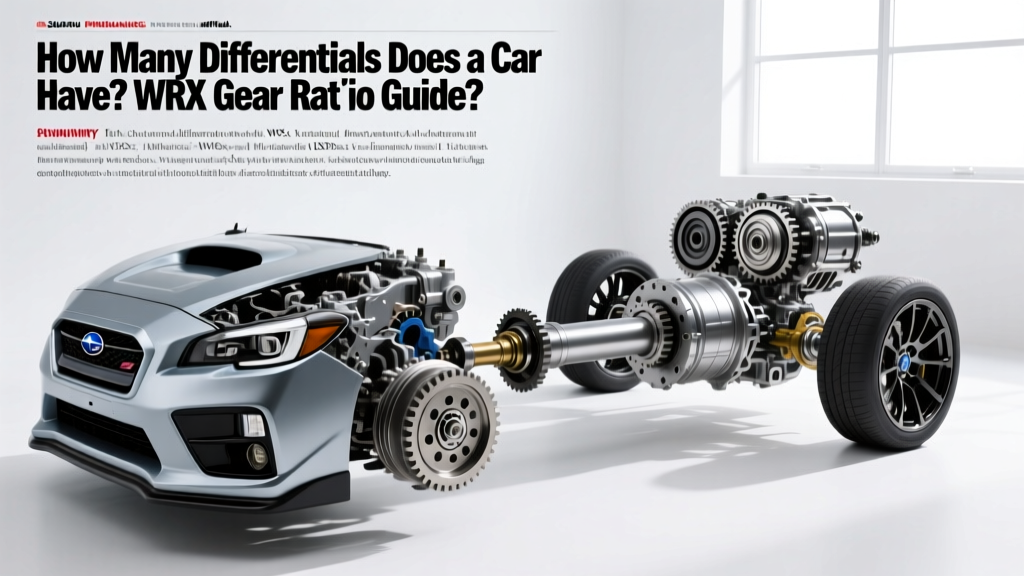
When enthusiasts ask, 'how many differentials does a car have,' the answer depends entirely on the drivetrain architecture. A standard front-wheel-drive (FWD) or rear-wheel-drive (RWD) vehicle utilizes exactly one differential to split torque between the left and right wheels. A part-time four-wheel-drive truck, like a Jeep Wrangler, uses two differentials (one on the front solid axle, one on the rear). However, a full-time Symmetrical All-Wheel-Drive (AWD) performance platform, such as the Subaru WRX (spanning the 2015-2021 VA and 2022-2026 VB generations), relies on a complex network of three distinct differentials: a front differential, a center differential, and a rear differential.
Understanding this three-differential layout is critical for model-specific repair, maintenance, and performance tuning. Each differential houses a ring and pinion gear set (front and rear) or a complex clutch/viscous coupling pack (center) that dictates how power reaches the pavement. In this 2026 model-specific repair guide, we will use the Subaru WRX platform to explore how differential gear ratios impact vehicle performance, how to execute a ratio swap, and the exact fluid specifications required to keep these components alive under high-stress track and rally conditions.
Understanding Final Drive Ratios in the WRX Platform
The front and rear differentials in the WRX contain a ring and pinion gear set that establishes the Final Drive Ratio (FDR). This ratio acts as a torque multiplier between the transmission output shaft and the axles. For both the VA chassis (6-speed manual) and the current VB chassis, the factory FDR is set at 4.111. This means the driveshaft must rotate 4.111 times to turn the wheels one full rotation.
Modifying this ratio is one of the most transformative performance upgrades you can perform. According to RaceComp Engineering's AWD dynamics research, altering the FDR changes the effective gearing of every single forward gear without requiring you to open the transmission case. This is particularly relevant in 2026 as owners look to optimize the VB WRX's FA24DIT engine powerband for specific track layouts or to compensate for the rotational mass of larger aftermarket wheels and tires.
Gear Ratio Performance Comparison Chart
| Final Drive Ratio | Application Profile | Wheel Torque Multiplier | Highway RPM (6th Gear @ 75 MPH) |
|---|---|---|---|
| 3.900 (Taller) | High-speed oval tracks, highway fuel economy | Decreased (-5.1%) | ~2,450 RPM |
| 4.111 (OEM Stock) | Street driving, rallycross, balanced acceleration | Baseline | ~2,580 RPM |
| 4.444 (Shorter) | Tight autocross, steep hill climbs, drag racing | Increased (+8.1%) | ~2,790 RPM |
Model-Specific Repair Guide: Rear Differential R&P Swap
Swapping the ring and pinion in the WRX rear differential (an R180-style open or Torsen limited-slip unit depending on the trim) requires precision machining tools, a hydraulic press, and strict adherence to torque specifications. Unlike a simple fluid change, a gear swap demands measuring gear backlash and tooth contact patterns to prevent catastrophic failure.
Step 1: Removal and Teardown
- Drain the Fluid: Remove the 14mm rear differential drain plug and fill plug. Expect to drain approximately 0.8 liters of gear oil.
- Disconnect Driveline: Unbolt the rear driveshaft flange using a 12mm 12-point socket. Mark the flange orientation with a paint pen to maintain factory balance.
- Drop the Differential: Support the rear subframe. Remove the 17mm differential mounting bolts (torque spec for reinstallation is 85 Nm / 63 lb-ft). Lower the unit carefully.
- Extract the Carrier: Unbolt the rear differential cover (12mm bolts). Use a brass drift and dead-blow hammer to tap the carrier assembly out of the housing, ensuring you do not damage the bearing races.
Step 2: Setting Pinion Depth and Backlash
When installing a new 4.444 ring and pinion set, you cannot reuse the factory pinion depth shim. You must measure the new pinion head etching and calculate the exact shim thickness required. Once the pinion is pressed into the housing with a new crush sleeve (or solid spacer for track use), you must set the gear backlash.
Using a magnetic dial indicator mounted to the housing, measure the ring gear backlash. The factory service manual specifies a backlash target of 0.13 mm to 0.18 mm (0.0051 - 0.0071 in.). Adjust the side bearing adjuster nuts to achieve this measurement. Once backlash is set, apply yellow gear marking compound to three teeth on the ring gear and rotate the assembly to verify the contact pattern. The pattern should be centered on the tooth face; if it is biased toward the toe or heel, you must adjust the pinion depth shim and repeat the process.
Step 3: Reassembly and Torque Specs
- Ring Gear to Carrier Bolts: Clean threads with brake cleaner. Apply Loctite 243 (blue). Torque to 110 Nm (81 lb-ft) in a star pattern.
- Pinion Flange Nut: If using a crush sleeve, torque incrementally while measuring rotational drag until you achieve 15-20 in-lb of total preload. If using an aftermarket solid spacer, torque to 145 Nm (107 lb-ft) and stake the nut.
- Differential Cover: Apply a 3mm bead of ThreeBond 1217E or equivalent liquid gasket. Torque cover bolts to 25 Nm (18 lb-ft).
2026 Fluid Specifications and Maintenance Intervals
Because the WRX utilizes three separate differential chambers, fluid maintenance is often neglected by casual owners, leading to premature wear on the hypoid gear teeth. The shearing forces inside a high-torque AWD system rapidly degrade standard lubricants. According to Subaru's official 2026 maintenance guidelines, severe driving conditions (track days, rally, or frequent towing) require halving the standard fluid change intervals.
Exact Capacities and Viscosity Requirements
- Front Differential: Capacity is 1.0 Liters. Located inside the front transaxle housing on older models, but standalone on specific AWD layouts. Requires 75W-80 or 75W-90 GL-5 gear oil.
- Center Differential / Transmission: The 6-speed manual transmission and center differential share a common sump. Total capacity is 3.5 to 3.7 Liters. Requires 75W-80 GL-5. Do not use friction-modifier additives here, as they will cause synchro engagement issues in the manual gearbox.
- Rear Differential: Capacity is 0.8 Liters. Requires 75W-90 GL-5. If equipped with a clutch-type aftermarket LSD (like a Cusco RS), you must add a specialized limited-slip friction modifier to prevent chatter during low-speed cornering.
For 2026 track builds, we highly recommend stepping away from standard OEM fluids and utilizing ester-based synthetic lubricants. Motul Gear 300 75W-90 provides exceptional shear stability and maintains its protective film strength even when differential temperatures exceed 250°F (121°C) during sustained high-speed cornering.
Diagnosing Gear Whine After a Ratio Swap
A common issue following a DIY or poorly executed gear ratio swap is differential whine. Diagnosing the noise requires paying attention to when the sound occurs:
- Whine on Acceleration (Drive Side): Usually indicates that the gear backlash is too tight, or the pinion depth is set too shallow, causing the contact pattern to ride high on the face of the ring gear tooth.
- Whine on Deceleration (Coast Side): Typically points to excessive backlash or a pinion depth that is too deep, pushing the pattern toward the root of the tooth.
- Consistent Howling at All Speeds: Often a sign of bearing preload issues or a warped ring gear caused by improper torquing of the ring gear bolts during assembly.
If whine is present, the differential cover must be removed, and the dial indicator test must be repeated. Ignoring gear whine will eventually lead to spalling on the hypoid gear teeth, sending metallic shards through the fluid and destroying the carrier bearings.
Cost Breakdown for WRX Differential Upgrades
Budgeting for a performance gear swap requires accounting for both parts and specialized labor. As of 2026, aftermarket ring and pinion sets from reputable manufacturers like OS Giken or Cusco typically range from $850 to $1,200 per axle. If you are upgrading from an open differential to a helical or clutch-type LSD simultaneously, expect to add $600 to $1,100 for the carrier unit.
Labor for a professional ring and pinion setup, including machining, press-work, and pattern verification, generally costs between $600 and $900 per differential. Because the front and rear ratios must perfectly match in a Symmetrical AWD system to prevent binding the center differential, you must budget for a complete front-and-rear swap, bringing the total realistic investment to approximately $3,500 to $4,500 for a fully optimized, track-ready drivetrain.