In the 2026 landscape of electric mobility, drivetrain architectures have bifurcated into highly specialized configurations based on vehicle application. On one end of the spectrum, high-performance electric powersports machines like the Stark Varg utilize ultra-lightweight, single-motor direct-drive layouts. On the other end, automotive and heavy-duty off-road platforms rely on complex dual-motor and tri-motor All-Wheel Drive (AWD) systems to manage traction and payload. Understanding the engineering trade-offs between the stark varg drivetrain and modern electric all-wheel drive system operation provides critical insight into how torque, thermal management, and software define modern propulsion.
The Stark Varg Drivetrain Architecture: Single-Motor Efficiency
The Stark Varg (available in MX and Enduro trims) is a masterclass in minimizing unsprung mass and rotational inertia. Unlike automotive platforms that require power delivery to multiple axles, the Varg relies on a single, high-output Permanent Magnet Synchronous Motor (PMSM) mounted centrally in the chassis.
Core Specifications and Power Flow
- Motor Output: Up to 80 hp (60 kW) and 65 Nm of raw motor torque.
- Gear Reduction: A single-speed helical gear reduction unit (typically a 3:1 to 4:1 primary ratio) multiplies torque before it reaches the countershaft.
- Final Drive: A high-tensile 420 or 520 O-ring chain transfers power to the rear sprocket, yielding a final drive ratio that pushes rear-wheel torque past 900 Nm.
- Inverter Logic: A custom silicon-carbide (SiC) MOSFET inverter switches DC current from the 6kWh honeycomb battery pack into 3-phase AC at frequencies exceeding 10 kHz.
The Stark Future engineering team opted against an all-wheel drive system operation for the Varg because motocross and enduro disciplines demand extreme power-to-weight ratios. Adding a front eAxle, additional wiring harnesses, and a secondary inverter would add upwards of 35 kg (77 lbs) of weight and drastically alter the bike's center of gravity and gyroscopic dynamics.
Electric All-Wheel Drive (eAWD) System Operation
While the Stark Varg dominates in single-track agility, automotive and UTV platforms require the traction benefits of AWD. Traditional internal combustion AWD systems rely on mechanical transfer cases, viscous limited-slip differentials, and complex driveshaft routing. Modern electric all-wheel drive system operation eliminates these mechanical linkages entirely, relying instead on software-defined torque distribution.
Independent eAxles and Decoupling
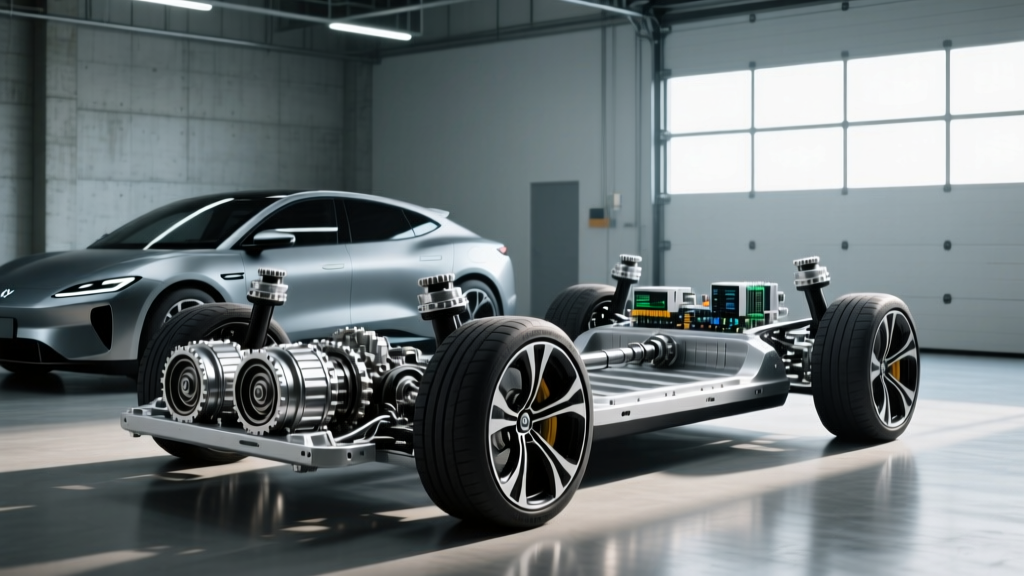
In a dual-motor eAWD setup (such as those found in the Tesla Model Y, Audi e-tron, or Rivian R1T), the front and rear axles are driven by completely independent electric motors. There is no mechanical connection—no driveshaft, no center differential, and no U-joints—between the front and rear wheels.
"The shift from mechanical to electric AWD replaces physical locking differentials with algorithmic torque vectoring, allowing for millisecond-level traction correction that mechanical systems simply cannot achieve." — Powertrain Engineering Journal, 2025
To prevent parasitic drag and back-EMF (electromotive force) losses when cruising, modern eAWD systems utilize active decoupling clutches. Manufacturers like BorgWarner integrate electro-mechanical disconnect clutches directly into the eAxle housing. When front-axle torque is not required, the clutch disengages the motor rotor from the final drive gears, allowing the wheels to spin freely without turning the motor's internal magnets, thereby increasing highway range by up to 4%.
Sensor Fusion and PID Control Loops
The operation of an eAWD system is governed by a central Vehicle Dynamics Controller (VDC). The VDC monitors data from a network of sensors at a rate of up to 1,000 samples per second:
- Wheel Speed Sensors (WSS): Detect micro-slip at individual corners.
- Yaw Rate & Lateral Acceleration Sensors: Measure the vehicle's rotation around its vertical axis to predict oversteer or understeer.
- Steering Angle & Throttle Position: Anticipate driver intent.
When the VDC detects front-wheel slip during hard acceleration, it does not wait for a mechanical clutch pack to engage. Instead, it instantly alters the Pulse Width Modulation (PWM) signals sent to the front and rear inverters. It reduces current to the slipping front motor while simultaneously ramping up current to the rear motor, effectively shifting the torque bias from 50:50 to 20:80 in under 10 milliseconds.
Comparative Data: Direct-Drive vs. eAWD Architectures
To understand the engineering divergence, we must look at the hard data comparing a lightweight single-motor layout against a dual-motor eAWD configuration.
| Specification | Stark Varg (Single-Motor Direct) | Dual-Motor eAWD (Automotive/UTV) |
|---|---|---|
| Motor Count | 1x Central PMSM | 2x or 3x Distributed eAxles |
| Power Electronics | 1x SiC Inverter (Integrated) | 2x IGBT/SiC Inverters (Axle-mounted) |
| Torque Vectoring | N/A (Rider-controlled via rear brake/throttle) | Active (Software-defined via independent inverters) |
| Drivetrain Weight | ~22 kg (Motor + Gearbox + Chain) | ~140 kg (Dual Motors + Inverters + Coolant) |
| Primary Cooling | Air / Passive Chassis Conduction | Active Liquid Glycol Loop (Stator Jackets) |
| Mechanical Linkage | Countershaft to Rear Wheel (Chain) | None (Fly-by-wire power distribution) |
Thermal Management and Drivetrain Losses
One of the most critical aspects of all-wheel drive system operation is managing the immense heat generated by dual stators and high-frequency inverter switching. While the Stark Varg utilizes a patented honeycomb battery casing that doubles as a structural heat sink for its single inverter, eAWD vehicles require active liquid cooling.
Cooling Circuit Architecture
In systems engineered by companies like ZF, the eAxle housing contains intricate water jackets machined directly around the stator windings. A dedicated electric water pump circulates a dielectric or low-conductivity glycol mixture (typically operating at 45°C to 65°C) through the motor housing, the inverter cold plate, and an external heat exchanger.
If an eAWD system is subjected to sustained high-load conditions—such as towing a trailer up a 7% grade or performing repeated launch-control starts—the thermal management system will aggressively derate the front motor's output to protect the copper windings and Neodymium magnets from demagnetization, which occurs if stator temperatures exceed 150°C.
Maintenance, Fluids, and Torque Specifications
Despite having fewer moving parts than internal combustion drivetrains, both single-motor and eAWD systems require precise maintenance to ensure longevity.
Stark Varg Single-Motor Maintenance
The Varg's gearbox requires periodic fluid changes to prevent helical gear wear and bearing degradation.
- Fluid Type: 75W-85 Full Synthetic Gear Oil (or specialized EV dielectric gear fluid).
- Capacity: Approximately 0.45 to 0.6 Liters.
- Chain Maintenance: The 520 O-ring chain requires cleaning with non-aerosol solvents and lubrication every 500 km. Rear axle nut torque spec is critical: 85 Nm (63 lb-ft) with a cotter pin or threadlocker to prevent catastrophic detachment under 900 Nm of wheel torque.
eAWD eAxle Service Intervals
Dual-motor eAWD eAxles house the motor, reduction gears, and differential in a single bath of specialized e-Fluid (such as Castrol ON or Shell E-Fluids). These fluids are engineered to provide both gear lubrication and dielectric insulation for the motor windings if they are directly oil-cooled.
- Fluid Capacity: 1.5L to 2.8L per axle, depending on the unit.
- Service Interval: Often marketed as "lifetime," but severe-duty operation (off-road, towing) mandates a drain and fill every 60,000 miles.
- Mounting Torque: eAxle subframe mounting bolts (typically M14 or M16) require high torque values, often 140 Nm to 180 Nm, to handle the instant torque reaction forces without fatiguing the bushings.
Conclusion: Application Dictates Architecture
The stark contrast between the stark varg drivetrain and modern automotive eAWD systems highlights a fundamental rule of powertrain engineering: application dictates architecture. The Varg's single-motor, chain-driven layout is the undisputed king of lightweight, high-transient-response motocross performance, where unsprung mass is the enemy. Conversely, electric all-wheel drive system operation excels in environments requiring maximum traction, payload capacity, and algorithmic stability control. As power electronics continue to shrink and silicon carbide inverters become more efficient, we will likely see the lines blur, with tri-motor and quad-motor systems eventually trickling down into lighter, more agile off-road platforms.