Introduction: Decoding the Drivetrain
When gearheads, DIY mechanics, and prospective buyers ask, 'what is semi automatic car transmission' technology, the answer requires splitting hairs between two fundamentally different architectures. The umbrella term 'semi-automatic' is frequently misused to describe any gearbox that shifts without a traditional clutch pedal. However, in the engineering world, there is a massive chasm between a Single-Clutch Automated Manual Transmission (AMT) and a Dual-Clutch Transmission (DCT). As we navigate the 2026 automotive landscape—where AMTs have largely retreated to budget commercial vehicles and DCTs dominate high-performance platforms like the C8 Corvette's Tremec TR-9077—understanding the mechanical distinction is critical for proper maintenance, diagnostics, and repair.
This step-by-step guide will walk you through identifying your specific transmission type, executing the correct fluid maintenance procedures, diagnosing mechatronic faults, and evaluating real-world repair costs. Whether you are dealing with a Fiat Magneti Marelli Dualogic or a Volkswagen DQ250 DSG, the following protocols apply.
Step 1: Identify Your Transmission Architecture
Before ordering parts or draining fluid, you must confirm whether your vehicle utilizes a single-clutch AMT or a dual-clutch setup. The physical driving experience and internal hardware differ drastically.
Single-Clutch AMT (Automated Manual)
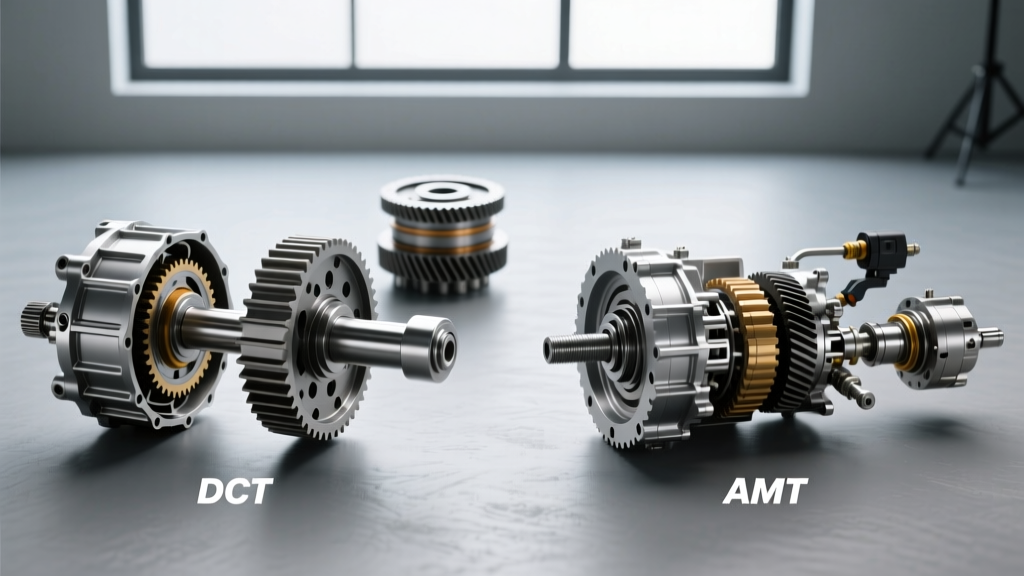
An AMT is literally a traditional manual gearbox (complete with a single dry friction clutch and synchronizers) mated to electrohydraulic or electromechanical actuators. Because the computer must physically disengage the clutch to change gears, torque delivery is interrupted. This results in the notorious 'head nod' effect during upshifts. Common examples include the early BMW SMG II (found in the E46 M3), Toyota MultiMode (MMT), and the Magneti Marelli Dualogic systems used across Fiat and Alfa Romeo models.
Dual-Clutch Transmission (DCT / DSG / PDK)
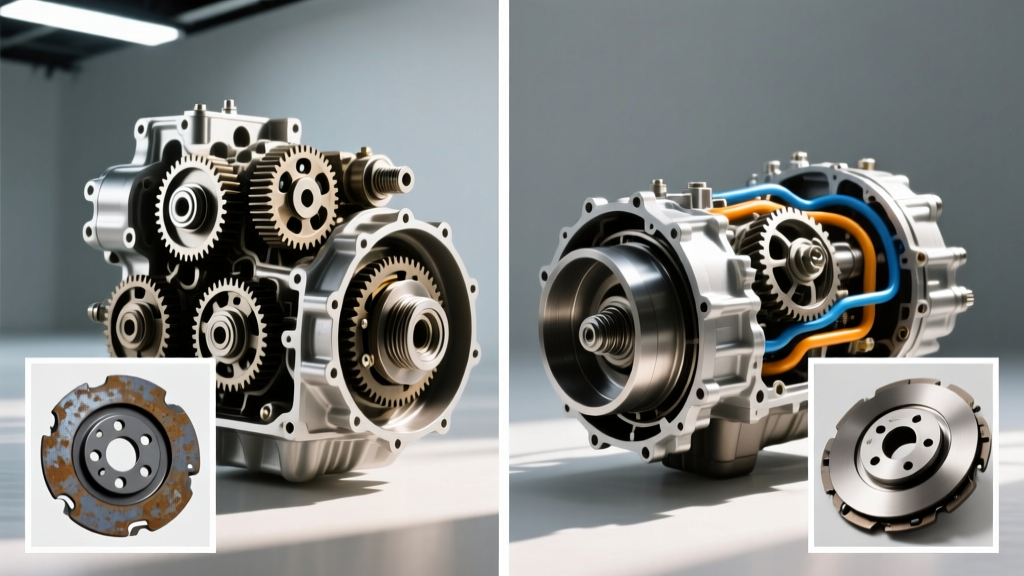
A DCT essentially houses two manual transmissions in one casing. One clutch handles odd gears (1, 3, 5, 7), while the other handles even gears (2, 4, 6, R). The genius of the DCT lies in pre-selection: while you are in 3rd gear, the 4th gear collar is already engaged on the secondary shaft, waiting for its clutch to lock. This allows for shift times as rapid as 8 milliseconds with zero torque interruption. Examples include the VAG DSG (DQ250, DQ500), Porsche PDK (ZF 7DT), and the Getrag 7DCT300.
Step 2: Cross-Reference Fluid and Capacity Specifications
The most catastrophic mistakes DIYers make involve treating an AMT and a DCT as interchangeable when selecting fluids. They are not. Below is a comparative breakdown of the internal requirements for the three most common semi-automatic architectures.
| Feature | Single-Clutch AMT (e.g., Dualogic) | Wet Dual-Clutch (e.g., VAG DQ250) | Dry Dual-Clutch (e.g., VAG DQ200) |
|---|---|---|---|
| Clutch Setup | Single dry friction plate | Dual wet multi-plate packs | Dual dry friction plates |
| Gearset Fluid Type | 75W-80 GL-4 Manual Gear Oil | Pentosin FFL-4 / G 052 182 A2 | 75W GL-4 Manual Gear Oil |
| Gearset Capacity | ~1.8 Liters | ~7.2 Liters (Total System) | ~1.9 Liters |
| Actuator/Mechatronic Fluid | Tutela CS Speed / CHF 11S | Shared with wet clutch packs | Pentosin FFL-4 (1.0L Mech only) |
| Shift Time (Typical) | 300 - 500 ms | 8 - 200 ms | 8 - 200 ms |
| Max Torque Rating | Up to 350 Nm | Up to 600 Nm | Up to 250 Nm |
Note: Never introduce standard ATF (like Dexron VI) into a wet DCT. The friction modifiers will cause the wet clutch packs to slip and glaze, leading to immediate failure. For authoritative fluid specifications, always consult OEM TSBs or trusted repositories like the Ross-Tech Wiki for VAG-specific fluid part numbers.
Step 3: Execute the Correct Maintenance Procedure
Maintaining a semi-automatic transmission requires strict adherence to torque specs and temperature-dependent fill procedures. Here is how to service the two most common variants.
Procedure A: Wet DCT Service (e.g., VW/Audi DQ250 6-Speed)
- Preparation: Raise the vehicle on a level lift. The DSG fluid must be checked at a specific temperature range (35°C to 45°C). Connect a bi-directional scan tool to monitor the transmission fluid temperature sensor (TFT).
- Drain: Remove the 14mm hex drain plug. Allow the old fluid to drain completely. Torque the drain plug back to 45 Nm upon reinstallation.
- Filter Replacement: Locate the filter housing on top of the transmission. Remove the housing bolts and replace the paper filter element and O-rings. Torque the filter housing cap to 20 Nm. Detailed visual guides for this process are well-documented by specialists like FCP Euro's DSG service guides.
- Fill and Level: Pump exactly 7.2 liters of fresh G 052 182 A2 fluid through the drain hole using a specialized fill adapter. Once the fluid temperature hits 35°C, remove the fill adapter and allow the excess to drip until it slows to a steady stream. Reinstall the final level plug.
Procedure B: Single-Clutch AMT Service (e.g., Fiat Dualogic)
- Gearbox Drain: Drain the manual gear oil from the bottom plug and refill with exactly 1.8L of Tutela ZC 75W-80.
- Hydraulic Actuator Bleed: The hydraulic robot mounted to the side of the gearbox requires Tutela CS Speed. If the hydraulic pump has been replaced or the system opened, you must use a bi-directional scanner to run the 'Hydraulic System Bleed' routine. This cycles the throw-out bearing and opens the electronic bleed valves to purge air from the 50-bar high-pressure lines.
Step 4: Diagnose Mechatronic and Actuator Faults
When a semi-automatic transmission fails, it is rarely the physical gears that break; it is the electrohydraulic brain (the mechatronic unit or actuator robot). Here is how to diagnose the most common edge cases.
AMT Hydraulic Pump Failures
If your AMT-equipped vehicle refuses to go into gear and throws a P0942 (Hydraulic Pressure Unit) code, listen to the hydraulic pump located in the engine bay or near the actuator. If the pump runs continuously without shutting off, the hydraulic accumulator has lost its internal nitrogen charge, or there is a severe leak in the high-pressure circuit. On the E46 M3 SMG II, this is frequently caused by a failing accumulator (Part # 23007503693) or the infamous 'salmon relay' (Part # 12 63 1 742 690) which fails to deliver consistent 12V power to the pump.
DCT Mechatronic Wear
Wet DCTs rely on the mechatronic unit to route pressurized fluid to the clutch packs and shift forks. A common fault code on the VAG DQ250 is P17BF (Hydraulic Pump Play Protection). This indicates that the internal electric pump gears inside the mechatronic have worn down, and the unit can no longer achieve the target 45-55 bar of pressure required to clamp the clutches. Another frequent code is P2711 (Unexpected Mechanical Gear Disengagement), which points to worn shift fork position sensors or bent shift rail detents inside the mechatronic valve body.
Step 5: Calculate Repair vs. Replacement Viability
As of 2026, the aftermarket support for DCTs is robust, while AMT parts are becoming increasingly scarce. Use this pricing framework to make informed repair decisions.
- AMT Actuator Robot Replacement: A brand-new Magneti Marelli actuator assembly will cost between $900 and $1,500. However, programming it to the vehicle's ECU requires dealer-level software (like Fiat's WiTECH), adding $150-$300 in labor.
- DCT Mechatronic Unit: A factory-remanufactured mechatronic unit for a DQ250 ranges from $1,800 to $2,800. This includes the TCU, valve body, and internal hydraulic pump. Installation requires dropping the transmission pan, unbolting the mechatronic from the bell housing (torque spec for the mechatronic retaining bolts is strictly 10 Nm), and performing a clutch adaptation via OBD2.
- Clutch Pack Overhaul: Replacing the clutch packs in a wet DCT requires pulling the entire transmission and using a specialized OEM alignment tool (such as VAG 10200) to set the clutch pack clearance shims. Expect to pay $2,500 to $3,500 for parts and labor. In contrast, an AMT single-clutch replacement is mechanically identical to a standard manual car clutch job, typically costing $800 to $1,200.
Conclusion: The Future of Semi-Automatics
Understanding 'what is semi automatic car transmission' hardware means recognizing the trade-offs between cost, complexity, and performance. While the single-clutch AMT has largely been abandoned in the passenger car market due to its inherently jerky shift quality, the dual-clutch transmission continues to evolve. Modern 8-speed and 10-speed wet DCTs have largely solved the low-speed shudder issues that plagued early dry-clutch designs like the Ford DPS6 PowerShift. By adhering to strict fluid intervals, utilizing the correct OEM-approved lubricants, and monitoring hydraulic pressure data via advanced OBD2 diagnostics, you can ensure these complex marvels of engineering survive well past their 100,000-mile warranties.