The Core Question: Does a FWD Car Have a Differential?
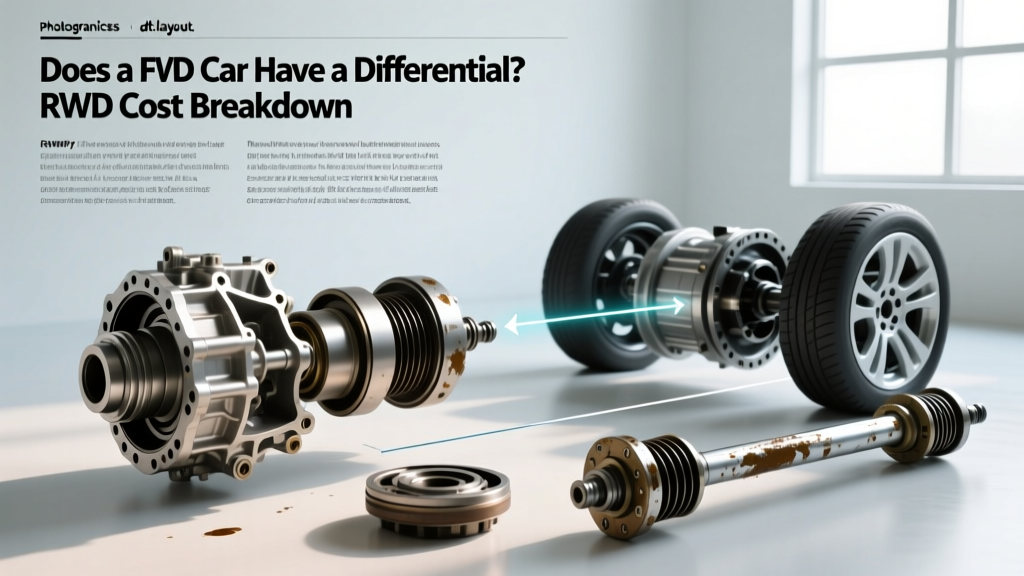
When automotive students and DIY enthusiasts first ask, "does a fwd car have a differential," the answer is an unequivocal yes. However, unlike rear-wheel drive (RWD) vehicles where the differential is a distinct, standalone housing bolted to the rear axle, front-wheel drive (FWD) vehicles integrate the differential directly into the transmission casing, creating a single unit known as a transaxle. While FWD layouts save space and manufacturing costs, they concentrate immense thermal and mechanical stress into one aluminum housing.
To truly understand the financial and mechanical implications of drivetrain layouts, we must contrast the FWD transaxle with traditional rear-wheel drive system operation. In 2026, as repair labor rates push past $165 per hour at specialized drivetrain shops, understanding the modular cost breakdown of an RWD system versus a consolidated FWD transaxle is critical for both fleet managers and performance enthusiasts.
Anatomy of Rear-Wheel Drive System Operation
Rear-wheel drive system operation relies on a longitudinal power flow. The engine's rotational force is routed through a torque converter and into a longitudinal transmission—such as the ubiquitous ZF 8HP70 or the GM 10L80. From the transmission's tail shaft, power travels through a driveshaft (utilizing Spicer U-joints or a rubber Giubo flex disc) to the rear differential.
Expert Insight: The standalone RWD differential acts as the final gear reduction and torque multiplication point. It utilizes a hypoid ring and pinion gear set to redirect rotational force 90 degrees to the rear axle shafts. This modular separation means a catastrophic failure in the differential does not inherently destroy the transmission, a distinct financial advantage over FWD transaxle designs where a shattered differential case often totals the entire transmission.
In a modern RWD setup, the differential housing (often a Dana 44, Ford 8.8, or GM 10-bolt) contains the ring gear, pinion gear, carrier, and either an open spider gear set or a Limited-Slip Differential (LSD) clutch pack. Power is then distributed to the rear wheels via independent half-shafts utilizing inner and outer Constant Velocity (CV) joints, mirroring the front axle shafts of a FWD car but handling significantly higher torque loads in performance applications.
2026 Cost Breakdown: FWD Transaxle vs. RWD Drivetrain
When analyzing repair and replacement costs, the modularity of RWD system operation heavily influences the bottom line. If a FWD transaxle differential suffers a bearing failure or gear tooth shearing, the entire transaxle must be removed, disassembled, and often replaced as a unit. Conversely, RWD differentials can be serviced independently of the transmission.
| Drivetrain Component / Service | FWD Layout (Transaxle Integrated) | RWD Layout (Modular System) |
|---|---|---|
| Complete Unit Replacement (Reman) | $3,800 - $5,500 (Transaxle) | $1,400 - $2,200 (Rear Diff Assembly) |
| Labor Time (R&R) | 6.5 - 9.0 Hours | 1.8 - 2.5 Hours (Diff Only) |
| Differential Fluid Service | Often requires full transaxle drain (4-8 qts ATF) | 2.0 - 3.0 qts Gear Oil ($45 - $80) |
| CV Joint / Axle Shaft Replacement | $250 - $450 per side | $300 - $650 per side (Heavy Duty) |
| Driveshaft / U-Joint Service | N/A (No longitudinal driveshaft) | $120 - $250 (Spicer U-Joint R&R) |
As illustrated above, while an RWD vehicle has more total moving parts (adding a driveshaft and rear half-shafts), the localized repair costs are significantly lower. Replacing a worn Spicer 5-1310X U-joint on an RWD driveshaft costs roughly $25 for the part and an hour of labor. A comparable vibration issue in a FWD car might point to an internal transaxle differential bearing, requiring a $4,500 teardown.
RWD Differential Rebuild: Precision Specs and Pricing
For those maintaining RWD performance vehicles, rebuilding the rear differential is a rite of passage and a massive cost-saver compared to buying crate axles. A master overhaul kit from Yukon Gear & Axle for a standard Ford 8.8-inch rear end typically costs between $250 and $350. This kit includes Timken bearings, crush sleeves, shims, and ring gear bolts.
Ring and Pinion Setup Tolerances
Setting up an RWD hypoid gear set requires exacting precision. If you are paying a drivetrain specialist in 2026, expect to pay $800 to $1,200 in labor for a professional ring and pinion setup. The mechanics must adhere to strict tolerances:
- Backlash: Typically 0.008 to 0.012 inches, measured via a dial indicator on the ring gear face.
- Pinion Bearing Preload: Usually 8 to 14 inch-pounds of rotating torque (measured with an inch-pound beam torque wrench) after the crush sleeve is compressed.
- Carrier Bearing Preload: Adjusted via side shims or threaded adjusters to ensure zero lateral play without binding the gears.
Failure to achieve the correct gear contact pattern (verified via yellow gear marking compound) will result in catastrophic gear whine and premature tooth shearing under load.
Limited-Slip Differential (LSD) Clutch Pack Costs
Many RWD systems utilize clutch-type LSDs (like the Ford Traction-Lok or GM Eaton Positraction). Over time, the friction discs wear down, causing "chatter" or binding during low-speed cornering. Replacing an LSD clutch pack and steels costs roughly $150 to $250 in parts. Crucially, this requires a specific friction modifier additive (such as Motorcraft XL-3, costing about $12 per bottle) mixed into the 75W-140 synthetic gear oil to prevent the clutches from grabbing abruptly.
Preventative Maintenance: Fluids and Torque Specs
The longevity of rear-wheel drive system operation hinges on rigorous maintenance of the standalone differential and its connecting driveline components. Neglecting the rear differential fluid leads to overheating, which degrades the LSD friction modifiers and destroys the pinion bearing.
Common RWD Drivetrain Torque Specifications & Capacities:
- Ford 8.8 Differential Cover Bolts: 12mm heads, torque to 28 lb-ft. (Capacity: ~2.5 Quarts 75W-140).
- GM 10-Bolt (8.5/8.6 Ring Gear) Cover Bolts: 10mm heads, torque to 22 lb-ft. (Capacity: ~2.1 Quarts).
- Dana 44 Ring Gear Bolts: 3/8"-24 left-hand threads (often), torque to 55 lb-ft with Loctite 263.
- Transmission to Driveshaft Flange (e.g., GM 10L80): M10 bolts, torque to 37 lb-ft.
- Pinion Flange Nut (Typical): Often requires upwards of 150-250 lb-ft to crush the preload sleeve; always use a new nut and apply thread locker.
For driveshaft maintenance, inspect the U-joints for rust dust (a sign of internal needle bearing failure). High-quality replacement U-joints from Spicer Parts feature zerk fittings for greasing, though many modern performance joints are sealed and utilize synthetic grease to handle higher rotational velocities without requiring maintenance.
Summary Verdict
So, does a FWD car have a differential? Yes, but its integration into the transaxle makes it a high-stakes, high-cost component to service. Rear-wheel drive system operation, by contrast, embraces modularity. While an RWD vehicle requires maintaining a driveshaft, U-joints, and a standalone rear differential, the ability to isolate failures and perform targeted, precision rebuilds makes the RWD layout vastly more economical to repair over the vehicle's lifespan. For enthusiasts and fleet operators alike, understanding these mechanical boundaries and their associated 2026 pricing matrices is the key to intelligent drivetrain management.