The Science of Operating Temperature and Contamination
To properly assess fluid health, the transmission must be at normal operating temperature—typically between 180°F and 200°F (82°C to 93°C). At these temperatures, the automatic transmission fluid (ATF) expands and flows freely. If you check the fluid cold, heavy metallic particles and clutch friction material may have settled at the bottom of the transmission pan, giving you a false sense of security on the dipstick. Furthermore, checking the fluid while the engine is running ensures the torque converter is charged and the internal pump is circulating fluid. This circulation pulls debris from the valve body and cooler lines into the pan, making it available for your inspection. According to Sonnax technical resources, analyzing fluid under dynamic conditions is one of the most reliable non-invasive diagnostic steps a technician can take before recommending a pan drop or teardown.Step-by-Step: Extracting a Sample Under Operating Conditions
Follow this precise procedure to safely check your fluid for contamination while the vehicle is running.Step 1: Vehicle Preparation and Safety
Park the vehicle on a perfectly level surface. Engage the parking brake firmly and chock the drive wheels. Start the engine and allow it to idle. For vehicles equipped with a transmission fluid temperature (TFT) sensor, connect an OBD2 scanner capable of reading manufacturer-specific PIDs. You are looking for a TFT reading of at least 180°F.
Step 2: The Gear Cycle
With your foot firmly on the brake pedal, slowly shift the transmission through every gear position (P-R-N-D-L), pausing for three seconds in each. This actuates the various clutch packs and valves, stirring up any settled contaminants and forcing them into the fluid stream.
Step 3: The Dipstick Extraction and Wipe Test
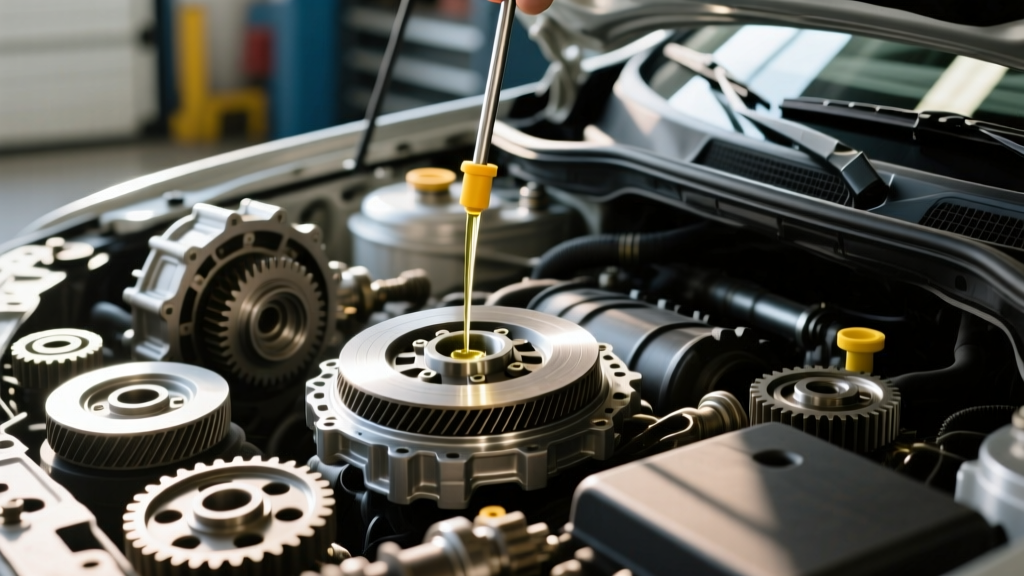
Leave the engine running and the transmission in Park (or Neutral for certain older Honda/Acura models). Pull the dipstick, wipe it with a lint-free white shop towel, reinsert it fully, and pull it again. Do not just look at the fluid level; you are conducting a visual and olfactory contamination audit.
The Contamination Matrix: Decoding Fluid Color and Debris
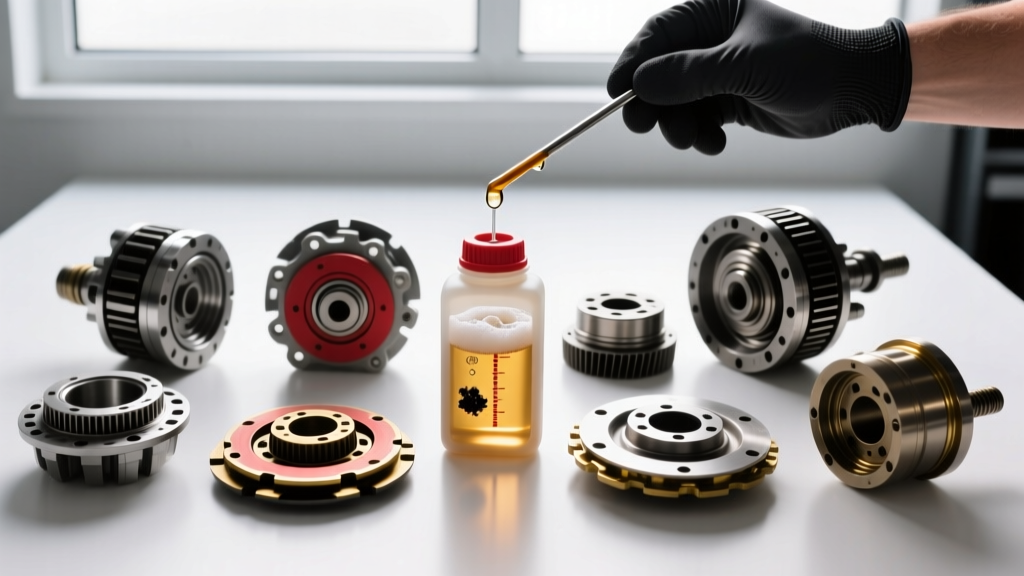
Identifying transmission fluid contamination signs requires a trained eye and nose. Use the following diagnostic matrix to interpret your findings.| Fluid Appearance | Odor Profile | Probable Contaminant | Likely Component Failure |
|---|---|---|---|
| Bright, Translucent Red | Slightly Sweet / Neutral | None (Healthy) | N/A |
| Dark Brown / Opaque | Burnt Toast / Acrid | Oxidized Fluid / Burnt Friction Material | Slipping Clutch Packs / Overheating |
| Milky Pink / Frothy | Sweet Antifreeze | Engine Coolant Intrusion | Internal Radiator Cooler Breach |
| Gold / Brass Glitter | Normal or Slightly Burnt | Non-Ferrous Metals | Thrust Washer / Bushing Wear |
| Black Grit / Sludge | Severe Burnt / Metallic | Steel / Ferrous Debris | Planetary Gear / Bearing Failure |
The "Strawberry Milkshake" of Death
If your fluid resembles a milky pink emulsion, you are witnessing coolant intrusion. In vehicles like the Nissan Pathfinder or older VW models utilizing a transmission fluid cooler integrated into the engine radiator, a microscopic internal breach allows pressurized engine coolant to enter the lower-pressure transmission side. Coolant destroys the water-soluble glue binding the friction material to the clutch steels. If caught immediately, a Transmission Digest case study suggests multiple aggressive flushes with specialized solvents can sometimes save the unit, but in 90% of cases, the torque converter and clutches are permanently compromised, leading to a $3,500+ rebuild.
Sealed Unit Diagnostics: ZF 8HP and GM 10L80
Modern vehicles increasingly utilize "sealed" transmissions without a traditional dipstick. For units like the ZF 8HP70 found in BMWs, Ram trucks, and Jaguars, or the GM 10L80 in modern Mustangs and Camaros, checking for contamination while running requires a different approach.The Overflow Plug Method
With the vehicle on a lift and the engine running, the transmission must be brought to the manufacturer-specified temperature window (for the ZF 8HP, this is strictly between 30°C and 50°C / 86°F to 122°F). You then remove the inspection/overflow plug located on the bottom of the transmission pan. While this is primarily a level-check procedure, the fluid that drains out must be caught in a clean, white-lined pan to inspect for metallic shimmer or burnt odors.
Crucial Torque Specs: When reinstalling the ZF 8HP inspection plug, it must be torqued to exactly 35 Nm (26 lb-ft). The GM 10L80 fluid level plug requires 25 Nm (18 lb-ft). Over-torquing will strip the aluminum pan threads, necessitating a $400-$800 pan and filter assembly replacement.
Magnet Analysis
If contamination is suspected in a sealed unit, the pan must be dropped. Modern pans feature high-strength rare-earth magnets. A fine, grey paste on the magnet is normal wear from steel clutch plates. However, if you find distinct metallic shards, chips, or bronze-colored flakes, the transmission is experiencing catastrophic mechanical failure, and a simple fluid change will not rectify the issue.
Financial Impact: Catching Contamination Early
Ignoring early signs of fluid degradation is a fast track to catastrophic financial loss. Here is a realistic breakdown of costs based on the contamination stage:- Stage 1: Darkening Fluid / Mild Oxidation ($250 - $400): A proactive drain-and-fill using OEM-spec fluid (e.g., $9/qt for Motorcraft Mercon LV or $12/qt for ZF LifeguardFluid 8) and a new filter.
- Stage 2: Burnt Smell / Clutch Material Present ($800 - $1,500): Requires a machine flush to clear the torque converter and cooler lines, followed by a valve body inspection to ensure solenoids are not clogged with friction debris.
- Stage 3: Metallic Debris / Milky Emulsion ($3,500 - $6,000+): Complete transmission teardown, torque converter replacement, radiator replacement (if coolant mixed), and full rebuild with hardened aftermarket clutch drums.