The Short Answer: Is Rear Differential Service Necessary?
When browsing truck forums or chatting at the local off-road shop, a common question inevitably surfaces: is rear differential service necessary? For daily drivers who never tow heavy loads or trail ride, draining and replacing gear oil might seem like an unnecessary dealership upsell. However, as an automotive drivetrain specialist, I can tell you that skipping this maintenance is the fastest way to destroy the most critical, expensive, and precise component in your axle: the ring and pinion gear setup.
The short answer is an absolute, unequivocal yes. But to truly understand why rear differential service is necessary, you have to look past the drain plug and understand the extreme mechanical forces at play inside the axle housing. This beginner-friendly explainer will demystify the ring and pinion gear setup, show you how degraded fluid causes catastrophic failure, and break down the real-world costs of maintenance versus a full rebuild in 2026.
Meet the Heart of Your Axle: The Hypoid Gear Set
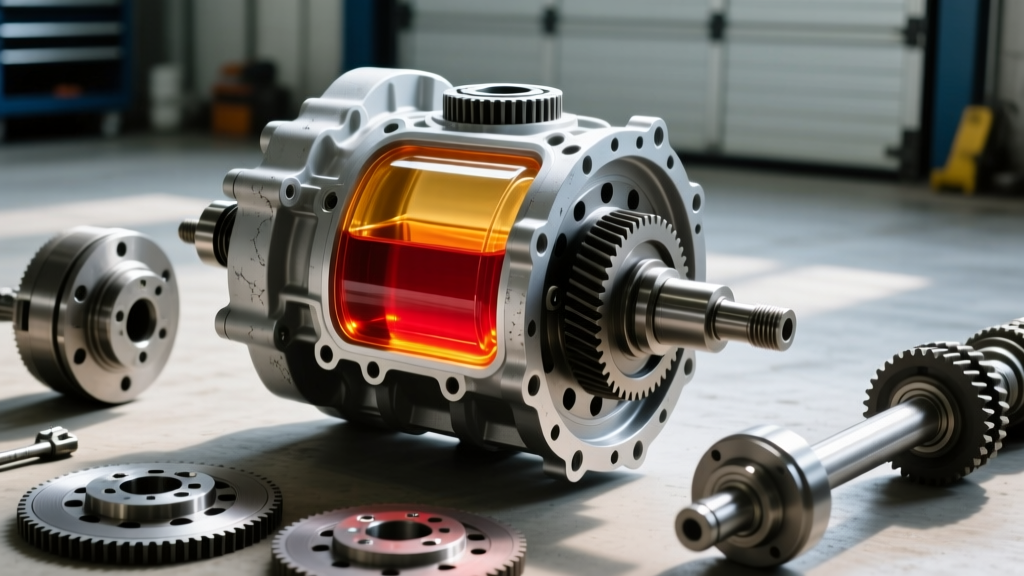
Unlike the straight-cut or helical gears found inside your transmission, the rear differential relies on a hypoid gear design. In a hypoid setup, the centerline of the pinion gear is offset below the centerline of the massive ring gear. This allows for a lower driveshaft tunnel in your vehicle, improving interior space and lowering the center of gravity.
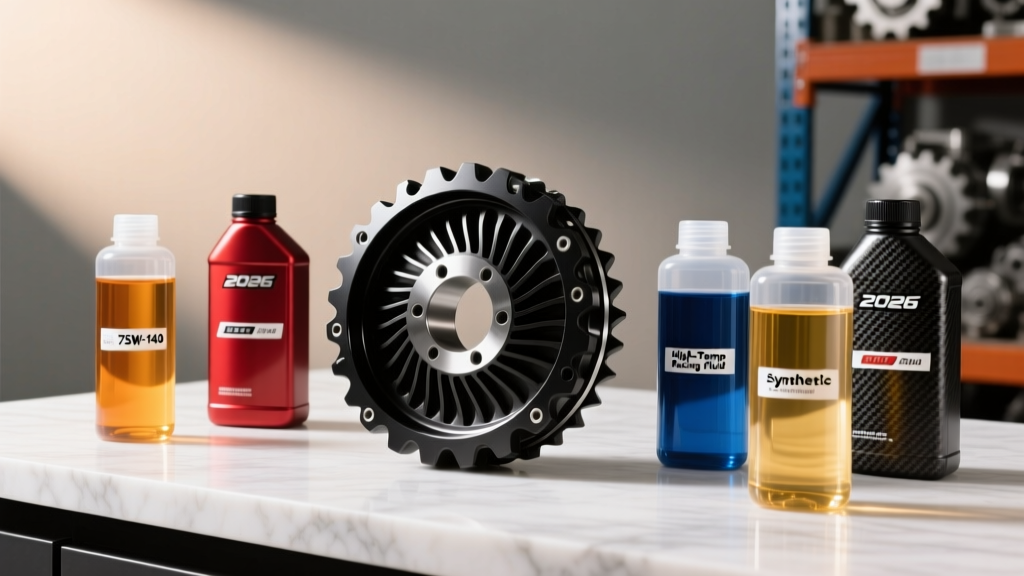
However, this offset creates a massive engineering challenge. As the teeth of the pinion and ring gear mesh, they do not simply roll against one another; they slide under extreme pressure. This sliding friction generates immense heat and shear forces. To survive, hypoid gears require specialized GL-5 gear oils (like 75W-90 or 75W-140) packed with Extreme Pressure (EP) additives, typically containing zinc and phosphorus. These additives create a microscopic sacrificial chemical film on the gear teeth, preventing metal-on-metal contact.
How Neglected Fluid Destroys Gear Sets
Over time, the EP additives in your differential fluid become depleted. Furthermore, the fluid becomes contaminated with microscopic metal shavings from the clutch packs (in limited-slip differentials) and normal gear wear. When you ignore rear differential service, the fluid loses its shear stability. The sacrificial film breaks down, leading to a destructive chain reaction:
- Micropitting: Tiny surface fractures appear on the gear teeth due to metal-on-metal friction.
- Spalling: Chunks of the hardened gear surface begin to flake off, contaminating the oil further.
- Bearing Failure: Metal shavings circulate through the pinion and carrier bearings, scoring the races and causing them to seize or disintegrate.
- Catastrophic Tooth Shear: The weakened teeth eventually snap under load, locking the rear axle and potentially causing a severe accident.
The Anatomy of a Perfect Ring and Pinion Setup
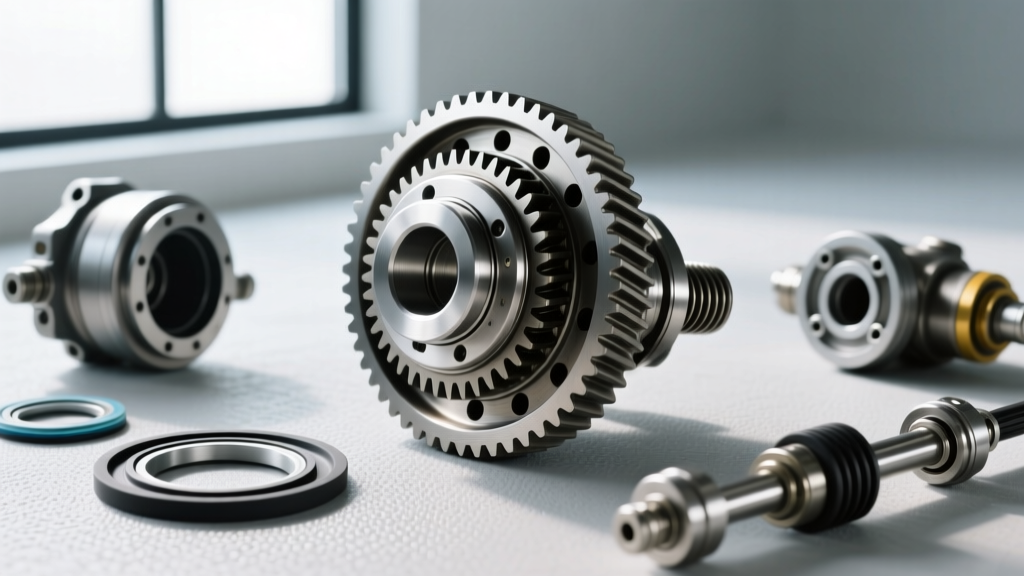
If your differential fluid is neglected and the gears are destroyed, you cannot simply bolt in a new set. A ring and pinion gear setup is an exercise in extreme precision. According to technical guidelines from Spicer Parts, setting up a hypoid gear set requires tolerances measured in thousandths of an inch. If you are off by even 0.002 inches, the gears will whine, overheat, and fail prematurely.
A proper setup requires three critical measurements:
1. Pinion Depth
Pinion depth dictates how far the pinion gear protrudes into the carrier housing relative to the ring gear's centerline. This is adjusted using precision shims placed behind the inner pinion bearing cup or on the pinion shaft. Mechanics use a specialized depth micrometer and a master bearing setup tool to dial this in perfectly.
2. Pinion Bearing Preload
Preload is the amount of tension applied to the pinion bearings to prevent them from shifting under load. It is measured in inch-pounds (not foot-pounds) of rotating torque using a specialized beam-style inch-pound torque wrench. Too little preload, and the pinion gear will wobble, destroying the gear pattern. Too much preload, and the bearings will overheat and burn up within 500 miles.
3. Backlash
Backlash is the tiny amount of rotational "play" between the ring and pinion teeth before they make contact. It is measured using a dial indicator with a magnetic base mounted to the axle housing. Backlash is adjusted by moving the carrier bearing adjuster nuts or swapping carrier shims. As Randy's Ring and Pinion emphasizes in their technical manuals, backlash must be checked at a minimum of three different points around the ring gear to account for minor manufacturing variances in the gear blank.
Target Setup Specifications for Common Axles
To give you an idea of the precision required, here is a data table showcasing the target setup specifications for three of the most common light-truck and SUV rear axles on the road today.
| Axle Model | Ring Gear Diameter | Target Backlash | Pinion Preload (Used Bearings) | Pinion Preload (New Bearings) |
|---|---|---|---|---|
| Ford 8.8-inch | 8.8 inches | 0.008" - 0.012" | 8 - 14 in-lbs | 16 - 29 in-lbs |
| Dana 60 | 9.75 inches | 0.006" - 0.010" | 10 - 15 in-lbs | 20 - 35 in-lbs |
| GM 10-Bolt (8.5") | 8.5 inches | 0.006" - 0.010" | 12 - 18 in-lbs | 20 - 30 in-lbs |
Reading the Gear Pattern: The Mechanic's Crystal Ball
Even if the dial indicator and torque wrench say the numbers are perfect, a master axle builder will always verify the setup using gear marking compound (such as Permatex 80050 Yellow Ochre). The compound is painted onto the ring gear teeth, and the pinion is rotated against it under moderate braking load to leave a physical footprint.
A perfect pattern will sit squarely in the middle of the tooth face, from the heel (inner edge) to the toe (outer edge). If the pattern is biased toward the toe or heel, the pinion depth is incorrect. If it is pushed too high toward the top land (face) or too low toward the root (flank), the backlash is incorrect. Reading these patterns is an art form that separates true drivetrain specialists from general mechanics.
Real-World Costs: Fluid Service vs. Ring and Pinion Rebuild
Understanding the complexity of the ring and pinion gear setup makes the financial argument for differential service undeniable. Let us break down the real-world costs you can expect to encounter at a reputable 4x4 or drivetrain shop in 2026.
The Cost of Prevention: Differential Fluid Service
A standard rear differential service involves removing the cover (or using a fluid extractor on sealed units), cleaning the housing and magnetic drain plug, inspecting the gear faces for abnormal wear, and refilling with high-quality synthetic GL-5 fluid.
- Parts: 2.5 to 3.5 quarts of 75W-90 Synthetic Gear Oil ($45 - $80), RTV Silicone or new gasket ($10 - $15).
- Labor: 0.5 to 1.0 hour of shop time ($75 - $175).
- Total Estimated Cost: $130 to $270
The Cost of Neglect: Full Ring and Pinion Rebuild
If the fluid is ignored and the gears begin to howl or spall, you are looking at a complete teardown. This requires a master install kit (e.g., Yukon Gear & Axle YK F8.8 for a Ford 8.8, which includes all bearings, races, and shims, costing around $350) and a new ring and pinion set (e.g., Motive Gear or Revolution Gear, costing $250 - $400).
Because setting up a ring and pinion is incredibly labor-intensive, requiring bearing presses, pullers, and hours of shim-swapping, labor times are steep.
- Parts: Gear set, master bearing kit, new axle seals, and fluids ($650 - $900).
- Labor: 8 to 12 hours of specialized drivetrain labor at 2026 average rates of $150/hr ($1,200 - $1,800).
- Total Estimated Cost: $1,850 to $2,700+
Beginner Takeaways: Listening to Your Drivetrain
So, is rear differential service necessary? If you want to avoid a $2,500 repair bill and a stranded vehicle, the answer is yes. Most manufacturers recommend servicing the rear differential fluid every 30,000 to 60,000 miles. If you tow trailers, drive in deep water, or participate in off-roading, that interval should be cut in half.
Pay attention to the sounds your axle makes. A slight whine on deceleration (coast side) often indicates worn pinion bearings due to contaminated fluid. A clunk when shifting from drive to reverse suggests excessive backlash from worn gear faces. By staying proactive with your differential fluid maintenance, you ensure that the intricate, high-tolerance ring and pinion gear setup continues to transfer power to the pavement smoothly for hundreds of thousands of miles.